

Prologue
Before the dinner
A disagreement can contain several problems at once. A fact may be true while the conclusion drawn from it depends on an assumption nobody has said aloud. New evidence may arrive while each side notices a different part of it. A person may even revise a belief privately and still resist saying so because agreement has acquired consequences of its own.
Blame Game follows one ordinary argument through those layers.
Aristotle helps expose the premise underneath an accusation. Bayesian reasoning asks what the evidence should change, and which observations actually distinguish one explanation from another. Questions about denominators and selection test whether the evidence represents the whole story. Blame introduces a further distinction between cause, responsibility and what needs to change. Game theory becomes useful once concession itself affects status, identity and what happens next.
The final problem is practical: whether an argument can make revision possible and produce better evidence the next time the same choice appears.
The framework below provides the map. Maya and Daniel's dinner supplies the test case.
TAKE IT WITH YOU
A Field Guide to Disagreement
SIX QUESTIONS FOR WHEN EVIDENCE, BLAME AND INCENTIVES GET TANGLED
Read what is happening
Audit what the argument is doing
Out of how many? What evidence has disappeared from the story?
Move: Restore the denominator. Notice how memory, selection and framing produced the sample.
Are we arguing about cause, responsibility, or what needs to change?
Move: Keep a behavioral problem from becoming a premature judgment of character.
Change the conditions
What does agreeing cost them? And could anything they say prove me wrong?
Move: Detect expensive concessions and self-sealing arguments before resistance becomes inevitable.
What is the smallest useful concession, and what would count as better evidence next time?
Move: Make revision sayable. Agree on the behavioral change. Then observe what happens.
STILL DISAGREE?
THE AUMANN CHECK
AUMANN · 1976Do we start from a common prior?
Different priors can sustain different assessments.
Do we know each other's posterior beliefs?
Private evidence can differ.
Are those beliefs common knowledge?
Knowing a belief is weaker than everyone knowing that everyone knows it.
Aumann’s benchmark is demanding: common prior + common knowledge of posteriors. Different private information is allowed.
Bring these questions to the next disagreement that matters.

At 8:17 on a Thursday evening, Maya decided that Daniel did not respect her.
She had not used those words yet. For the moment, she was still performing the small domestic rituals people use to postpone an argument they already know is coming. She straightened a napkin, moved Daniel’s wineglass three inches to the left, and checked the oven even though the chicken had been ready for twenty minutes.
Six places were set at the table: two for close friends, two for colleagues from Maya’s new firm, one for Maya, and one for an empty chair.
At 7:21 Daniel had texted:
Running a few mins late. Start without me ❤️
At 7:43:
Call blew up. Leaving soon.
At 8:05:
I’m so sorry.
At 8:17 there was no new message.
“You should serve,” Claire said.
“I know.”
Nobody was angry on Maya’s behalf yet, which somehow made it worse. Her colleagues were being politely uninterested, while Claire was working hard not to look at the empty chair.
Maya smiled. “He does this.”
It came out more lightly than she intended.
Claire looked at her. “Work?”
“Everything.”
By then, Maya had already moved from a fact about the evening to a judgment about the sort of person Daniel was.
He arrived at 8:31 carrying a bottle of wine nobody needed and wearing the expression of a man who had spent the cab ride assembling his defense. The argument was already underway; Daniel simply had not been informed.
“Disaster. Absolute disaster. I’m sorry, everyone. Client call went completely sideways.”
He kissed Maya on the cheek. She turned just enough that the kiss landed nearer her ear.
“You could have left,” she said.
Daniel stopped taking off his jacket. “I really couldn’t.”
“You always really can’t.”
The sentence was grammatically about tonight and actually about history. Daniel glanced toward the table, asked whether they could do this later, and received the answer he probably expected.
“Of course,” Maya said. “When would be a convenient time for you?”
Claire became fascinated by the salad.
“I said I’m sorry,” Daniel said, lowering his voice. Maya told him he was sorry that she was upset; he said he was sorry he was late. She said he was always sorry afterward. “That’s not fair,” Daniel said. Maya reminded him that he had been forty-five minutes late to dinner with people from her work. “A client emergency came up,” he said.
Maya“You had a choice.”
Daniel“No. I didn’t.”
Maya“Yes, you did.”
They had finally reached the argument. Daniel’s lateness was observable and his explanation was on the table, but the disagreement rested on a proposition neither had spoken aloud. Maya believed that when something mattered enough to Daniel, he found a way to be there. Daniel had failed to find a way tonight, so the dinner seemed to have revealed its place in his hierarchy of priorities, with Maya herself sitting uncomfortably close behind it.
The premise underneath the argument
Every serious argument has a structure, even when the people inside it never draw one. Maya’s conclusion depended on a belief about what lateness revealed: if Daniel could make himself punctual for the things that mattered, then his failure to do so for her was evidence about how much she mattered.
That belief is the hidden premise. It gives the accusation its force, and it also tells Daniel where a useful response would have to begin. He could say that he loved Maya twenty times and leave her reasoning untouched. He would need to show that lateness was a poor measure of value, that tonight was unusually constrained, or that a person can genuinely care while repeatedly making choices that hurt someone else.
Daniel carried a premise of his own. He thought blame should follow meaningful control: criticism carries more weight when a person could reasonably have done something different. An unavoidable delay could still hurt Maya while carrying less information about Daniel’s priorities and less moral weight about his character. The evening alone could not decide how much weight either premise deserved. It could only make the evidence matter.

Maya’s enthymeme
If I matter,
Daniel finds a way.
Daniel’s counter-enthymeme
No meaningful control,
no blame.
Maya
He did not find a way tonight.
∴ I matter less.
Daniel
The emergency left no reasonable alternative.
∴ This says nothing
about my priorities.
Click to expand: Aristotle, enthymemes, and the hidden premise
Aristotle’s Prior Analytics defines a syllogism as discourse in which certain things are stated and something else follows of necessity. Ordinary arguments rarely arrive in that complete form. In the Rhetoric, Aristotle’s treatment of the enthymeme describes a compressed rhetorical form in which the listener supplies part of the bridge. Calling an enthymeme “a syllogism with a missing premise” is a useful modern shorthand, although Aristotle’s treatment is broader than that formula.
Maya never needs to announce that she treats punctuality as an indicator of priority. “Funny how you are never forty-five minutes late for your CEO” does the work because Daniel can supply the missing proposition himself. The useful move is to ask what premise makes the accusation possible before asking whether the conclusion is fair.
Sources: Aristotle, Prior Analytics I.1; Aristotle, Rhetoric.
The receipts
The guests left at 10:06. Maya stacked plates while Daniel loaded the dishwasher, and for nine minutes neither spoke. Then Daniel made the mistake of assuming silence meant de-escalation.
Daniel“So,” he said, “other than me ruining civilization by arriving late, I thought dinner went well.”
Maya“You know what I find interesting?”
Daniel“What?”
Maya“You had a seven a.m. flight to New York last Tuesday.”
Daniel“Yes.”
Maya“You left here at 5:15.”
Daniel“Yes.”
Maya“You had that presentation with your CEO last month.”
Maya put down a plate. Daniel closed his eyes. There are few phrases in the English language more threatening than you know what I find interesting?
Daniel turned around. “What about it?” Maya said he had gotten there twenty minutes early. “Those are completely different,” he said. “Exactly,” she said. He asked what that was supposed to mean, and Maya told him it meant he knew how to be on time. Daniel said he had never claimed clocks were beyond his understanding. Maya said he acted as if lateness just happened to him; sometimes it did, Daniel said, but not when Delta was involved.
Daniel started wiping a countertop that was already clean. “The plane leaves whether I’m there or not,” he said. “Exactly,” Maya said. “A live client problem isn’t the same thing as dinner,” Daniel said. “Exactly,” Maya replied.
Daniel stared at her. Maya thought she had him until he asked whether she actually knew what had happened that night. “You had a client emergency,” she said. Daniel explained that an analyst on his team had put the wrong numbers into a board deck; the client caught them during the meeting, and she was having a panic attack because she thought she was about to be fired. “She’s twenty-four,” he said. Maya said nothing.
Daniel said he could have walked out, technically, and could have told everyone good luck because he had dinner plans. Maya said that was not what she was saying. “It’s a little bit what you’re saying,” he said. When she said no, Daniel replied that she kept calling it a client call as if he had stayed because he enjoyed PowerPoint.
The new information complicated Maya’s first rendering of the evening. She had pictured Daniel facing a clean choice between work and the dinner, then choosing work. The frightened twenty-four-year-old analyst now occupied part of the same story, and Daniel’s decision looked less like casual disregard even if Maya’s dinner remained important.
“Okay,” Maya said. Daniel looked surprised. “Okay?” he said. “Tonight may have been unavoidable,” she said. He nodded. “But that doesn’t explain the pattern,” Maya added. The relief disappeared. “What pattern?” Daniel asked.
Maya began listing: Claire’s birthday, the theater, her office Christmas party, dinner with her sister, the furniture delivery, and the Saturday they were supposed to leave for Wisconsin. Daniel listened. After the sixth example, he asked a question Maya had not prepared for: “Six times out of how many dinners?” Maya stared at him. “What?” she said. Daniel asked how many things they had gone to in the last two years. Maya asked whether he was serious. “Yes,” he said. She asked whether he wanted praise for occasionally arriving when he said he would. Daniel said he was asking whether she remembered only the times he did not.
Selected evidence
Six remembered failures
The missing denominator
Out of how many occasions?

The comparison set
The full set of occasions
Every example Maya had offered could be true while the set of examples still produced a distorted picture. Accurate evidence can tell a misleading story when failures are vivid enough to be remembered and ordinary successes disappear into the background.
What the evidence should change
The useful question was no longer which explanation sounded more plausible. Each did. The more useful question was what the two explanations predicted when they met the rest of Daniel’s life.
Maya could imagine two broad stories. In one, Daniel’s work was genuinely chaotic and much of his lateness was difficult to control. In the other, he had considerable control but exercised it most reliably when lateness carried immediate consequences. Tonight fit both stories, because a demanding job could produce the delay and so could a life in which Maya absorbed the cost of it.
The better evidence was diagnostic evidence: evidence one explanation predicts and the other struggles to explain. If chaos did most of the work, Daniel’s lack of control should occasionally appear around flights, CEOs, and important client meetings as well. If his schedule became remarkably manageable whenever the consequences were immediate, Maya had learned something about the mechanism behind the pattern.
Daniel looked at her.
Maya“I don’t think you’re late because you can’t manage your time.”
Daniel“Okay.”
Maya“I think you triage.”
Daniel“Of course I triage. Everybody does.”
Maya“Yes.”
Daniel“So?”
Maya“The things with hard consequences survive.”
“The plane leaves. Your boss notices. The client gets angry.”
Maya’s accusation had shifted. She was increasingly willing to accept that Daniel’s work could become genuinely chaotic. Her concern was that he seemed to regain control whenever the consequences of lateness became immediate. In her account, Daniel was triaging competing demands and responding to incentives, which was uncomfortably close to his own view of how people behaved.
Click to expand: how Bayesian updating changes an argument
Bayesian epistemology treats probabilities as degrees of belief and evidence as a reason for revising them. A prior is the starting confidence in a claim. A posterior is the confidence after new evidence. The evidence matters through its likelihood: how expected would this observation be if one explanation were true rather than another?
Maya’s first story gives a missed dinner more weight as evidence of indifference. Daniel’s account of the analyst lowers the likelihood that this particular evening was a clean choice against Maya. The flight and CEO comparisons raise the likelihood of a different explanation for the broader pattern: Daniel’s time becomes more reliable when the consequences of lateness arrive immediately. Updating changes confidence in specific claims; it does not require a person to replace an entire worldview after one conversation.
Source: Stanford Encyclopedia of Philosophy, “Bayesian Epistemology”.
The ones that worked
Daniel leaned against the counter. “Fine. But the six examples still bother me.”
Maya rolled her eyes. “No. Listen.”
“Do you remember the weekend your mother came?”
“Yes.”
“You told me Friday afternoon she was arriving Saturday. I canceled golf.”
“That was...”
“The fundraiser?”
“You came.”
“I moved a client dinner.”
Maya hesitated.
“The interview for this job?” Daniel continued. “I canceled Boston because you said you were freaking out.”
“I know.”
“Your brother’s surgery.”
“Obviously.”
Daniel laughed. “See? The ones that worked disappear.”
“The ones that worked disappear.”
“There’s nothing to remember,” he said. “I changed the plan. I showed up. We moved on.”
That was a better argument than Maya’s six missed dinners had prepared her for. A ruined evening generated emotion, discussion, and sometimes a fight, which made it memorable. A successful accommodation vanished into ordinary life precisely because nothing happened. Her mental archive could therefore contain genuine evidence while still overrepresenting failure.
The missing denominator did not absolve Daniel. It made the claim more demanding. Maya needed some sense of the full set of occasions before she could decide whether six failures were a pattern, an unfair sample, or both.
There was another complication. Daniel had received six true examples selected by a person trying to persuade him, which meant the process that produced the evidence mattered alongside the evidence itself. Omission alone did not prove dishonesty. Selection changed what a sample could establish.
Click to expand: why selected evidence tells us something about the selector
Vincent Crawford and Joel Sobel’s sender-receiver model studies communication when an informed sender and a receiver have partly divergent interests. Kamenica and Gentzkow’s Bayesian-persuasion model studies how an information structure can affect a receiver’s update and action. Maya’s memory is not a literal instance of either formal model. The models clarify why the selection process matters alongside the selected facts.
Six examples can all be true and still be a poor guide to Daniel’s overall rate of reliability if successful accommodations are omitted. The omission may reflect memory, timing, or persuasion without requiring a charge of deliberate deception. The right next question is what population of occasions the examples are meant to represent.
Sources: Crawford and Sobel, “Strategic Information Transmission”; Kamenica and Gentzkow, “Bayesian Persuasion”.
When an argument becomes a verdict
For a while neither spoke.
“Fine,” Maya said. “Maybe I remember the failures more.”
Daniel nodded.
“But I still think there’s a pattern.”
“Of course you do.”
“What does that mean?”
“It means you already decided what I am.”
Maya frowned. “What you are?”
“You think I’m selfish.”
“I didn’t say selfish.”
“You think I don’t prioritize you.”
“I think you assume I’ll accommodate you.”
“That’s different.”
“Is it?”
“Yes.”
“How?”
Daniel looked at her. “Because one is something I do.” He paused. “The other is who I am.”
Maya did not especially care about the distinction. “You want me to separate the behavior from the person forever.”
“No.”
“Yes. Every single thing has an explanation. The call ran over. Traffic was bad. The train stopped. Your boss needed you. And if I ever add them together, suddenly I’m attacking your character.”
“Because you are.”
“Maybe your character is the pattern.”
The room changed quietly. Until that sentence, Daniel had been defending choices that could be discussed one by one. Now the accumulated evidence seemed to be passing judgment on him. The argument had acquired the force of a verdict.
Blame often compresses several questions into one. A disagreement may concern what caused a problem, how much moral responsibility attaches to the person who caused it, and whose behavior has to change for the situation to improve. Those questions overlap, although they can point in different directions.
Daniel’s scheduling choices may be an important cause of Maya’s frustration even if some are heavily constrained by work. The same evidence can support a practical conclusion about what needs to change without settling a global judgment about Daniel as a husband. When causation, moral evaluation, and remedy collapse into a single verdict, a dinner begins to carry the weight of a person’s identity.
The price of agreement
Daniel poured himself water while Maya sat at the island.
“You know what? Forget it,” Maya said. Daniel said no. “No, it’s fine,” she said, and he replied that it clearly was not. Maya said he could never just say she had a point. “There it is,” Daniel said. When she asked what, he said she did not want him to understand her point; she wanted him to say she won. Maya stared at him. “Would it kill you?” she said. Daniel asked, “Say what?” “That I’m right,” Maya said. “About which part?” Daniel asked. “You know which part.” “No, actually, I don’t.”
By then, Daniel’s response depended on more than his estimate of what had happened. Agreement itself had acquired consequences, and the argument had become strategic.
The price of agreement rose when Maya’s criticism came to mean more than “please protect our plans more carefully.” A narrow concession now risked sounding like acceptance of a much broader diagnosis: that Daniel was selfish, unreliable, or fundamentally careless with her. The evidence that made his original position harder to sustain had also made public concession costlier.
Daniel may privately have reached the view that Maya had a point. He still had to think about what she would infer from anything he said, what precedent it would establish, and whether a sentence about this dinner would become evidence about every dinner. In that setting, speaking is more than a report of belief. It is an action inside a relationship.
When retreat became expensive, Daniel opened another front.
“You want to talk about priorities?” Daniel said. Maya looked at him. “No, go ahead.” He reminded her that she had canceled dinner with his parents twice. Maya said she had been sick once and traveling once. “Right,” Daniel said. When she asked what, he said hers were reasons. “They are reasons,” Maya said. “And mine are excuses.” She started to object that he was seriously comparing them; Daniel said yes, he was comparing. Maya said he was changing the subject. “Of course you think that,” he said. When she asked what that meant, Daniel said that everything supporting her was relevant and everything supporting him was changing the subject. Maya laughed. “You’re unbelievable.” Daniel pointed at her. “That.” “What?” Maya said. Daniel said he challenged the argument and somehow the challenge became more evidence. As Maya opened her mouth, he asked: “If I defend myself, I’m defensive. If I give an example, I’m deflecting. If I disagree, I can’t take responsibility. What could I possibly say tonight that would make you think your theory was wrong?”
“What could I possibly say tonight that would make you think your theory was wrong?”
Maya stopped. Her theory was beginning to absorb every possible response. Agreement would confirm that she had been right; resistance could be read as proof that he was defensive; anger could look like a nerve had been touched; calmness could look like indifference. A belief that can reinterpret every outcome in its own favor becomes increasingly difficult to test against reality.

Maya’s prior
“Daniel cannot take responsibility.”
1. He agrees
Maya was right.
2. He disagrees
He is defensive.
3. He gets angry
The truth touched a nerve.
4. He stays calm
He does not care.
No response can count against the belief.
Click to expand: private belief, public concession, and game theory
Game theory studies choices made in anticipation of other people’s choices and incentives. Harsanyi’s work on games with incomplete information formalized settings in which players are uncertain about payoff-relevant features of the situation and hold beliefs about what they do not know. Maya and Daniel are not a formal game. The distinction still helps: Daniel can privately revise his assessment while withholding public agreement because he expects agreement to change the next move.
Rabin and Schrag model one form of confirmatory bias in which ambiguous information is interpreted in the direction of prior beliefs. Bénabou and Tirole show how favorable beliefs about one’s own abilities can carry motivational value. These theories illuminate the pressure around the conversation without diagnosing either character. A narrow concession becomes easier when it changes the behavior under discussion without forcing a larger verdict that the evidence has not established.
Sources: Harsanyi, “Games with Incomplete Information Played by ‘Bayesian’ Players, I”; Rabin and Schrag, “First Impressions Matter”; Bénabou and Tirole, “Self-Confidence and Personal Motivation”.
The way out
Maya went to the bedroom and Daniel remained in the kitchen. At 10:48 she returned wearing sweatpants, found him on the sofa, and sat at the other end. For several minutes they stared at a television show neither was watching.
“I think I said it wrong,” Maya said.
Daniel looked at her.
“I don’t think you don’t care about me.”
His arms uncrossed.
Maya“I know you care about me. That’s not actually what I’m trying to prove.”
Daniel“Okay.”
Maya“I think... I think your job punishes you immediately when you’re late.”
“If you miss a flight, the plane leaves.”
Daniel“Sure.”
Maya“If you’re late for your CEO, that’s bad.”
Daniel“Yes.”
Maya“If you’re late for a client, there might be an actual consequence.”
Daniel looked at her. Maya stopped. “And if you’re late for me...” she said. Daniel looked down. “I annoy you,” he said. “You hurt me,” Maya replied. “But I’m still here,” she added. “And eventually I forgive you.”
Neither spoke. “So maybe you’re right,” Maya said. Daniel looked up. “About what?” he asked. Maya said she did not think he sat in the office consciously deciding that she mattered less. “Thank you,” Daniel said. “I think when five things compete, some of them punish you immediately and I don’t,” Maya said.
Daniel looked at the television. “And you know I’ll still be here,” Maya said. A long pause followed. “Yes. I know you’ll still be here,” Daniel said. “I don’t want you to be scared I’m going to leave,” Maya said. “I know,” he said.
“I just don’t want being safe with me to make me the easiest person to disappoint.”
The dispute became negotiable because Maya had changed what Daniel was being asked to concede. The evidence had stayed the same. The social meaning of agreement had changed.
An off-ramp lowers the unnecessary cost of revision. Daniel could acknowledge that the incentives around his life made Maya’s time easy to sacrifice while preserving a more complicated view of himself: someone who loved her and had behaved in ways that hurt her. His concession could remain specific to the behavior and its consequence, leaving the wider judgment of his character outside what the evening had established.
Accountability can still matter, especially when harm or responsibility needs to be named. Persuasion becomes harder when every useful concession is bundled with a loss of status that the evidence itself does not establish. The practical craft of a good argument lies partly in making the first useful concession sayable.
The evidence may move. The price of saying so can still rise.

Maya narrows the claim
“I don’t think you don’t care about me.”
The verdict Daniel hears
“I am selfish.”
The sayable concession
Maya’s time has become too easy to sacrifice.
When the room gets bigger
Six months later and several hundred miles away, imagine another version of the same problem around a mahogany table. A chief executive has spent $4 billion acquiring a smaller competitor on a thesis that sounded plausible at the time: the combined company would cross-sell more products, customers would stay, costs would fall, and the acquisition would pay for itself.
Two years later, integration is behind schedule, retention has deteriorated, and the promised cross-selling has not appeared. The board wants to know what happened. The CEO has several explanations, and every one is partly true.
“The market changed,” he says.
It did.
“The regulatory environment got harder.”
It did.
“Financing costs rose.”
They did.
Each explanation can account for part of the outcome without settling whether the acquisition thesis still deserves confidence. A director who declares that the CEO pushed through an obvious mistake changes the decision problem in the room. Evidence about retention and synergies becomes evidence about the CEO’s competence, authority, and perhaps his job.
The immediate question concerns the acquisition thesis. Once the meeting attaches career consequences to admitting that the thesis has failed, the CEO also has to calculate what will happen if he says so. The organization’s ability to learn depends partly on the price it places on revision.
A narrower intervention preserves the evidence while lowering that price: “The original thesis depended on customer retention remaining above a certain level. We now have two years of evidence showing that assumption did not hold. Whatever we thought then, what should we do given what we know now?”
That formulation leaves room for a later judgment about how defensible the original decision was. Its immediate purpose is to separate retrospective accountability from the present decision about whether the company should keep investing behind a thesis the evidence has weakened. The kitchen problem has moved into a boardroom, where the furniture is more expensive and the institutional cost of admitting error is larger.
The mechanism becomes harder to manage when the audience expands again. Imagine a politician who has spent two years arguing that a burst of inflation came almost entirely from excessive government spending. He repeats the claim on television, his party builds advertisements around it, and he mocks people who emphasize supply disruptions.
Then more evidence accumulates. Inflation appears across countries with different fiscal responses, and serious analyses identify contributions from both demand and supply. Federal Reserve research links larger fiscal support to stronger excess-demand pressure across countries. An IMF decomposition across 32 countries separately identifies demand- and supply-driven inflation and finds that oil shocks and supply-chain pressures affected the supply component. The sources are linked in the optional module below.
A person who first assigned most of the explanatory weight to demand and fiscal effects can retain that concern while giving more weight to supply constraints and global shocks. The revised view remains continuous with the earlier one even as its causal balance changes.
The strategic problem lies in the public record surrounding the update. A private belief can move quietly. A public position is attached to speeches, interviews, donors, opponents, supporters, and two years of expressed certainty. A technically modest revision can acquire a political meaning far beyond the economics, including the appearance of vindicating an opponent or conceding that earlier confidence was excessive.
An off-ramp in that setting might sound like this: “The initial concern about excessive demand was justified. Subsequent evidence showed that supply constraints and global shocks were more persistent and important than we expected.” The politician revises the causal weighting while keeping the act of learning separate from a ritual of humiliation.
Public debate learns slowly when revision is priced as defeat. Political actors then have an individual incentive to preserve a position that may no longer match their private assessment, even though the larger system needs visible updating to learn from new evidence.

Click to expand: the evidence behind the inflation example
The politician is hypothetical. The empirical claim is deliberately narrow: demand and supply forces both contributed to the post-pandemic inflation surge, with their relative importance varying across countries and over time.
The Federal Reserve analysis links stronger fiscal support to stronger excess-demand pressure across countries, while noting that the pandemic disrupted production and consumption on both sides of the market. The IMF paper constructs demand-driven and supply-driven inflation series for 32 countries and reports that supply-driven inflation was more reactive to oil shocks and supply-chain pressures, while demand-driven inflation responded more strongly to monetary-policy shocks. Both are working papers or research notes with stated limits. They support a revision in causal weighting, not a single-cause verdict.
Sources: Federal Reserve, “Fiscal policy and excess inflation during Covid-19: a cross-country view”; Firat and Hao, IMF Working Paper 2023/205.
The investment in certainty
Certainty produces immediate rewards. It signals confidence, rallies allies, and makes a difficult story easier to repeat. Those rewards create a liability because the more publicly and repeatedly a person invests in a claim, the more social capital becomes attached to maintaining it.
A casual prediction can be revised with little ceremony. A slogan repeated for two years is embedded in speeches, alliances, and identity. The same escalation appears around corporate strategies, academic theories, and intimate relationships, wherever a belief gradually becomes a statement about the person who holds it.
Disagreement therefore contains two linked problems. Evidence has to change what a person thinks about the world, and the surrounding social game determines the consequences of acting on that revised belief. As the second cost rises, visible certainty can persist after private certainty has begun to weaken.
What rational agreement would require
Robert Aumann’s agreement theorem provides a useful benchmark, largely because ordinary arguments rarely meet its conditions. Under a common prior and common knowledge of each person’s posterior probability, the theorem says those posteriors must agree.
Maya and Daniel live in a messier world. They may start with different priors, they have different private information, neither knows the other’s precise degree of confidence, and both have reason to question how the other selected and interpreted the evidence. Their problem includes one complication the theorem sets aside: every sentence during their argument is both a statement about what one person believes and a move inside a relationship.
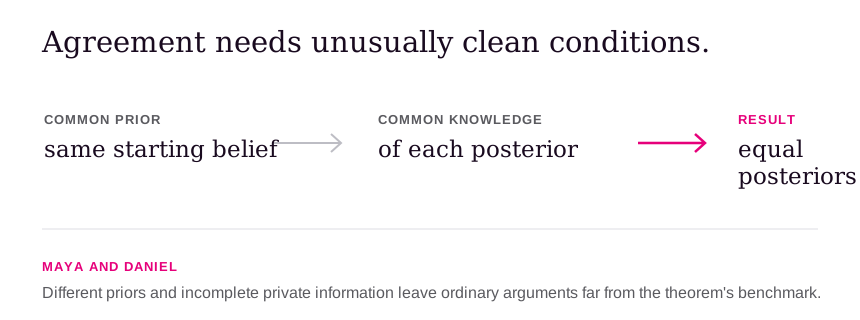
The theorem does not explain away ordinary disagreement. It gives disagreement a demanding benchmark, then makes clearer why real people remain apart even after some evidence has started to move both sides.
Click to expand: what Aumann actually proved
In “Agreeing to Disagree,” Robert Aumann proves that agents with a common prior cannot have posterior probabilities that are both different and common knowledge. Different private information is allowed. The demanding conditions are the common prior and common knowledge of the posteriors.
The popular sentence “rational people cannot disagree” stretches the theorem beyond its result. Maya and Daniel may have different priors, their posterior beliefs are not common knowledge in the technical sense, and their speech changes the relationship as well as reporting a belief. Aumann is a benchmark for an unusually clean informational setting, not a verdict on ordinary argument.
The next dinner
Three months later, Daniel was sitting at his desk at 6:22. He and Maya were meeting friends at seven, and at 6:24 his boss sent him a message.
Can you stay on for 15? Need to pressure-test one thing.
Daniel looked at it. Three months earlier he would have typed Sure, and fifteen minutes might have become twenty, then thirty-five. Maya would have waited because no flight was leaving, no client was exploding, and no meeting would begin without him.
That had been part of the problem.
Daniel looked at the clock and typed:
Can’t tonight. I can look first thing tomorrow.
The reply arrived almost immediately.
Yep no problem.
Daniel stared at it for a moment. Work had often seemed immovable. Sometimes it had required one sentence.
He closed the laptop and walked into the restaurant at 6:58. Maya was already there.
“You’re early.”
“Two minutes.”
She smiled.
Neither mentioned the Thursday-night dinner. Maya never received the confession she had wanted that night, and Daniel never sat down to declare that she had been right and he had been wrong. What she received was new evidence about what Daniel would do the next time work and their plans competed.
The argument had moved through several layers. It began with the premises Maya and Daniel used to interpret the same evening, then became a question of how each should revise those beliefs as new evidence arrived. Once concession acquired consequences for status and identity, the disagreement also became strategic. Ordinary life delivers those layers together, which is why better evidence alone can fail to produce better arguments.
By seven o’clock, the old argument had acquired a new kind of evidence. Daniel had changed the behavior that generated it.

For once, there was no empty chair.
Return to A Field Guide to Disagreement
Sources & Notes
The Aristotle, Bayesian, strategic-communication, game-theory, self-confidence, inflation, and Aumann modules preserve the technical provenance for readers who want it without interrupting the human reading experience. The CEO and politician scenes are hypothetical. The inflation example is grounded in the linked Federal Reserve and IMF work, and the language stays limited to the claim those sources support: the post-pandemic inflation episode reflected both demand- and supply-side forces.
Aristotle, Prior Analytics · Stanford Encyclopedia of Philosophy, Bayesian Epistemology · Crawford and Sobel · Kamenica and Gentzkow · Harsanyi · Rabin and Schrag · Bénabou and Tirole · Federal Reserve · IMF Working Paper 23/205 · Aumann.