
Communists vs Capitalists: The World Map That Never Fully Disappeared
Communists vs Capitalists: The World Map That Never Fully Disappeared
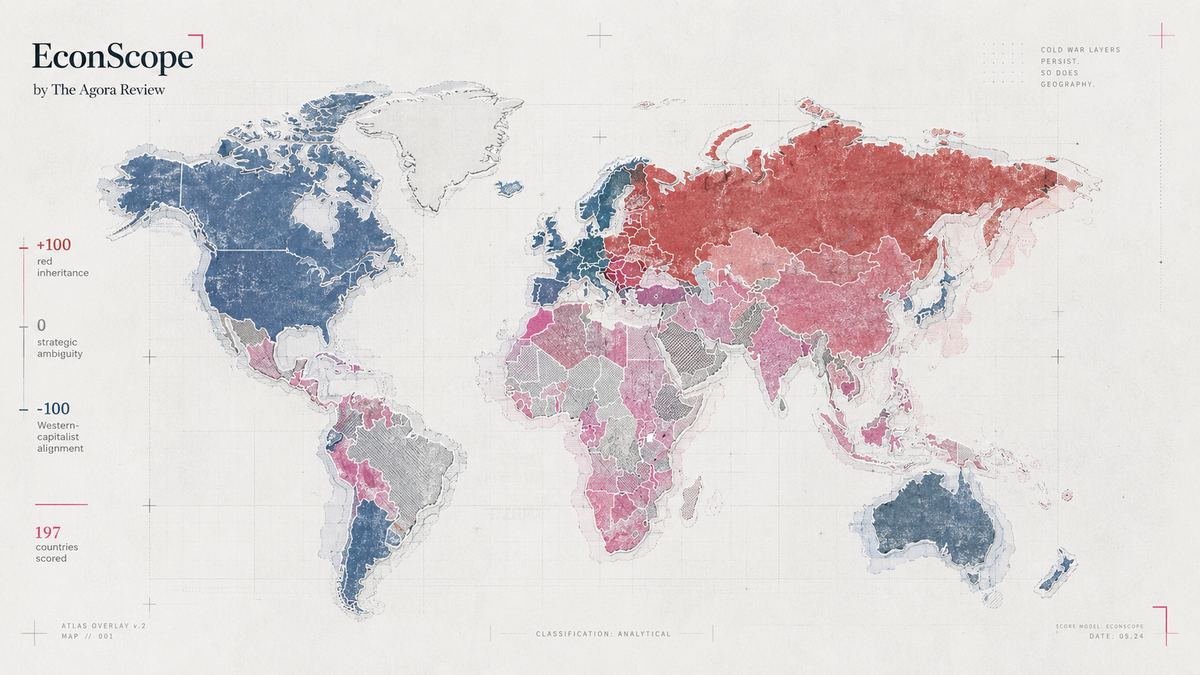
Score 197 countries on a spectrum from communist to capitalist and what you get is not convergence. You get a world that sorted into three durable tiers, and a vast middle that has turned ambiguity into the most sophisticated geopolitical posture on the map.
Interactive Map
Communists vs Capitalists: 197 Countries Scored
Methodology
Every country is scored from +100 (strongest communist/socialist/post-communist/revolutionary inheritance) to −100 (strongest capitalist/anti-communist/U.S.–Western alignment). Scores near zero indicate mixed, strategically autonomous, or low-salience cases.
The score sums six subscores: regime type, economy, Cold War alignment, security links, political memory, and present-day alignment.
Capitalist does not mean democratic. Gulf monarchies and authoritarian anti-communist states score into the blue range.
Communist does not mean pure planned economy. China and Vietnam have market mechanisms but retain single-party rule.
Russia is coded as a post-Soviet revisionist power, not a communist state.
Iran is coded as an anti-U.S. revolutionary republic, not a communist state.
Colors indicate historical-structural inheritance, not democracy, moral legitimacy, or short-term diplomacy., EconScope by The Agora Review
Map Key, Alignment Score (+100 to −100)
Score derived from six subscores: regime type, economy, Cold War alignment, security links, political memory, and present-day posture. Click any country for its full breakdown., EconScope / The Agora Review
After the Cold War ended in 1991, most people expected the world to converge on one model. It did not. Instead it sorted into three groups that have proven surprisingly stable: a tighter-than-ever Western alliance, a handful of communist-party states that kept the politics while changing the economics, and a vast middle of countries that have refused to fully join either side. This article maps those three groups and asks why the lines have held.
When the Berlin Wall came down in 1989, the dominant expectation was convergence: freed from Soviet pressure, the world would gradually reorganize around market economies and liberal institutions. Thirty-five years later, the 197-country map tells a different story.
Score each country on a spectrum from +100 (communist-aligned) to −100 (capitalist-aligned), accounting for party structure, military posture, economic governance, and historical inheritance. What you find is a world that sorted into three distinct and durable tiers. The Western bloc consolidated around a center so institutionally dense it now generates its own gravity. A cluster of seven communist-aligned states survived, shrank slightly, and mutated economically while staying politically intact. And between them, seventy countries landed between −10 and +10, including India, Indonesia, Nigeria, and Kenya, a band that contains the majority of the world’s working-age population growth through 2050 and has, with increasing deliberateness, refused to be placed in either column.
The Cold War frame did not become obsolete after 1991. It became more legible, because the countries that chose the West chose it completely, the countries that stayed communist dropped the economics while keeping the politics, and the countries that chose neither have since turned that ambiguity into a foreign policy instrument. What the map shows is a set of choices that were made decades ago, in some cases under coercion, and have since hardened into institutional facts that are genuinely difficult to reverse.
The tightest alliance in modern history got tighter
The Western alliance did not drift or fracture after the Cold War. It expanded and locked in. Germany at -82 is the map's most literal case: one people split by which army arrived in 1945, and 40 years of divergent alignment produced a productive gap that cost over a trillion euros to close. The Gulf states cluster in the blue column not because they share Western values but because of a security deal cut on a U.S. warship in 1945. The West's durability is structural: leaving is expensive, and nobody has yet managed it.
NATO and its close partners average −79.7 on the index. France at −70, Germany at −82, the United States at −95: the variation is real and reflects genuine political diversity, but the distribution is tight enough that it reads less like a spectrum than a cluster. No other grouping on the 197-country map approaches that degree of coherence: not the communist-aligned states, not BRICS, not the African Union, not the Non-Aligned Movement.
Germany supplies the map’s most literal illustration of what alignment meant in material terms. In May 1945, whichever army arrived first determined which system a German citizen would spend the next four decades inside. The western zones became the Federal Republic; the Soviet zone became the German Democratic Republic. One language, one culture, one pre-war industrial base, split by the geography of military advance.
The West German Wirtschaftswunder, the economic miracle of the 1950s, produced a country that by 1989 was the world’s third-largest economy. East Germany was, by Soviet bloc standards, a relative success: it had the highest living standard in the Eastern Bloc. That is precisely the point. Being the best-performing Soviet-aligned economy still meant falling so far behind West Germany that by 1989, East Germans were voting with their feet, walking through Hungary’s newly opened border with Austria in September of that year. The Wall fell two months later, unmanned, because the East German state had lost the will to enforce it.
Germany today scores -82 on this map. That number carries 45 years of bifurcated history inside it. The reunification transfer from West to East, estimated at between 1 and 1.6 trillion euros across three decades, is simultaneously the largest voluntary wealth transfer in peacetime history and a measure of the productive gap that 40 years of divergent alignment created. The map did not create that gap; it records it.
The sharpest evidence comes from the bloc’s most recent additions. Poland, which spent forty years inside the Warsaw Pact, now scores −88. The Baltic states (Estonia, Latvia, Lithuania) were Soviet republics until 1991 , their citizens held Soviet passports within living memory. They now score between −85 and −86: a swing of more than 150 points in three decades, accomplished without military conquest in either direction.
What drove it was institutional gravity: EU accession, NATO’s Article 5 guarantee, euro-denominated trade, integration into Western financial architecture. These imposed real exit costs on any return to the previous alignment. The bloc does not coerce its members into staying. It makes leaving expensive.
Hungary and Turkey demonstrate where that gravity currently reaches its limits. Hungary under Orbán scores −18, the shallowest of any EU member state. The government has blocked EU statements on Russia, courted Chinese investment, and compromised judicial independence systematically enough to trigger EU oversight mechanisms. But −18 is still well inside the capitalist column. Hungary has not defected; it has tested the outer edge of what Brussels and Washington will tolerate without triggering the kind of rupture that would actually move the needle. Turkey at −42 has purchased Russian air defense systems, periodically suspended NATO accession processes for other members, and positioned Ankara as an indispensable intermediary with Moscow. It still scores firmly in the Western-aligned tier. Both countries are evidence of the bloc’s internal stress; neither is evidence that the stress is structural.
Singapore is the index’s most deliberate editorial decision. Its raw score would place it near France and well into the capitalist range, but the editorial classification holds it as a capitalist non-liberal state: a single-party government that has not lost an election since 1959, running free markets under a managed democracy. The classification is a reminder that the capitalist column measures economic-security alignment, not liberal governance. Saudi Arabia at −68 makes the same point from a different direction: a rentier monarchy integrated deeply into dollar-denominated oil markets and Western sovereign wealth fund architecture, classified near France on the economic-security dimension. Saudi Arabia’s politics have nothing in common with France’s. The index treats them as near-equivalent on the one dimension it is actually measuring, which is the point.
The map’s blue column is not a column of democracies or of liberal societies. It is a column of states that aligned their economic and security structures with the United States and its allies. Nothing makes that distinction more concrete than the deal struck on the USS Quincy in February 1945, when President Roosevelt met King Abdulaziz Ibn Saud in the Suez Canal and negotiated the framework that has governed U.S.-Saudi relations ever since: American security guarantees in exchange for reliable oil production and dollar-denominated pricing.
Saudi Arabia scores -68 on this map, placing it near France and well within the blue column’s range. The kingdom is an absolute monarchy with no elected legislature and a state religion enforced through legal structures that conflict with every norm the Western bloc nominally champions. It is also a founding OPEC member, a close U.S. security partner, host to American military bases, and a major purchaser of American weapons systems. The deal Roosevelt made on that ship has been renegotiated and renewed through every subsequent American administration, surviving the 1973 oil embargo, the September 11 attacks, and the 2018 assassination of journalist Jamal Khashoggi.
The Gulf states (Saudi Arabia, the UAE, Kuwait, Qatar, Bahrain) cluster in the blue column because of a security architecture built over 80 years of petroleum geopolitics, not because of shared political values. The blue column measures integration into a U.S.-led economic and security order. It has never measured anything else.
The bloc’s gravitational pull is structural: NATO’s mutual defense guarantee, dollar-denominated trade, EU regulatory harmonization, IMF conditionality, Five Eyes intelligence sharing. These are not beliefs that can be renounced at an election. They are institutional architectures that impose real costs on exit, which is why the bloc has held, and why every attempt to pull members toward the periphery has failed to produce a genuine rupture.
You can vote against the Western order from inside it. The Baltic states, Poland, and the Czech Republic demonstrate that you can vote your way in. What no country has yet managed is voting itself out.
Seven countries, five different economies, one shared political fact
The seven countries at the communist end of the map have almost nothing in common economically. The Korean peninsula is the starkest proof: one people split by which army arrived in 1945, and South Korea became a $1.7 trillion semiconductor economy while North Korea built nuclear weapons and produced famine. China runs the world's largest trading economy while the alternative Chinese government, the one that chose capitalism, sits 100 miles offshore in Taiwan and manufactures 90 percent of the world's most advanced chips. What the communist column's members share is not economics. It is a single political rule: one party controls the state, and no election can remove it.
Seven countries sit in the communist-aligned tier: North Korea at +100, China at +88, Laos at +86, Cuba at +83, Vietnam at +74, Belarus at +72, Venezuela at +62. Reading them as an ideological bloc is an error the data makes visible almost immediately.
No two points on this map are closer in history and farther apart in outcome than the two Korean states. In August 1945, Soviet forces occupied the peninsula above the 38th parallel; American forces took the south. The line was drawn by a U.S. Army colonel using a National Geographic map. Five years later, Kim Il-sung’s forces swept south and a U.S.-led UN coalition fought three years to restore the division. That armistice, signed in 1953, has never become a peace treaty.
The divergence since then is the map’s most instructive single data point. South Korea, a country with no significant natural resources, devastated by war, and still formally in a state of armistice with its neighbor, built a $1.7 trillion economy that leads the world in semiconductor memory, shipbuilding, and advanced steel. North Korea, under three generations of the Kim dynasty, produced a nuclear arsenal, a famine that killed an estimated one to three million people in the 1990s, and a per capita income a fraction of the South’s.
The difference was alignment. South Korea received American security guarantees, access to U.S. markets, and integration into the capitalist supply chain at precisely the moment those things generated compound returns. North Korea received Soviet-model industrialization followed by Soviet collapse, then Chinese patronage that preserved the regime without modernizing the economy. The Korean peninsula is a controlled study, run live across 70 years: column A and column B, side by side, separated by a minefield.
Consider Vietnam and Laos. They share a border, nearly identical constitutional structures (single-party Leninist states with provisions guaranteeing the party’s permanent leading role), and scores within twelve points of each other on the index.
Their economies have gone in completely different directions. Vietnam has integrated into global supply chains at remarkable speed: it is now a preferred relocation destination for firms diversifying away from China, a signatory to more free trade agreements than almost any comparable economy, and a rising consumer market increasingly connected to the outside world. Laos remains landlocked, aid-dependent, and heavily indebted to China for infrastructure it cannot yet generate enough revenue to repay.
Vietnam achieved what no other communist insurgency matched: it defeated, in sequence, France and the United States through a combination of guerrilla warfare, conventional assault, and the political unsustainability of foreign occupation against a nationalist movement. The fall of Saigon in April 1975 unified the country under Hanoi. What followed was economically catastrophic: collectivization, the exodus of over a million boat people, isolation, and a command economy that could not feed its own population.
Vietnam then made two decisions with no parallel in the communist column. In 1978 it invaded Cambodia and ended the Khmer Rouge genocide, an intervention the United States quietly opposed because Washington had tacitly supported the Khmer Rouge as a counterweight to Vietnamese-Soviet alignment. Then in 1979 it fought a border war against China, its nominal communist ally, after China invaded to punish Hanoi for Cambodia. Vietnam won. The communist world’s supposed internal solidarity lasted about four years after victory.
The reformation came in 1986 with Doi Moi, a pragmatic acknowledgment that central planning had failed. Vietnam opened to foreign investment, decollectivized agriculture, and integrated into global supply chains while keeping the Communist Party’s political monopoly intact. When Apple, Samsung, and Intel diversify supply chains away from China, they move to Vietnam, a communist state. The score of +74 is what successful adaptation inside the communist column looks like.
The score measures political alignment and institutional posture, not economic model. In the communist-aligned column, those two things have almost entirely decoupled.
China makes this most visible. At +88, second-highest on the index, it is also the world’s largest trading nation, the largest manufacturer, and until recently the largest single holder of U.S. Treasury bonds. What China practices is state capitalism at continental scale: a Leninist party that sits atop a market economy, extracts rents through ownership stakes and regulatory leverage, and manages the managers without managing production. The party retains the communist label because its legitimacy is tied to continuity with the 1949 revolution. Abandoning the label would require renegotiating the founding myth of the state. So the vocabulary is preserved, and the economics are something else entirely.
Ninety miles off the coast of Fujian province sits the single most disruptive fact in Chinese political life. When the Communist Party won the civil war in 1949, the Nationalist government of the Republic of China retreated to Taiwan, taking the national treasury, a portion of the military, and the institutional claim to be the legitimate government of all China. Beijing has maintained its own competing claim ever since. The result is that the world’s most consequential unresolved sovereignty dispute is also a live economic comparison.
Taiwan chose capitalist development, land reform, and export-oriented industrialization. By 1987, Morris Chang founded TSMC on the premise that semiconductor fabrication could be separated from chip design. TSMC today produces over 90 percent of the world’s most advanced chips. Every AI system, every advanced smartphone, every next-generation weapons system runs on wafers processed in Hsinchu.
China’s +88 on this map represents the party-state that controls 1.4 billion people and the world’s second-largest economy. The alternative Chinese state, the one that lost the civil war and chose a different alignment, built the facility that makes China’s own technological ambitions structurally dependent on an island it claims to own. The Taiwan Strait is not merely a military flashpoint; it is the physical location where the communist-capitalist map generates its highest-stakes consequence in real time.
Belarus and Venezuela occupy the opposite ends of the column’s internal logic. Belarus at +72 never dismantled its Soviet economic architecture. Lukashenko did not privatize, did not liberalize, and has since formalized dependence on Moscow through a Union State framework that functions, in practice, as reintegration. The score reflects institutional inertia more than ideological conviction. Venezuela at +62 arrived in the column through a different mechanism entirely: electoral politics. Hugo Chávez won a democratic election, nationalized strategic industries, and built a patronage architecture that Nicolás Maduro has since consolidated through electoral manipulation and authoritarian control. Venezuela is what happens when the communist-aligned column is reached not by revolution or Soviet inheritance, but by Bolivarian populism compounding into authoritarian consolidation over two decades.
Fidel Castro did not arrive in Havana in January 1959 as a Marxist-Leninist. He arrived as a nationalist, and the United States spent the next two years converting him into a Soviet client. The Eisenhower and Kennedy administrations imposed a trade embargo, organized the Bay of Pigs invasion in April 1961, and pursued CIA assassination plots against Castro. Each escalation drove him further toward Moscow. By 1962, Soviet nuclear warheads were installed on the island 90 miles from Florida, producing the thirteen days in October when the two superpowers came closer to nuclear exchange than at any other moment of the Cold War.
Cuba then exported revolution on a scale that no other small country has matched. The Guevara-led attempt in Bolivia failed in 1967 when CIA-backed Bolivian rangers captured and executed Che. Africa proved different: Cuba deployed roughly 36,000 troops to Angola by 1976 to support the MPLA against South African-backed UNITA, and the Cuban intervention was decisive in determining that war’s outcome. Cuban forces and advisers also operated in Ethiopia, Mozambique, and Guinea-Bissau.
After the Soviet Union collapsed, Cuba entered the Special Period, a near-total economic implosion as Soviet subsidies evaporated. The island survived through tourism, remittances, and partnership with Venezuelan oil under Chavez. Now Chinese economic interest has arrived. Cuba’s +83 reflects a state that has survived sixty years of economic siege, superpower abandonment, and institutional attrition while maintaining the political structure its revolution established. The communist column does not require winning. It requires surviving, and Cuba is the case study in how that is done.
What the seven countries share is a single structural fact: one party controls the state, and no institutional mechanism exists to remove it through electoral competition. That is the column’s coherence. It is entirely political, entirely about the conditions under which power can be contested, and entirely separate from any shared theory of how an economy should be organized.
The communist-aligned column has the aesthetics of an ideological bloc, but not its discipline. What China, North Korea, Cuba, Laos, Vietnam, Belarus, and Venezuela share is not an economic model. It is a political structure: one party, no viable challenge, no exit mechanism.
A 103-point spread is not a coalition
BRICS is often described as a rival to the Western order. The data does not support that. Its members span 103 points on the ideological scale, from China at +88 to Brazil at -15. India's +8 is the most defensible score on the map: Nehru built a doctrine at the 1955 Bandung Conference that has survived fourteen prime ministers, and it means buying Russian weapons and hosting American military exercises in the same year. BRICS is less a bloc than a waiting room for countries that want options without paying alignment costs.
BRICS+ has been presented as the framework of a post-Western order: a coalition of major economies building alternatives to dollar hegemony and IMF conditionality. The index score for BRICS+ averages +15, barely into the communist-leaning range. The spread is 103 points, from China at +88 to Brazil at −15. A coalition with a 103-point ideological spread is not, in any meaningful sense, an ideological coalition.
Brazil at −15 is the most institutionally Western country in the grouping: a democracy with a legal and regulatory architecture inherited from European templates, a commodity exporter with deep ties to U.S. and European financial markets, and a government that has never pursued anything approaching a state-led economic model. Lula’s administration joined BRICS+ for reasons of diplomatic leverage, not ideological affinity. BRICS gives Brazil a forum and a seat at a table that includes China; it does not give Brazil an economic model or a military alliance.
Saudi Arabia at −68 and France at −70 illustrate why the capitalist column is not a synonym for liberal democracy. Saudi Arabia’s oil revenues flow through dollar-denominated markets; its sovereign wealth funds are concentrated in U.S. and European assets; its security relationship with Washington, however strained, remains the bedrock of its defense posture. The kingdom’s BRICS membership is insurance, a hedge against the scenario in which American power contracts and Riyadh needs to have already positioned itself as indispensable to the alternatives. Being seen as exclusively Western-aligned carries increasing costs in a world where American commitment is perceived as episodic; maintaining a BRICS membership costs almost nothing as long as oil markets function and the dollar remains the settlement currency. The UAE at −55 makes the same calculation more explicitly: Dubai is, by design, the financial hub for anyone who needs to move money or goods while minimizing Western scrutiny. That is a feature of its positioning, not a bug.
India at +8 is the grouping’s most consequential member. A fully Western-aligned India would reshape the Indo-Pacific balance of power; a China-aligned India is so contrary to India’s own strategic interests , an active land border dispute, competition for South Asian influence, deep mutual suspicion at the strategic level , as to be nearly inconceivable. India has therefore pursued neither, with consistent sophistication.
In the same period, India hosted Quad summits with Washington and accepted the S-400 air defense system from Moscow. It bought sanctioned Russian crude at a discount and sold refined products into European markets. BRICS+ needs India more than India needs BRICS, and India knows it.
India’s +8 on this map is not a failure of classification. It is the accurate reflection of a foreign policy doctrine constructed with philosophical deliberation and sustained across seven decades and fourteen prime ministers. Jawaharlal Nehru’s non-alignment was not strategic neutrality in the sense of having no views. Nehru believed in democratic socialism, genuine multiparty elections, and a development model that used Soviet technical assistance , steel plants, dams, industrial planning , without accepting Soviet political direction, while trading with the West without accepting American military alignment.
The Non-Aligned Movement that Nehru co-founded with Nasser and Tito at the 1955 Bandung Conference represented something specific: the attempt by post-colonial states to refuse the Cold War as the organizing framework for their foreign policy. India built steel plants with Soviet technical help, held democratic elections from independence in 1947 forward, and maintained trade relationships with both blocs simultaneously. That institutional architecture explains why India today is simultaneously the world’s largest democracy, a founding BRICS member, a major arms importer from Russia, a strategic partner of the United States, and a country that abstained on the UN resolution condemning Russia’s 2022 invasion of Ukraine.
India’s +8 is the most defensible score on the map because it reflects consistency rather than ambiguity: a seven-decade record of refusing to let anyone else’s cold war determine Indian choices.
BRICS has the aesthetics of a bloc, but not its discipline. Its members share frustration with Western hierarchy in at least one dimension; they do not share a model of political economy, a security architecture, or a theory of the international order.
The Soviet state dissolved; its institutions did not always follow
Twenty-five countries are in a middle tier shaped by Cold War inheritance that outlasted the Cold War itself. Algeria still runs its oil sector like a Soviet state. Iran's 1979 revolution was a coalition of leftists and Islamists united against a U.S.-backed shah; the communists helped bring Khomeini to power and were then executed by him, but the anti-American structure survived intact. Afghanistan hosted the Soviet Union's most expensive military overreach and then America's longest war, and both ended in withdrawal. The Soviet flag came down in 1991; the institutions it built are still running.
Twenty-five countries score between +11 and +30. This is the post-communist hybrid tier, the Cold War’s most under-examined legacy. These are states that inherited Soviet-style governance, aligned with Moscow or Beijing during the twentieth century, and have since been suspended in an institutional half-life: reformed enough in vocabulary, unreformed enough in architecture, to make clean classification difficult.
Algeria is the archetype. Governed by the FLN since independence in 1962 through a military-backed structure whose survival has never depended on competitive elections, Algeria built its administrative state on Soviet templates, equipped its military through Moscow, and organized its oil sector through state ownership structures that have resisted privatization pressure for six decades. The FLN no longer calls itself socialist in any serious way. The vocabulary shifted; the architecture did not. What remains is a security apparatus whose institutional design owes to Soviet doctrine, and a relationship between the ruling party and the resource sector that would be recognizable to any analyst of late-Soviet political economy.
Iran’s position in the hybrid tier arrived through a revolution that the communist world helped create and then watched be dismantled. The 1979 uprising against Shah Mohammad Reza Pahlavi was a coalition: leftists, students, Islamist clerics, bazaar merchants, and oil workers united by anti-imperialism and the shared experience of a CIA-backed coup in 1953 that had removed the democratically elected Mossadegh and installed the Shah. The Tudeh Party, Iran’s Soviet-aligned communist organization, organized demonstrations and strikes in 1978 that materially weakened the Shah’s regime.
By 1982, Khomeini’s government arrested the entire Tudeh leadership. Thousands of members were imprisoned; hundreds were executed in the 1988 mass prison killings. The communists had helped deliver the revolution; the Islamic Republic used them, then eliminated them. What survived was a structurally anti-American posture embedded in theocratic governance, and that posture proved entirely exportable without the ideological content.
Iran built a regional network, Hezbollah in Lebanon, Hamas in Gaza, Houthi forces in Yemen, Shia militias across Iraq, that operates on the currency of anti-Americanism rather than any class-based analysis. The axis of resistance does not aspire to socialize the means of production. It aspires to remove U.S. and Israeli influence from the Middle East. The map scores Iran in the hybrid tier because its operational alignment against the Western bloc is structural and sustained, even though its ideology has nothing to do with the Soviet tradition that produced the rest of the map’s orange column.
Ethiopia and Syria tell variants of the same story. Ethiopia’s governments, across administrations of very different composition, have inherited and adapted a Marxist-Leninist administrative state whose bones have proven more durable than its ideology. Syria at +32 is a Ba’athist state that survived its civil war by becoming a Russian client and a laboratory for Iranian power projection; the regime’s socialist institutional architecture has been preserved because the alternative was the state’s collapse.
Afghanistan has hosted two of the longest foreign military occupations in modern history, one from each side of this map, and both ended in withdrawal and state collapse. The Soviet Union invaded in December 1979 after a Marxist government in Kabul proved unable to consolidate power. Moscow’s stated justification was protecting a socialist ally; its actual calculation was preventing an Islamist government on the Soviet border. The invasion lasted nine years, killed an estimated one million Afghans, and produced five million refugees.
The United States funded the mujahideen through Operation Cyclone, the largest covert operation in CIA history at the time, channeling weapons through Pakistan and Saudi Arabia to Islamist fighters whose networks would later include those associated with Osama bin Laden. National Security Advisor Zbigniew Brzezinski later acknowledged that U.S. support for Afghan insurgents had begun in July 1979, six months before the Soviet invasion, with the explicit aim of drawing Moscow into a costly quagmire. The strategy worked. The Soviets withdrew in 1989; the Afghan state collapsed in 1992.
The United States invaded in October 2001, stayed for twenty years, spent over $2 trillion by Congressional Research Service estimates, built an Afghan army of 300,000, and watched it dissolve in eleven days as the Taliban reclaimed the country in August 2021. Afghanistan scores in the hybrid tier on this map not because of any coherent ideological alignment, but because it sits at the intersection of two failed occupations. The map’s most unsparing lesson about the limits of military force is written there: neither column has a clean record when it commits armies to other people’s territory.
The former Soviet space as a whole averages +14.9, and the variance across it is the defining political story of the post-Cold War period. Poland, the Czech Republic, and the Baltic states integrated into Western institutions in the 1990s, paid transition costs, and are now firmly in the Western bloc. Belarus made the opposite choice: Lukashenko preserved the Soviet economic model intact and has since formalized dependence on Moscow through a Union State that functions as reintegration in everything but name.
Africa’s scatter of orange and fuchsia scores is largely the institutional residue of Cold War proxy warfare that never announced itself as such. Angola is the template. When Portugal’s Carnation Revolution in April 1974 suddenly ended the colonial empire, three competing Angolan liberation movements sought to claim independence simultaneously. The Soviet Union had been arming the MPLA since the 1960s. Cuba deployed nearly 36,000 combat troops to Angola by 1976, the largest overseas military deployment in Cuban history. The United States and South Africa funded UNITA. The civil war that followed ran from 1975 to 2002, killed over half a million people, and left Angola with one of the world’s highest rates of landmine casualties per capita.
The pattern repeated across the continent. In Ethiopia, the Derg military junta that overthrew Haile Selassie in 1974 declared Marxism-Leninism the state ideology and received Soviet and Cuban military assistance. In Mozambique, the FRELIMO government aligned with Moscow; the CIA and Rhodesian intelligence backed RENAMO, which killed an estimated 100,000 civilians. In the Horn of Africa in 1977-78, the United States and Soviet Union literally switched sides when Somalia and Ethiopia changed alignments, Soviet and Cuban support shifting from Somalia to Ethiopia virtually overnight. The continent’s political architecture was being determined by which external patron arrived with weapons and financing first, ahead of any decision by African populations themselves.
The countries scoring in the hybrid tier across Africa today are, in significant part, states whose security services, ruling parties, and resource-extraction agreements were shaped by whichever side of the Cold War map paid for their formative institutions. The orange on the African map is the color of institutional inheritance.
Georgia at −9 is mid-trajectory toward Brussels, with EU candidate status and a clear if contested direction. Armenia at +1 sits at the tragic middle: a country that tried to balance Moscow against the West across successive governments, lost the Nagorno-Karabakh war, and found itself without a reliable patron at the moment it needed one most.
The most telling structural comparison within the post-Soviet tier is between the Baltic states and Central Asia. Estonia, Latvia, and Lithuania entered the European Union and NATO by 2004, scoring in the -60 to -70 range on this map. Kazakhstan, Uzbekistan, Turkmenistan, Kyrgyzstan, and Tajikistan score in the +15 to +28 range. Both groups experienced the same event in 1991: the Soviet Union collapsed and they became independent states. The divergence in outcome reflects something more fundamental than geography.
The Baltic states had pre-Soviet institutional memory: independent statehood, market economies, and legal traditions that Soviet occupation had suppressed but not erased. Central Asia had been incorporated into the Russian and then Soviet empire before any modern national institution existed. When the USSR dissolved, the transition in Central Asia was largely a personnel matter. Soviet first secretaries became presidents. The KGB became national security services under new acronyms. State ownership of resource extraction was maintained under sovereign flags. Nursultan Nazarbayev in Kazakhstan, Islam Karimov in Uzbekistan, and Saparmurat Niyazov in Turkmenistan, who renamed months of the calendar after himself and his mother, governed for decades without meaningful electoral accountability.
The result is a cluster of states with formal sovereignty, national currencies, and UN seats, but whose economic and security institutions are continuous with Soviet structures. They occupy the hybrid tier because their alignment is opportunistic rather than ideological: selling resource access to China, accepting Russian security frameworks through the CSTO, occasionally engaging Western energy companies, and resisting any political conditionality that would threaten existing elite control of the state. The orange on this part of the map is the Soviet political economy with the Soviet flag removed.
Ukraine, marked on the map as an active fault line, is the extreme case. It spent thirty years oscillating between Western-oriented and Moscow-oriented governments, then attempted to resolve the oscillation by choosing Europe. Russia responded with a full-scale invasion in February 2022, a war that has consumed parts of Ukrainian territory and hundreds of thousands of lives.
The cost gradient across the former Soviet space is steep and instructive. Countries that integrated early paid transition costs in the 1990s and are now inside a system that is genuinely difficult to leave. Countries that delayed or reversed integration have paid a different kind of cost: slower growth, institutional decay, and a dependence on Russian patronage that has proven both expensive and unreliable. The window for integration is narrow; the cost of missing it accumulates slowly and then suddenly.
The Soviet Union ended in 1991; its institutional architecture has outlasted its ideology in more places than the map makes immediately legible.
Seventy countries have declined to choose, and so far they are winning
Seventy countries, including India, Nigeria, Indonesia, and Kenya, have deliberately avoided picking a side. Their non-alignment is a policy conclusion drawn from a specific track record: Guatemala 1954, Chile 1973, Nicaragua in the 1980s, Angola's proxy war, Sri Lanka's 99-year port lease to China. Every time a country picked a side, the bill arrived. India turned that lesson into a doctrine at Bandung in 1955 and has maintained it ever since. Whoever wins the alignment of these seventy countries over the next few decades will have a decisive demographic and economic edge. Neither Washington nor Beijing has a convincing offer right now.
Seventy countries score between −10 and +10: India at +8, Indonesia at roughly 0, Nigeria at −7, Kenya at −8, Ghana at −7, Bangladesh at +3, Tanzania at −4. These are not peripheral states. Combined, they contain a majority of the world’s working-age population growth through 2050. They are the demographic and economic weight of the century ahead, and they are, with increasing deliberateness, non-aligned.
This non-alignment is not confusion or passivity. It is a policy conclusion drawn from a long track record of watching what happens to countries that do pick sides.
They watched the Cold War play out in their territories, receiving Soviet arms and American food aid sometimes simultaneously, and saw that both came with conditions. They watched structural adjustment in the 1980s and 1990s: IMF and World Bank prescriptions of privatization and austerity were applied to economies told these policies would generate growth. In many cases, they generated contraction and debt instead. They watched the Iraq War demonstrate that the rules-based international order did not prevent a Western coalition from removing a sovereign government on the basis of intelligence that proved false.
And they watched Belt and Road in the 2010s. Chinese infrastructure financing, presented as an alternative to Western conditionality, left Sri Lanka surrendering a port on a 99-year lease and Zambia in default negotiations over its power infrastructure. The conclusion from all of it: external alignment is not free, and the bill tends to arrive at the worst moment.
The story of Latin America’s political economy in the second half of the twentieth century begins with a corporate land dispute in Guatemala. In 1952, President Jacobo Arbenz introduced Decree 900, expropriating uncultivated land , including idle United Fruit Company holdings , and redistributing it to landless peasants. The compensation offered matched the value United Fruit had declared to its own tax authorities. The company demanded ten times more. In June 1954, a CIA-organized coup ousted Arbenz, installed a military government, returned the land, and dissolved 533 labor unions. The template was established: any Latin American government that threatened U.S. corporate or strategic interests could be labeled communist and removed.
Chile 1973 applied the template at larger scale. Salvador Allende won a free election in 1970, nationalized the copper industry, and was overthrown by General Augusto Pinochet in a CIA-backed coup on September 11, 1973. Washington chose a friendly authoritarian government over a hostile democratic one, and installed a regime that would torture and disappear thousands of its own citizens over the following decade. Nicaragua in the 1980s produced the affair that nearly destroyed the Reagan presidency: the CIA trained and funded the Contra insurgency against the elected Sandinista government, Congress made the funding illegal, and the administration did it anyway by selling weapons to Iran and channeling the proceeds to the Contras. Estimates of deaths in the Nicaraguan conflict run above 30,000.
The 2000s brought a different dynamic: Venezuela, Bolivia, Ecuador, Brazil, and Argentina each elected left-of-center governments through legitimate elections. The United States did not invade any of them. Venezuela under Chavez used oil revenues to fund social programs and regional alignment; when oil prices collapsed, the economy followed. Brazil under Lula joined BRICS; Bolivia oscillates between governments on election cycles. The region’s distribution across the non-aligned middle on this map is not indecision. It is the rational response of states that have watched Washington overthrow elected governments and then offer them free-trade agreements.
India is the tier’s most consequential actor and the most studied, but Indonesia and Nigeria deserve more attention than they typically receive.
Indonesia is the world’s largest Muslim-majority democracy and the fourth most populous country on earth. It has watched China’s South China Sea behavior with alarm while simultaneously depending on Chinese investment and the supply chains embedded in its manufacturing sector. That combination of strategic anxiety and economic interdependence has produced a foreign policy posture of studied neutrality that is unlikely to shift in either direction under normal conditions.
Nigeria at −7 is the pivot state for sub-Saharan Africa: the continent’s largest economy, its most populous country, and the state whose institutional direction will shape more of the African century than any other single variable. Nigeria maintains security cooperation with the United States, receives Chinese infrastructure investment, and has watched Russian private military operations expand through its Sahel neighbors. It has declined to align formally with any of them. That is not vacillation. It is a reading of the incentive structure.
The contest for the middle tier will be fought through economic statecraft: infrastructure financing, debt restructuring terms, pharmaceutical diplomacy, arms sales and training relationships, trade deal conditionality, and the competition over whose engineers build the power grids, whose legal frameworks govern commercial contracts, and whose universities train the next generation of technocrats. Neither Washington nor Beijing currently holds a compelling position in that contest. American foreign policy remains constrained by domestic dysfunction and attaches governance conditions that many gray zone governments find either hypocritical or unaffordable. China’s offer is more patient and less conditional, but the Belt and Road experience has made gray zone governments considerably more careful about the terms.
The middle tier is pricing its alignment in real time, watching which patron makes the better offer, and retaining the right to change its mind. That is less dramatic than the poles, and considerably more important.
The world did not converge after 1991. It sorted. The Western bloc tightened into the most institutionally coherent alliance in modern history, and every defection attempt has so far failed to produce a genuine rupture. The communist-aligned states dropped the economics while preserving the politics: party control rather than planned production turned out to be the durable core of the column. The ghost belt of post-communist hybrid states has drifted through institutional half-lives, Soviet architecture outlasting Soviet vocabulary. BRICS assembled as a grouping of powers dissatisfied with Western hierarchy in some dimension, which is a very wide category, and which tells you almost nothing about what any individual member actually wants the international order to look like. And seventy countries, containing most of the world’s demographic future, constructed a non-alignment that is less a position than a practice. Stay ambiguous, keep extracting concessions from both sides, and reserve judgment on which order survives.
The Cold War map still exists. What is less clear is whether either side remembers how to win on it.
EconScope is The Agora Review’s column on the political economy of global power. Data references are drawn from a 197-country ideological alignment index scored from +100 (communist/socialist/revolutionary) to −100 (capitalist/Western-aligned). Score methodology available via the map’s Methodology button above.
You can find our scoring methodology here: