
Thatcher's Children - The Socialdemocrats
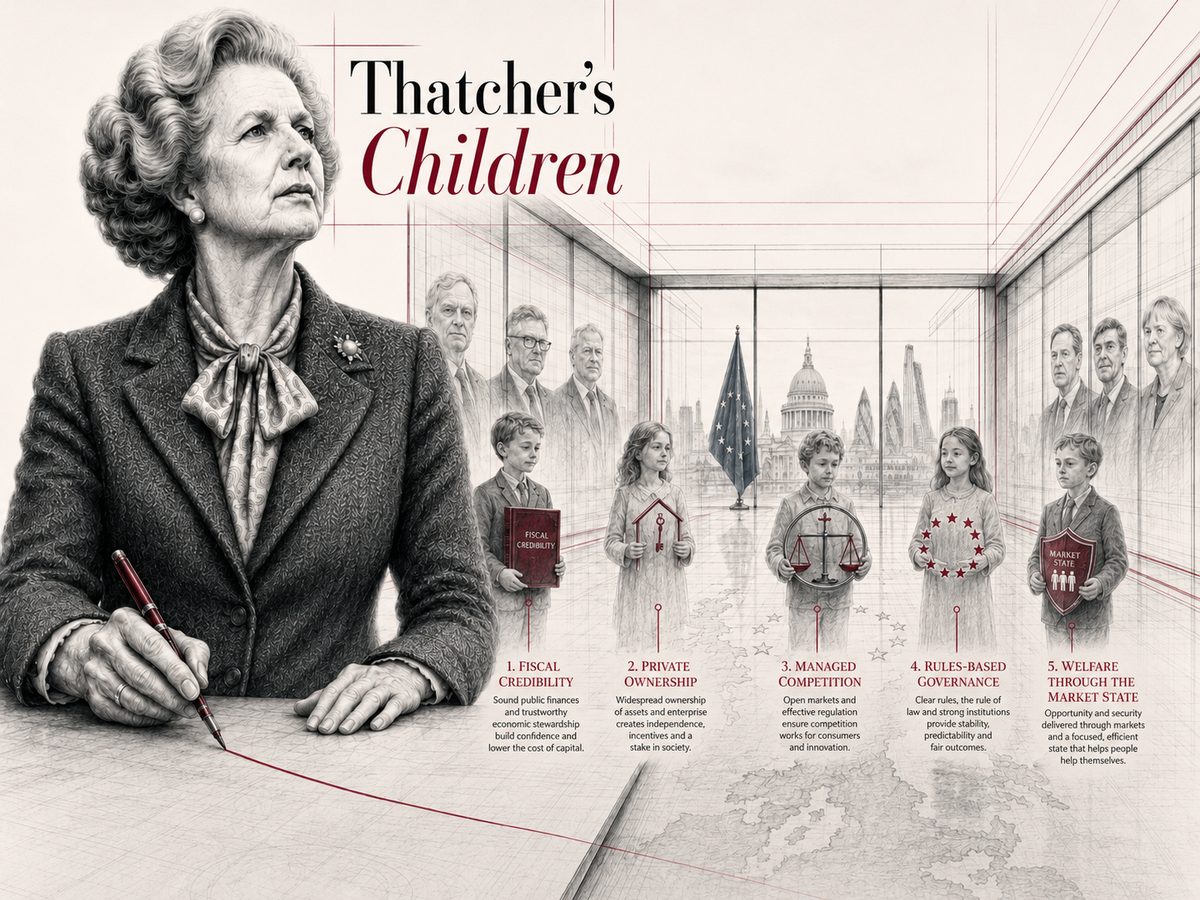
EconScope by The Agora Review
How the woman who fought old social democracy helped create the market state the modern left now governs.
Provocation
The tax rate that sounds like a typo
If Margaret Thatcher makes you think of trickle-down economics, tax cuts for the rich, and some tax-free fantasyland where money simply floats upward while everyone claps, the actual numbers might surprise you.
Thatcher inherited a Britain where the top income tax rate on earned income stood at 83%. Investment income could face 98% once the investment income surcharge was added. Ninety-eight percent. A number so high it almost stops meaning tax and starts sounding like a political dare.
Then came the revolution everyone remembers, and the surprise almost everyone forgets.
Geoffrey Howe’s 1979 Budget cut the top rate on earned income from 83% to 60%, cut the basic rate from 33% to 30%, and raised VAT to a unified 15%. Nigel Lawson’s 1988 Budget completed the symbolic journey to a 40% top rate.
Forty percent was once the great Conservative rupture.
Today, Britain’s income tax system has a 40% higher rate and a 45% additional rate in England, Wales, and Northern Ireland. Scotland goes higher. Thatcher’s endpoint now lives inside the fiscal imagination of modern welfare capitalism.
“The number that once symbolized liberation from old socialism now sits inside the normal tax universe of welfare capitalism.”
A 40–45% top income-tax world can coexist with public healthcare, pensions, redistribution, climate policy, industrial strategy, public investment, and a large state. That is the joke history plays on ideology.
Thatcher kept the state alive and rewrote its job description. The old British state owned industries, bargained with unions, controlled capital, managed demand, and treated markets as systems requiring containment. The Thatcher state sold assets, weakened organized labour, opened capital flows, strengthened financial markets, and treated competition as discipline.
Old Settlement
The Britain before the break
The pre-Thatcher world feels distant because our political vocabulary has shrunk.
The old social-democratic imagination reached beyond welfare. It meant ownership. Planning. National champions. Strong unions. High marginal taxation. Capital controls. A state with enough confidence to shape the economy directly.
Postwar Britain lived inside that settlement. The state owned major industries and services. A House of Commons Library briefing on public ownership describes the postwar nationalisations as a major transfer of ownership from the private sector to the public sector, covering institutions and industries such as the Bank of England, coal, rail, road haulage, gas, electricity, iron, and steel.
This mattered because old social democracy was an economic architecture. The state stood inside the production system. It owned assets. It negotiated with organized labour. It carried industrial responsibility. It tried to manage capitalism from the commanding heights.
By 1979, that model had lost confidence. In Howe’s diagnosis, manufacturing output in 1978 was 4% lower than in 1973, manufactured imports had risen by 13.5%, and inflation in the six months to April 1979, excluding seasonal foods, was running at an annualized 12.3%. He also placed the public-sector borrowing requirement above 5.5% of GDP in 1978–79.
This is the atmosphere Thatcher entered: a large state, a strained economy, a tax system that looked confiscatory at the top, and a political class arguing over how much of the old postwar settlement could still hold.
Howe’s 1979 Budget reads like a manifesto for escape. He spoke of supply-side failure, taxes that punished initiative, public borrowing requiring restraint, and a government determined to shift the tax burden from earnings to spending.
That phrase matters: from earnings to spending. It was a new moral economy. Income should carry a lighter penalty. Consumption could carry more of the load. The individual should keep more of what he earned. The market should discipline more. The state should stop acting as the owner of national life.
Tax Reset
The table that explains the turn
The tax story deserves its own table, because the numbers explain the political transformation better than any slogan.
| Moment | Top income tax | Basic income tax | VAT | Political meaning |
|---|---|---|---|---|
| Pre-Thatcher Britain | 83% earned income; up to 98% investment income with surcharge | 33% | 8% standard rate, with a higher luxury rate in the old system | High-tax postwar settlement |
| 1979 Howe Budget | 60% | 30% | 15% | Direct tax cut, indirect tax rise, incentives language |
| 1988 Lawson Budget | 40% | 25% | 15% | New top-rate ceiling for the market era |
| UK today | 40% higher rate; 45% additional rate in England, Wales, and Northern Ireland | 20% | 20% | Mainstream welfare capitalism |
Sources: Howe 1979 Budget, Lawson 1988 Budget, current GOV.UK income-tax rates, and IFS TaxLab’s overview of the long-term move toward VAT.
This is the part people miss. Thatcherism reduced income tax dramatically at the top, while strengthening a tax structure modern welfare states still use: broad-based consumption taxation.
The politics changed from visible confiscation at the top to a wider fiscal machine spread across income, spending, payroll, corporate profit, property, and social contributions. The Institute for Fiscal Studies describes a major UK revenue trend since the 1970s as a shift toward VAT.
The old 83/98% world belonged to a different political universe. The 40% world became durable.
Market State
Ownership retreats, finance opens
The tax cuts carried a wider reconstruction.
Exchange controls began to come down. Howe called Britain’s exchange-control regime more restrictive than any other major industrialized country and announced the first stage of dismantling controls on outward capital flows in 1979.
Public ownership retreated. Major privatizations followed across the 1980s, including telecommunications, gas, and other strategic industries. The postwar ownership state gave way to a shareholder state, a consumer state, and a regulator state.
Finance changed too. The City of London was remade by the 1986 Big Bang. A Bank of England Quarterly Bulletin article described the reforms as increasing competition, cutting transaction costs, boosting liquidity, ending the compulsory broker-jobber distinction, moving from fixed to negotiable commissions, and drawing British and foreign banks into the Stock Exchange structure.
A tiny state would have been politically fragile for a country with public healthcare, pensions, defence, schools, police, and welfare commitments. Thatcher built something more durable: a market state.
A market state still spends. It still taxes. It still regulates. It funds pensions, hospitals, schools, police, defence, and welfare. Its instincts run through different machinery.
Private ownership becomes the default. Competition becomes a remedy. Fiscal credibility becomes a moral language. Public services learn the vocabulary of efficiency. Unions become interest groups outside the core machinery of economic governance. The investor, the homeowner, the consumer, and the entrepreneur become political characters.
“Thatcher’s most durable legacy was an operating system: private ownership, open capital, weaker labour power, broader consumption taxation, and a state trained to govern through markets.”
That architecture survived because it grew larger than Thatcher. It became common sense.
Afterlife
The left moves in
The old left wanted to own more of the economy. The modern center-left usually wants to steer it.
That sentence explains a lot.
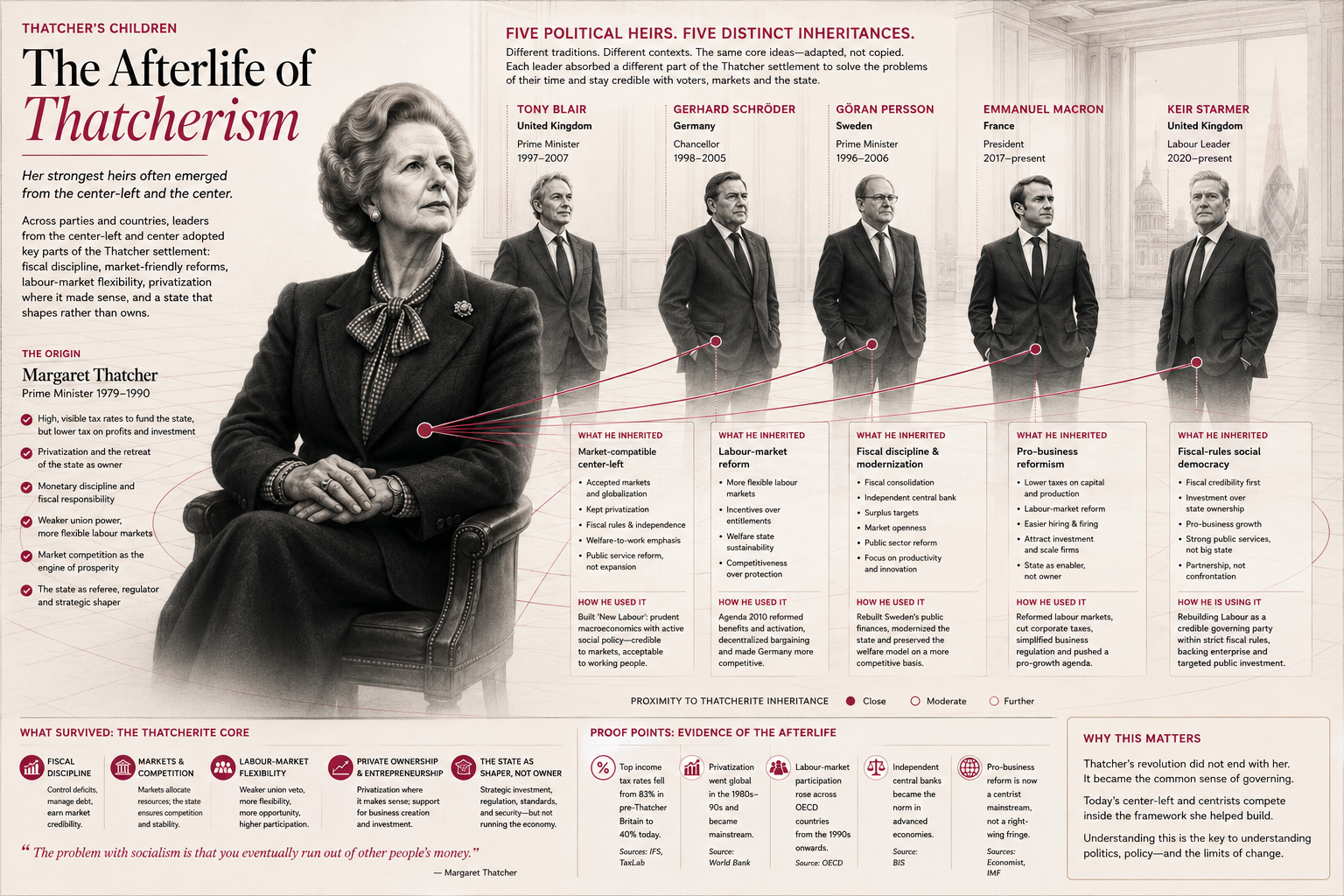
When Labour returned under Tony Blair, it accepted the private-sector economy, financial globalization, central bank independence, and fiscal credibility. It expanded public services and redistributed through tax credits, spending, and targeted support, while governing inside the market order Thatcher had helped normalize.
New Labour’s governing bargain was simple enough: make peace with the market state, then use it for social ends.
That bargain still shapes British politics. Labour’s 2024 manifesto page lists chapters on economic stability, growth, clean energy, streets, opportunity, the NHS, and a fiscal plan. The language is pro-business and pro-worker, cautious and interventionist, market-compatible and socially corrective.
This is modern social democracy in Britain.
It dreams in public investment, stronger rights at work, better services, childcare, green energy, planning reform, minimum wages, and industrial strategy. It speaks through regulators, missions, fiscal rules, targeted ownership, and market-shaping institutions.
The old 83/98% world has vanished from its practical imagination.
Thatcher’s victory was so complete that even the language of repairing her legacy often accepts her map. The modern left can still tax more, spend more, regulate more, redistribute more, and protect workers more. It usually acts inside a world where private ownership is normal, capital is mobile, central banks are independent, fiscal rules matter, and the state corrects markets more often than it commands them.
Thatcher fought old social democracy so successfully that she helped create the version of social democracy able to survive after her.
Caveat
The Nordic warning label
The Nordics matter because they keep the argument honest.
Sweden and Denmark show a stronger version of social democracy than Britain’s. They rely on private firms and open markets, alongside high bargaining coverage, strong labour institutions, generous welfare, and broad tax bases.
This is where the cartoon version of social democracy collapses. Nordic social democracy survives through organized capitalism. It combines open markets with collective bargaining, social insurance, and public services. A Financial Times letter on bargaining and productivity cited collective bargaining coverage of about 82% in Denmark compared with about 27% in the UK.
So the Nordic lesson is precise. Modern social democracy at its strongest is a governed market economy. Markets with bargaining. Competition with security. Open trade with social insurance. Private firms with collective rules.
Britain absorbed the Thatcher break in a particularly deep way. The Nordics adapted to globalization through a different institutional route. They preserved stronger worker power and broader social coordination.
Even so, the Nordic example strengthens the larger point. Successful social democracy today usually governs markets. The fight is over the rules, risks, rewards, and institutions around the market.
Today
Conservatives also changed
Modern conservatives in advanced democracies often govern as welfare-state managers with lower-tax instincts.
They inherit ageing populations, expensive health systems, pension promises, infrastructure needs, energy shocks, migration pressures, and voters who dislike taxes while loving public services. So they manage the state differently.
The British Conservatives’ 2024 offer promised further National Insurance cuts, including a two-point employee NIC reduction by April 2027 and the abolition of the main self-employed rate by the end of the parliament, along with a commitment on income tax and VAT. Reuters summarized the tax pledge during the campaign.
The same political family also promised NHS staffing, pensions protection, migration control, welfare savings, police recruitment, and defence spending. That is a conservative state with a particular moral order: lower taxes where possible, stronger borders, tougher welfare rules, weaker labour leverage, and a cost-first approach to decarbonization.
Modern social democracy
- Public investment and industrial strategy
- Stronger labour rights and bargaining power
- Redistribution through tax, transfers, and services
- Faster climate transition with state capacity
- Markets governed toward social outcomes
Modern conservatism
- Lower-tax instincts and business incentives
- Employer flexibility and strike discipline
- Welfare conditionality and border control
- Cost-first framing on climate policy
- Markets protected as the default order
The divide today is more precise than the old slogan.
Who pays? Who receives? Who works under what conditions? How much bargaining power should labour have? How fast should climate transition move? How much migration can the state manage? How generous should welfare be? How much inequality can a democracy absorb before it starts lying to itself?
Conservatives tend to protect the market order first and use the state to enforce discipline around work, welfare, borders, unions, and spending. Social democrats tend to protect households first and use the state to discipline markets, employers, inequality, underinvestment, and insecurity.
Every serious government governs a hybrid.
Legacy
The woman who made 40% look left-wing
The strangest thing about Thatcher’s legacy is how ordinary her once-radical endpoint now feels.
A 40% top tax rate once symbolized a break from the postwar settlement. Now it can sit inside the fiscal imagination of a center-left government. The old 83/98% world feels politically alien, even to many people who support redistribution.
That is a historical transformation.
The old social-democratic imagination was built around public ownership, union power, high marginal taxation, and the state as a direct economic actor. The modern center-left is more likely to talk about public investment, clean energy, childcare, minimum wages, industrial strategy, tax credits, regulated markets, planning reform, and targeted ownership where the case is strongest.
The moral concern survived. The machinery changed.
Thatcher helped change the machinery. She made the old settlement feel exhausted. She made markets feel like the default grammar of economic life. She made very high marginal tax rates feel politically exotic. She made private ownership the normal state of things and public ownership a tool requiring a specific case.
Then her opponents learned to govern there.
“Thatcher, the mother of modern social democracy” works as provocation because it captures a real historical inversion. She fought the old model and helped create the world in which the newer model had to reinvent itself.
Closing
Thatcher’s children
Every advanced democracy now lives with some version of the same contradiction.
People want low taxes and excellent hospitals. Cheap energy and climate action. Strong borders and enough workers. Higher wages and low inflation. More homes and protected neighborhoods. Faster growth and less disruption. Markets that innovate and states that rescue.
This is the politics of the market state.
Thatcher understood part of that world before many of her opponents did. She believed incentives mattered. Ownership mattered. Union power had limits. Inflation poisoned politics. Enterprise needed space. The state could become too confident in its own wisdom.
She also left behind a harsher country in important ways. Weaker unions. Greater inequality. More financial dependence. A housing model that turned ownership into political identity and scarcity into generational conflict. A public realm increasingly asked to behave like a balance sheet.
Her legacy is an operating system.
The left returned to power and patched it. Softened it. Added redistribution, public spending, tax credits, rights, targets, regulators, and missions. Sometimes it repaired damage. Sometimes it accepted too much. Sometimes it confused market confidence with national purpose.
But it lived inside the architecture.
That is Thatcher’s most durable victory. She pushed Britain out of the old postwar settlement and into a market-centered order. Conservatives still argue for lower taxes, tougher borders, welfare discipline, and weaker labour power. Social democrats still argue for public investment, stronger rights, redistribution, and a state that protects people from the market’s cruelties.
“The fight continues.
The battlefield is hers.”
Source trail
- Geoffrey Howe, 1979 Budget speech
- Nigel Lawson, 1988 Budget statement
- GOV.UK, current income-tax rates
- House of Commons Library, public ownership
- Bank of England, Big Bang and City regulation
- IFS TaxLab, UK revenue and VAT trend
- Labour Party Manifesto 2024
- Reuters, Conservative 2024 tax pledge
- Financial Times, collective bargaining comparison
- IFS, public spending during the Thatcher era