
Do You REALLY Need AI?
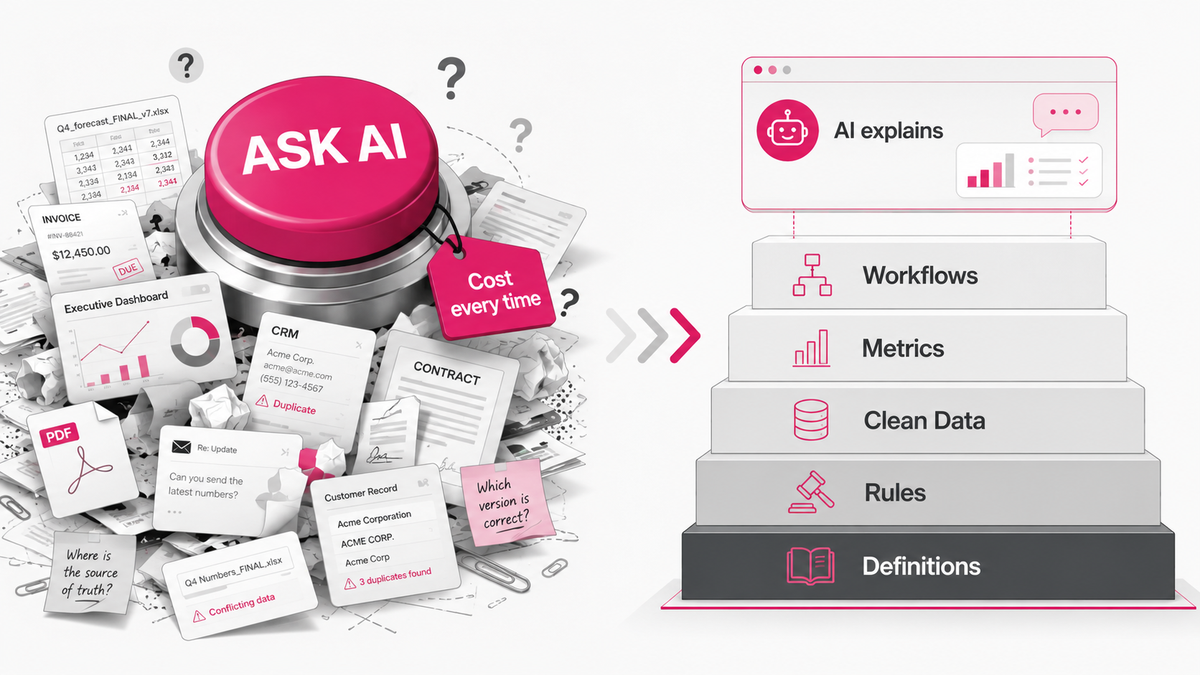
Companies are rushing to attach AI to every messy data problem. Sometimes that is exactly the right move. Often, the business first needs cleaner definitions, better rules, and systems that can answer the same question the same way every time.
A business guide to when AI saves money, when it wastes money, and why many companies need clearer rules before they need bigger models.
Executive summary
🤖 AI is powerful when the problem involves ambiguity, language, documents, or synthesis.
💸 AI becomes expensive when companies use it to rediscover rules that should have been written down once.
📊 Many business questions do not need a model. They need a metric, a rule, a dashboard, or a clean data table.
🧾 The hardest part is often not the technology. It is agreeing what words like “revenue,” “customer,” “retention,” or “risk” mean.
🧠 The best architecture puts AI at the front door: it understands the user’s question, routes it to the right system, and explains the answer.
Prologue
A familiar scene is playing out inside large companies.
A division has too much data. Some of it sits in the CRM. Some in finance systems. Some in spreadsheets. Some in PDFs. Some in emails. Some in dashboards that people no longer fully trust. Teams waste time looking for answers. Leaders ask the same questions again and again. Analysts become human search engines.
Then someone suggests the modern solution:
Let’s put everything in one data lake and use AI to ask questions.
It sounds clean. It sounds ambitious. It sounds like the company is moving from old reporting to intelligent work.
Sometimes, that is true.
Often, the company is about to build a very expensive machine for a problem that began somewhere simpler.
The business wants “revenue.”
Which revenue?
- Booked revenue?
- Recognized revenue?
- Gross revenue?
- Net revenue?
- Adjusted revenue?
- Revenue after cancellations?
- Revenue by customer?
- Revenue by product?
- Revenue by legal entity?
The business wants “retention.”
Which retention?
- Customer retention?
- Revenue retention?
- Premium retention?
- Policy retention?
- Logo retention?
- Renewal retention?
- Retention excluding customers that were never eligible to renew?
The business wants “risk.”
Which risk?
- Credit risk?
- Claims risk?
- Operational risk?
- Compliance risk?
- Client risk?
- Portfolio concentration risk?
AI can produce a confident answer to a messy question. That does not mean the business has asked a well-defined question.
This is where the economics of AI becomes more interesting than the technology.
The question is not simply whether AI can answer.
The better question is:
Is AI the cheapest, safest, and most reliable way to answer this specific business question?
For many recurring business questions, the answer is no.
For many ambiguous, document-heavy, language-heavy questions, the answer is yes.
The work is knowing the difference.
The new corporate reflex: put AI on it
AI has become the default answer to almost every enterprise frustration.
- People cannot find the right report. Put AI on it.
- Different teams disagree about the number. Put AI on it.
- Documents are scattered across systems. Put AI on it.
- Analysts are overloaded. Put AI on it.
- Executives want faster answers. Put AI on it.
Some of these are excellent AI use cases. Many are signs of a more basic operating problem.
A company may have weak definitions. Or poor data quality. Or duplicated systems. Or reports that calculate the same metric differently. Or manual workarounds hidden inside spreadsheets. Or business rules that live inside the heads of a few experienced employees.
AI can help people navigate complexity. It can also make disorder look more impressive.
The difference shows up in cost.
A deterministic system takes effort to build. The company has to define the metric, clean the data, write the rule, test the output, and agree on ownership. But once that work is done, the system can answer the same question cheaply and consistently.
AI has a different cost pattern. It can be fast to prototype. It feels flexible. Users can ask questions naturally. But each answer can involve retrieval, model calls, context processing, validation, security checks, and sometimes human review.
That makes the business case very different.
Rules are expensive once.
AI becomes expensive every time it is asked to rediscover rules the business never wrote down.
The expensive illusion of “ask anything”
The promise of enterprise AI often sounds like this:
Put all the data in one place. Let people ask anything. The AI will find the answer.
That promise is seductive because it removes friction from the user. No SQL. No dashboard hunting. No waiting for an analyst. No need to know which system contains the right information.
But “ask anything” has a cost.
The system has to understand the question. It has to know which data the user is allowed to see. It has to retrieve relevant context. It has to avoid the wrong source. It has to interpret business terms correctly. It has to produce an answer. Then someone has to trust that answer.
For a messy document question, this can be worthwhile.
For a repeated metric question, it can be wasteful.
Consider two requests.
Request 1
Which invoices are more than 30 days overdue?
This needs a rule.
The system needs invoice date, payment status, customer ID, and current date. The logic is simple. The answer should be the same every time.
Request 2
What are customers saying about billing problems in support calls this quarter?
This may need AI.
The answer sits inside messy text or transcripts. Customers may describe the same issue in different ways. The system needs to find patterns, cluster themes, and summarize evidence.
Both requests sound like business questions. They have different economics.
The first needs structure.
The second may justify AI.
Many business questions are ordinary data questions
Most companies ask the same types of questions repeatedly.
They want revenue by region. Margin by product. Retention by segment. Claims above a threshold. Headcount by team. Pipeline by stage. Customers up for renewal. Invoices overdue. SLA breaches. Open risks. Missing documents.
These are important questions. They are also structured questions.
| Business question | Better first answer engine |
|---|---|
| What was revenue last quarter? | Finance-approved metric |
| Which invoices are overdue? | ERP query or rule |
| Which customers are up for renewal? | CRM / policy system query |
| Which claims exceed $100k? | Deterministic filter |
| Which teams missed SLA? | Workflow data + rule |
| What was margin by product? | Governed finance model |
| Which accounts are missing documents? | Validation rule |
| What are customers complaining about in call notes? | AI-assisted text analysis |
| What changed in the contract language? | AI-assisted document comparison |
| Why did a KPI move? | Structured data + AI explanation |
This table is the central business point.
AI should handle the parts that require language, ambiguity, search, or synthesis.
Structured systems should handle the parts that require exact numbers, repeated logic, and consistency.
A company does not need an LLM to count overdue invoices.
It may need an LLM to understand why customers are angry about invoices.
Those are different problems.
The real cost is bigger than the model bill
When executives think about AI cost, they often think about the price of the model.
That is only one part of the cost.
A serious enterprise AI system also requires:
| Cost area | What the business pays for |
|---|---|
| Data ingestion | Moving data from systems, files, tools, and databases |
| Cleaning | Fixing duplicates, bad joins, missing values, inconsistent IDs |
| Storage | Keeping raw, cleaned, curated, and archived data |
| Indexing | Making documents and records searchable |
| Embeddings | Preparing text for semantic retrieval |
| Compute | Running queries, transformations, retrieval, and AI calls |
| Security | Controlling which users can see which data |
| Governance | Catalogs, lineage, approvals, ownership, audit trails |
| Validation | Checking whether answers are accurate |
| Monitoring | Tracking cost, errors, latency, and usage |
| Human review | Reviewing high-risk outputs before decisions are made |
This is why a naive AI business case can look cheap at the beginning and expensive later.
The prototype works. Users like the interface. Leaders see impressive demos.
Then the hard questions arrive.
- Which number is official?
- Which source did the AI use?
- Did the user have permission to see that data?
- Why did the answer change when the question was phrased differently?
- Can this be used in a management report?
- Can this be used with customers?
- Can this be defended to audit, legal, compliance, or regulators?
Those questions are expensive because they require structure.
The most important cost curve
The core economic distinction is simple.
Deterministic systems
High setup cost.
Low cost per repeated answer.
AI-heavy systems
Lower visible setup cost.
Higher variable cost per answer.
A deterministic rule has to be designed. That takes work. But after it exists, the rule can run again and again.
An AI system can interpret new questions. That flexibility is valuable. But if the same question appears every week, the company may be paying the model to solve the same problem repeatedly.
This is the point many AI business cases miss.
A company should not ask AI to keep reasoning through a rule that the business already understands.
It should encode the rule.
Then AI can help users find it, apply it, and understand it.
The real bottleneck: definitions
Many companies call their problem a data problem.
Underneath, it is often a definition problem.
The business wants a dashboard for “customer profitability.”
Before technology can solve that, the company needs answers to basic questions.
- What counts as a customer?
- How are parent companies treated?
- How are shared service costs allocated?
- Are one-time implementation fees included?
- Are refunds included?
- Are customers grouped by contract, legal entity, or relationship owner?
- How are inactive customers handled?
These are business decisions.
AI cannot safely guess them every time - and will not.
The same applies to many familiar terms.
| Term | Business decision hidden inside the word |
|---|---|
| Revenue | booked, recognized, net, gross, recurring, adjusted |
| Customer | account, user, legal entity, household, parent group |
| Retention | logo, revenue, policy, premium, account, renewal |
| Churn | voluntary, involuntary, gross, net, after win-back |
| Margin | gross, contribution, operating, adjusted |
| Risk | credit, compliance, claims, operational, portfolio |
| Active account | paid, logged-in, contract-active, recently used |
| Large client | revenue threshold, strategic list, employee count, premium |
An AI assistant can help surface ambiguity.
- It can ask, “Do you mean revenue retention or customer retention?”
- It can route a question to the right definition.
- It can explain the metric to a business user.
But the company still has to define the metric.
That is why many successful AI programs begin with unglamorous work: metric dictionaries, data ownership, access controls, quality checks, and agreed business rules.
The savings often come from the boring part.
The better architecture: AI at the front door
The best model is not “AI reads everything and answers.”
The best model is a routed system.
The user asks a natural-language question. AI interprets the intent. Then the system decides which kind of answer is needed.
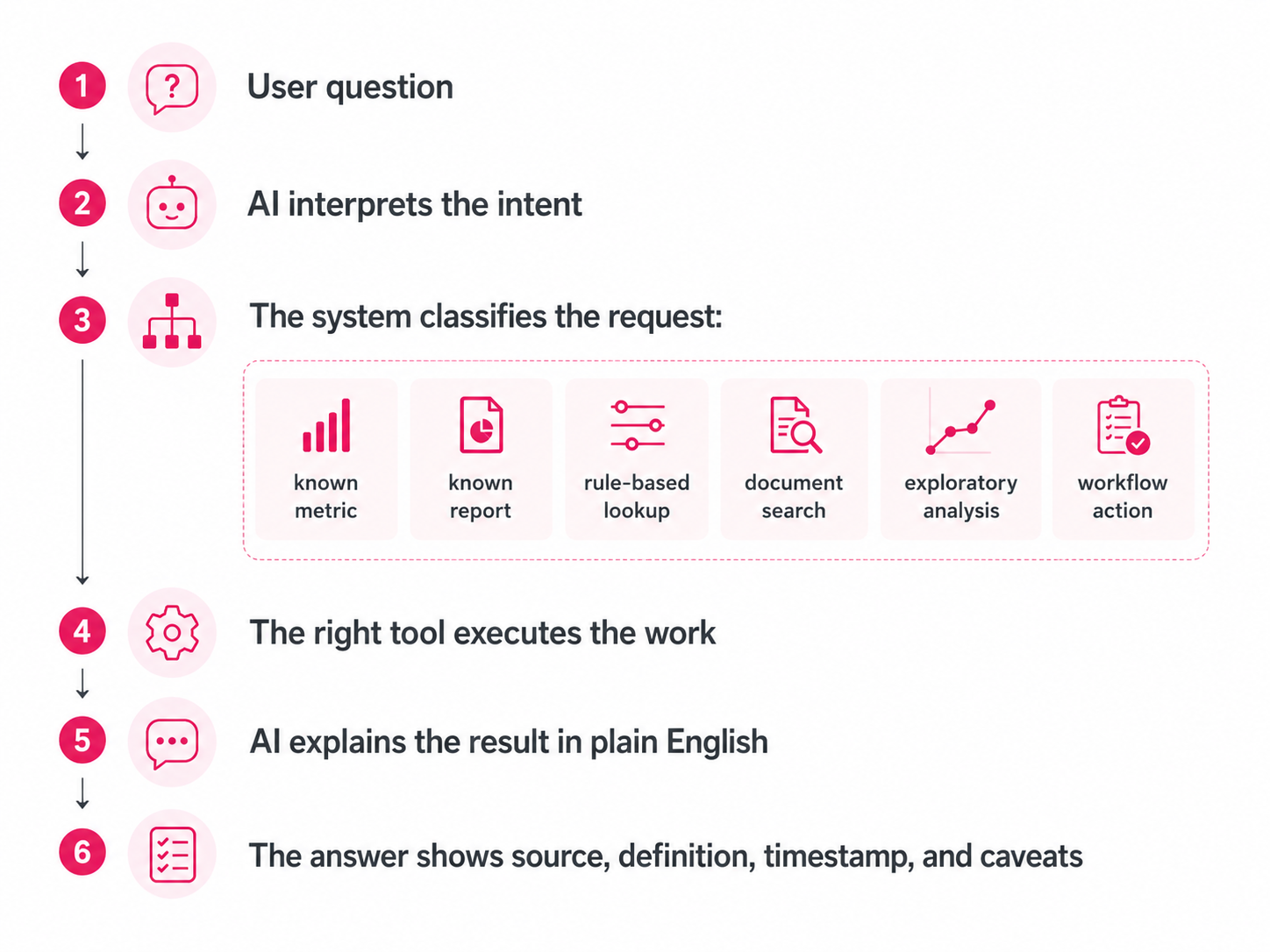
This keeps AI where it creates leverage.
- The AI understands messy human language.
- The data platform calculates official metrics.
- The rules engine handles repeated logic.
- The retrieval system searches documents.
- The workflow system triggers actions.
- The AI explains the output.
In business terms:
AI should be the interface to discipline, not a replacement for discipline.
When AI earns its keep
AI is worth paying for when traditional systems struggle.
1. Documents
Companies contain enormous amounts of knowledge in text:
- contracts
- policies
- claims notes
- call transcripts
- client emails
- underwriting memos
- compliance guidance
- meeting notes
- legal documents
- sales notes
Dashboards are weak here. AI can search, summarize, compare, and extract themes.
2. Vague questions
A user may ask:
Are customers becoming less sticky?
A structured system may not know what “sticky” means.
AI can translate the question into possible metrics:
- retention
- churn
- repeat purchase
- renewal rate
- product usage
- wallet share
- cancellation reasons
Then the system can pull the official data.
3. Explanation
A dashboard can show that margin fell.
AI can help explain the movement:
- which segment changed
- whether price, volume, mix, or cost drove the change
- which products mattered
- which caveats apply
- what a leader should ask next
4. Search across silos
AI can help users find the right report, source, document, policy, or expert.
5. First drafts
AI can turn analysis into:
- executive summaries
- client notes
- board updates
- risk memos
- operating review commentary
- action plans
This can save real time because many companies already have the information. They struggle to turn it into a clear narrative.
When AI is the wrong first investment
AI becomes a costly first move when the company has not solved basic structure.
Warning signs include:
- different teams calculate the same metric differently
- business rules live in spreadsheets
- reports require manual reconciliation every week
- source systems contain duplicated customer records
- dashboards exist but leaders ask analysts to verify every number
- access rights are unclear
- sensitive data is mixed with general business data
- no one owns the definition of key metrics
- users cannot tell whether an answer is official or exploratory
In these cases, AI may still help. But the stronger investment is the foundation.
- Clean the data.
- Define the metrics.
- Clarify ownership.
- Build repeatable rules.
Then use AI to make those systems easier to use.
The seven-question test before funding AI
Before approving an AI use case, leaders can ask seven simple questions.
1. Is this question repeated?
If yes, build a metric, report, API, or rule.
2. Does the answer need to be exact?
If yes, use deterministic logic for the calculation.
3. Should two users get the same answer every time?
If yes, the system needs governed definitions and reproducible queries.
4. Does the answer live in messy text?
If yes, AI may add value.
5. Does the user need explanation or synthesis?
If yes, AI may add value.
6. Is the cost of being wrong high?
If yes, add controls, citations, audit trails, and human review.
7. Is AI being used because the process is unclear?
If yes, fix the process.
This test is simple enough for business leaders. It also prevents AI from becoming a premium-priced workaround for ordinary operating discipline.
The decision table
| Business need | Better solution |
|---|---|
| Exact KPI | Governed metric layer |
| Repeated report | Dashboard or scheduled report |
| Threshold flag | Rule engine |
| Operational lookup | Source system query or API |
| Compliance check | Deterministic rule + audit trail |
| Long document summary | AI |
| Contract clause search | Retrieval + AI |
| Customer complaint themes | AI over notes/transcripts |
| Plain-English explanation of dashboard | AI |
| Exploratory business question | AI + analyst workflow |
| Board-ready narrative | Structured data + AI drafting |
The best answer is often combined.
The system calculates.
AI explains.
What executives should ask
A weak executive question is:
Can we use AI here?
A better question is:
Which part of this problem actually requires AI?
That question changes the business case.
- Maybe the user interface needs AI.
- Maybe document search needs AI.
- Maybe the explanation layer needs AI.
- Maybe the metric calculation should stay in SQL.
- Maybe the workflow needs rules.
- Maybe the company needs a semantic layer.
- Maybe the company needs fewer pilots and more definitions.
AI should be funded where it reduces friction, compresses time, improves understanding, or unlocks information trapped in text.
It should face more scrutiny where it replaces a cheap rule with an expensive model call.
A practical architecture
A practical enterprise design looks like this:
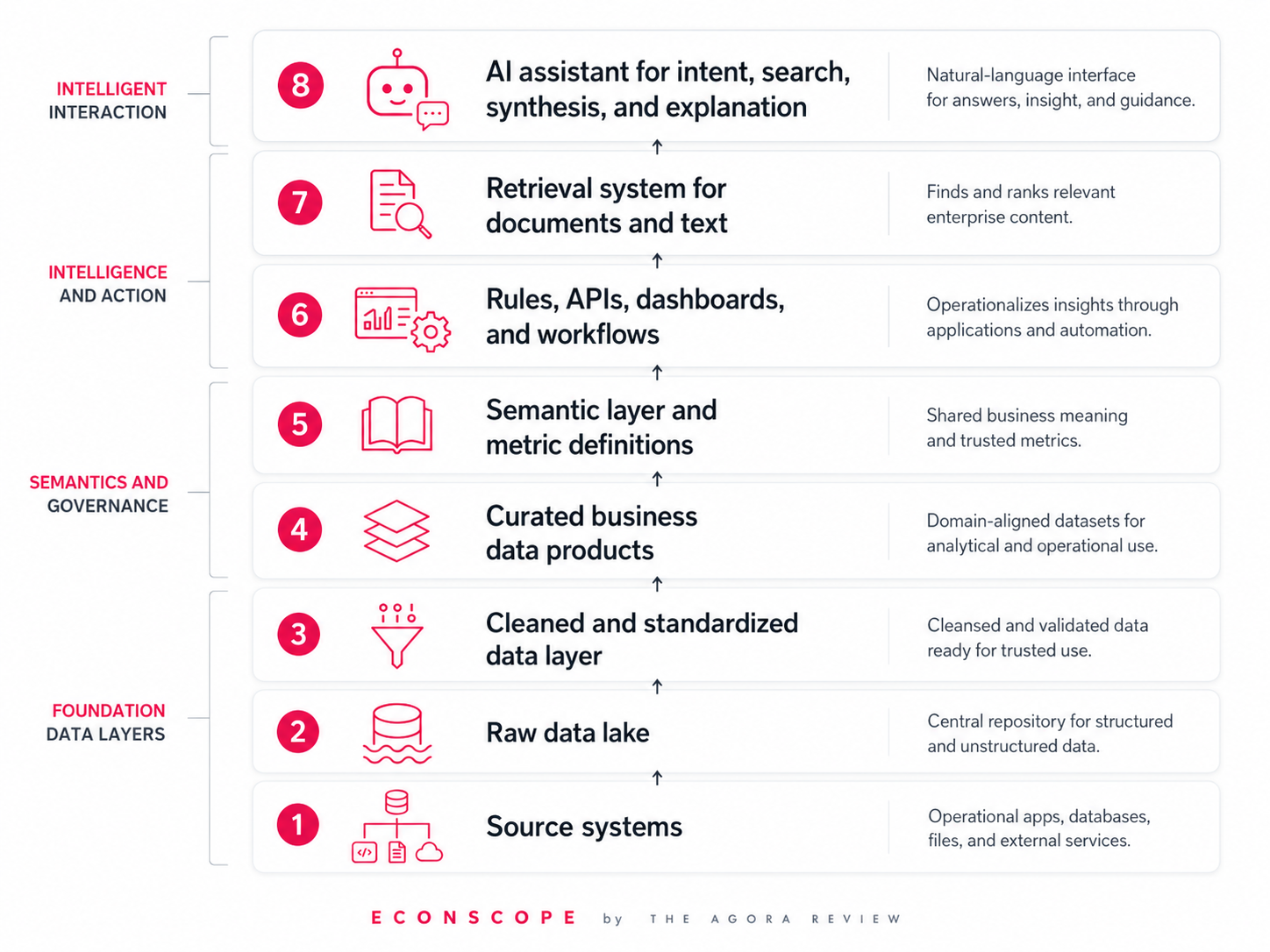
Each layer has a job.
- The source systems hold the facts.
- The cleaned layer makes the facts usable.
- The curated layer makes the data business-ready.
- The semantic layer defines meaning.
- The rules layer handles repeated logic.
- The retrieval layer finds relevant text.
- The AI layer helps people interact with all of it.
This is the difference between AI as a demo and AI as leverage.
A simple rule for leaders
The clearest business rule is this:
If the answer needs to be calculated, structure it.
If the answer needs to be found in messy text, retrieve it.
If the answer needs to be explained, use AI.
That framing avoids two mistakes.
The first mistake is forcing every problem into dashboards.
The second mistake is forcing every problem into an AI prompt.
Modern companies need both structure and intelligence.
The order matters.
Structure first.
AI where it adds leverage.
🔽 Click to Expand: What is a data lake?
A data lake is a central environment where a company stores large volumes of data, often in its original form.
It can include:
- database exports
- logs
- spreadsheets
- documents
- application data
- transaction data
- customer data
- operational data
The appeal is flexibility. The company can store data before knowing every future use case.
But raw storage is only the beginning. Many data platforms use layers:
The lake becomes valuable when the company adds metadata, quality checks, lineage, permissions, ownership, and business definitions.
Without those layers, the data lake is mainly a large storage area.
🔽 Click to Expand: Why LLM answers cost money?
Large language models usually charge based on tokens.
A token is a small unit of text. The user question, system instructions, retrieved documents, previous context, and final answer all contribute to usage.
A serious enterprise AI application may involve several steps:
- classify the user’s intent
- retrieve relevant records or documents
- rerank the retrieved material
- generate an answer
- validate the answer
- produce citations or caveats
- log the output for audit and monitoring
The business may also pay for:
- embeddings
- vector databases
- document parsing
- indexing
- access filtering
- monitoring
- security reviews
- human validation
This is why repeated structured questions should be routed to deterministic systems when possible.
🔽 Click to Expand: What is a semantic layer?
A semantic layer defines the meaning of business terms on top of data.
It answers questions such as:
- What does “revenue” mean?
- Which table is the official source?
- Which fields should be used?
- Which filters apply?
- Who owns the metric?
- How often is the metric refreshed?
- Which dimensions can users slice by?
This matters because business words are ambiguous.
For example, “customer” can mean:
- billing account
- legal entity
- user
- household
- parent company
- policyholder
- active subscriber
If a user asks an AI assistant for “customer growth,” the assistant needs a governed definition to map the question correctly.
A semantic layer gives AI a reliable business map.
🔽 Click to Expand: What deterministic systems do better?
Deterministic systems produce the same output when given the same input and rules.
Examples include:
- SQL queries
- dashboards
- metric layers
- rules engines
- APIs
- validation scripts
- workflow systems
- scheduled reports
They are strong when the company needs:
- exact numbers
- repeatability
- auditability
- low cost per repeated query
- fast response time
- compliance controls
- consistent definitions
Examples:
If invoice_due_date < today
and payment_status = unpaid
→ flag invoice as overdue
If claim_amount > approval_threshold
→ route to senior reviewer
Renewal retention =
renewed premium / eligible renewal premium
for the selected period and segment
These tasks need clean data and clear rules.
Final takeaway
AI is powerful. It is also easy to overbuy.
Many companies will waste money by using AI to answer questions that should have been handled by definitions, rules, dashboards, and clean data.
The practical opportunity is more precise.
Use deterministic systems for repeatable facts.
Use retrieval for information trapped in documents.
Use AI for ambiguity, language, synthesis, and explanation.
Then make clear which answers are official, which are exploratory, and which require human judgment.
The winning model is simple:
Structure what can be structured.
Retrieve what must be found.
Use AI where judgment, language, and synthesis create value.
That is how AI becomes a business tool rather than an expensive shortcut.