You don't need them until you need them
Why countries keep building weapons even when everyone says they want peace: A simple ten-island model explains how nuclear deterrence works, and why Europe’s defense debate is about vulnerability.
Rearmament, deterrence, and the cost people notice too late
Executive Summary
🔹 Defense spending attracts criticism because the invoice arrives before the benefit can be seen.
🔹 Vulnerability has a delayed cost. It appears when pressure arrives, when guarantees weaken, or when an adversary decides coercion may work.
🔹 Europe is rediscovering security as a form of infrastructure after years of treating it as background protection.
🔹 France’s nuclear debate forces Europe to face the hardest promise in security politics: who is willing to protect whom when the cost could be existential?
🔹 A simple island model explains how peaceful actors can create an arms race through fear, proximity, and uncertainty.
🔹 Nuclear weapons pushed deterrence to its most extreme form because they made victory harder to define and catastrophe harder to contain.
Prologue
I have noticed a change in ordinary conversations. People who usually ask me about elections, inflation, Greece, markets, or the political drama of the week have started asking about weapons.
One friend asked why Europe was talking about rearmament again. Another sent me a headline about France and nuclear protection. A third asked about Iran, Israel, the United States, and whether the world was moving into a darker phase. The conversations began in different places, but they kept circling back to the same question:
Why are governments spending so much money on weapons?
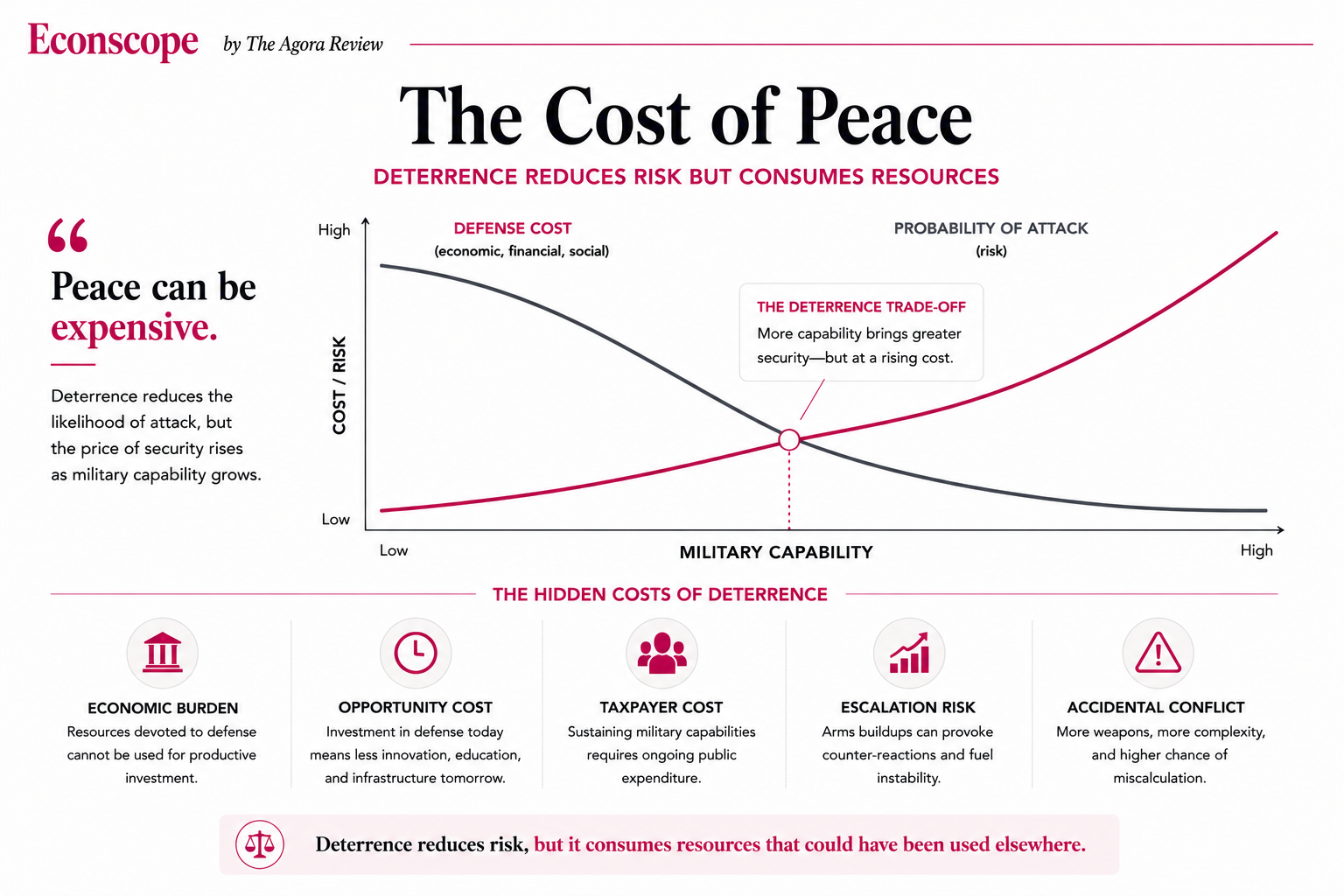
The question is reasonable because defense spending competes with almost everything a society can see and touch. Every missile battery uses money that could have gone to hospitals. Every submarine draws resources away from housing, transport, energy grids, childcare, debt reduction, research, or tax relief. Ammunition stockpiles sit beside ordinary public needs that feel more immediate and more human.
For years, especially in Europe, this question stayed in the background. NATO existed, armies existed, and experts warned about readiness, but the public mood rested on a quieter assumption. Large war on the continent belonged to history, nuclear deterrence belonged to Cold War documentaries, and military planning felt remote from daily life.
That assumption has weakened. Ukraine changed Europe’s security conversation. Iran keeps returning to the center of escalation and nuclear-threshold debates. France is speaking more openly about European nuclear protection. Governments now discuss ammunition, drones, air defense, industrial production, and readiness with a seriousness that would have sounded unusual a decade ago.
The truth is that people notice the bill and the expenses, while the cost of vulnerability usually goes undetected. That gap brought me back to a game theory model from LSE.
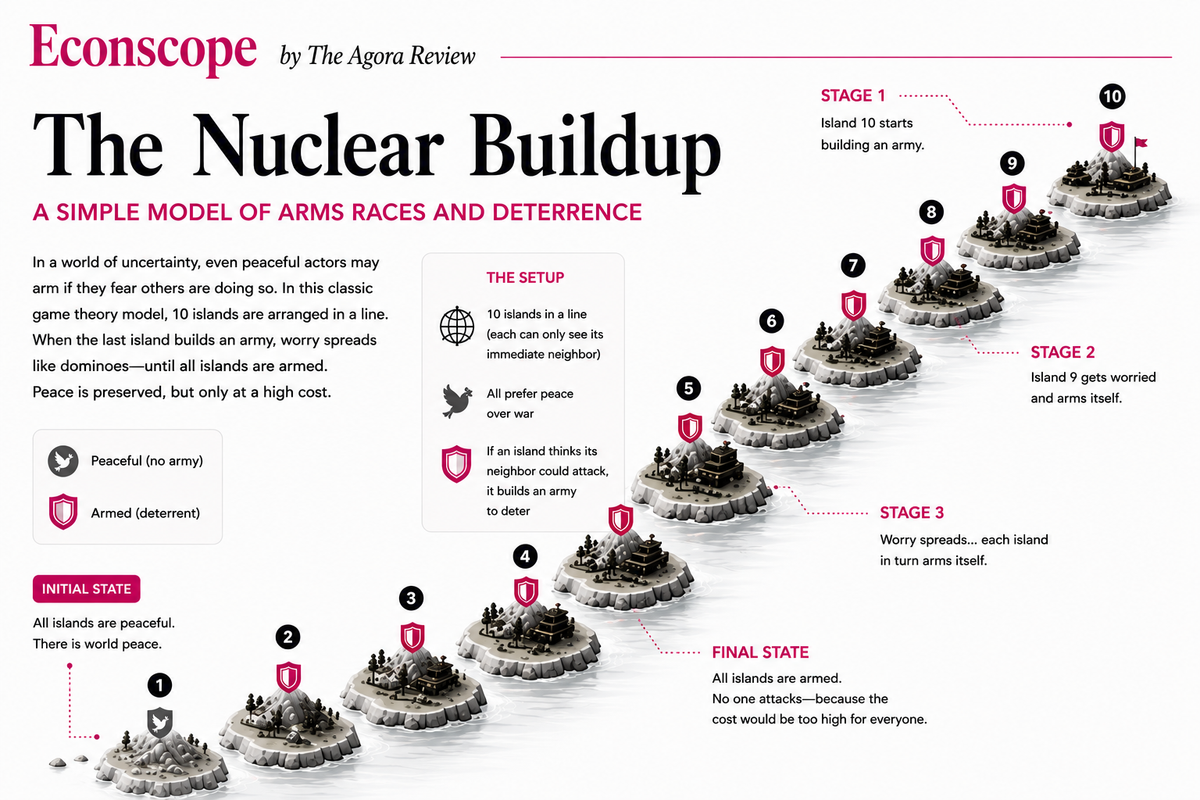
The Ten Islands
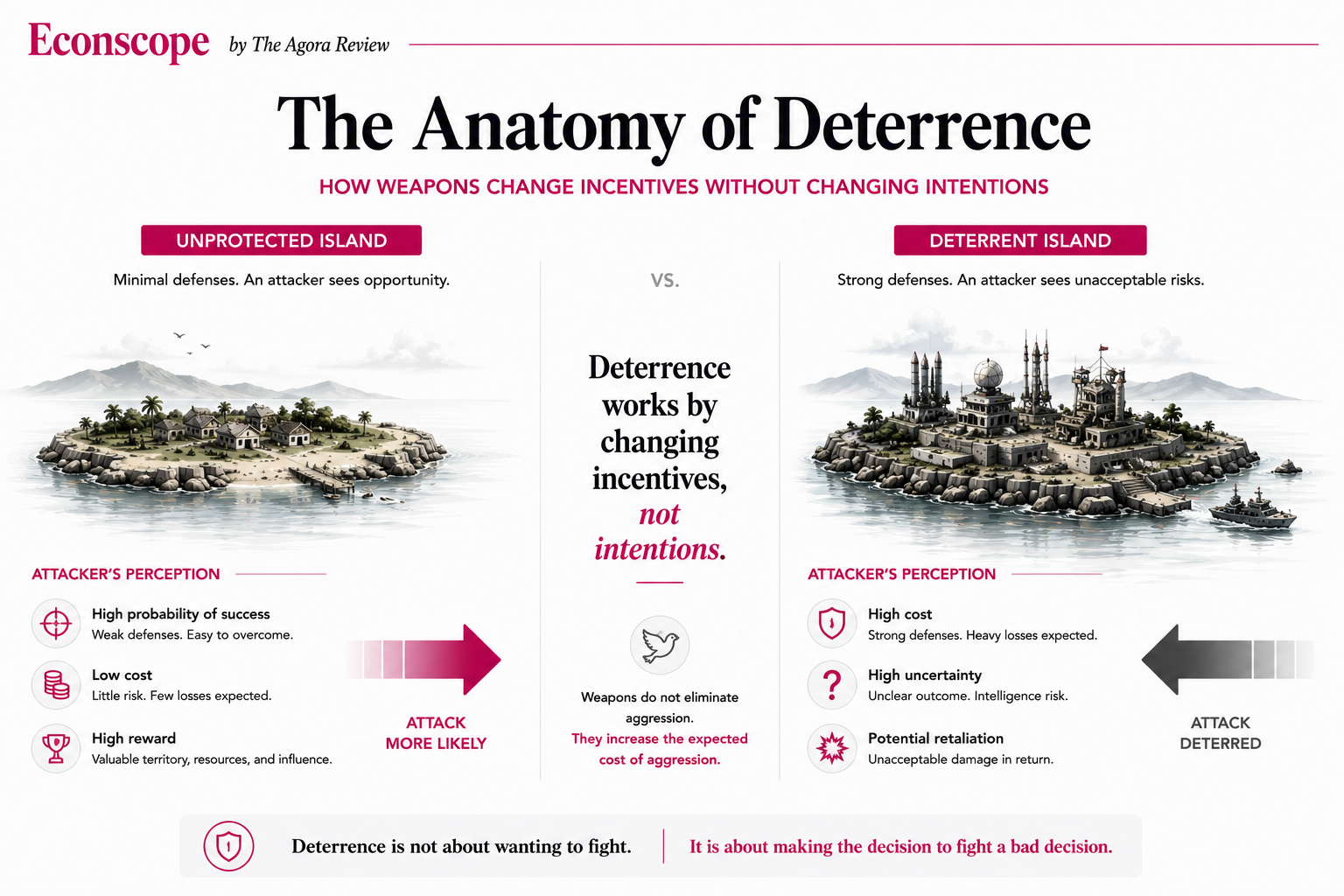
Imagine ten islands arranged across the sea. At the beginning, they are peaceful. Each governs itself, trades, fishes, builds, educates its children, and spends most of its resources on civilian life. There are rivalries and old memories, as there always are among neighbors, but the archipelago has avoided becoming a chain of military camps.
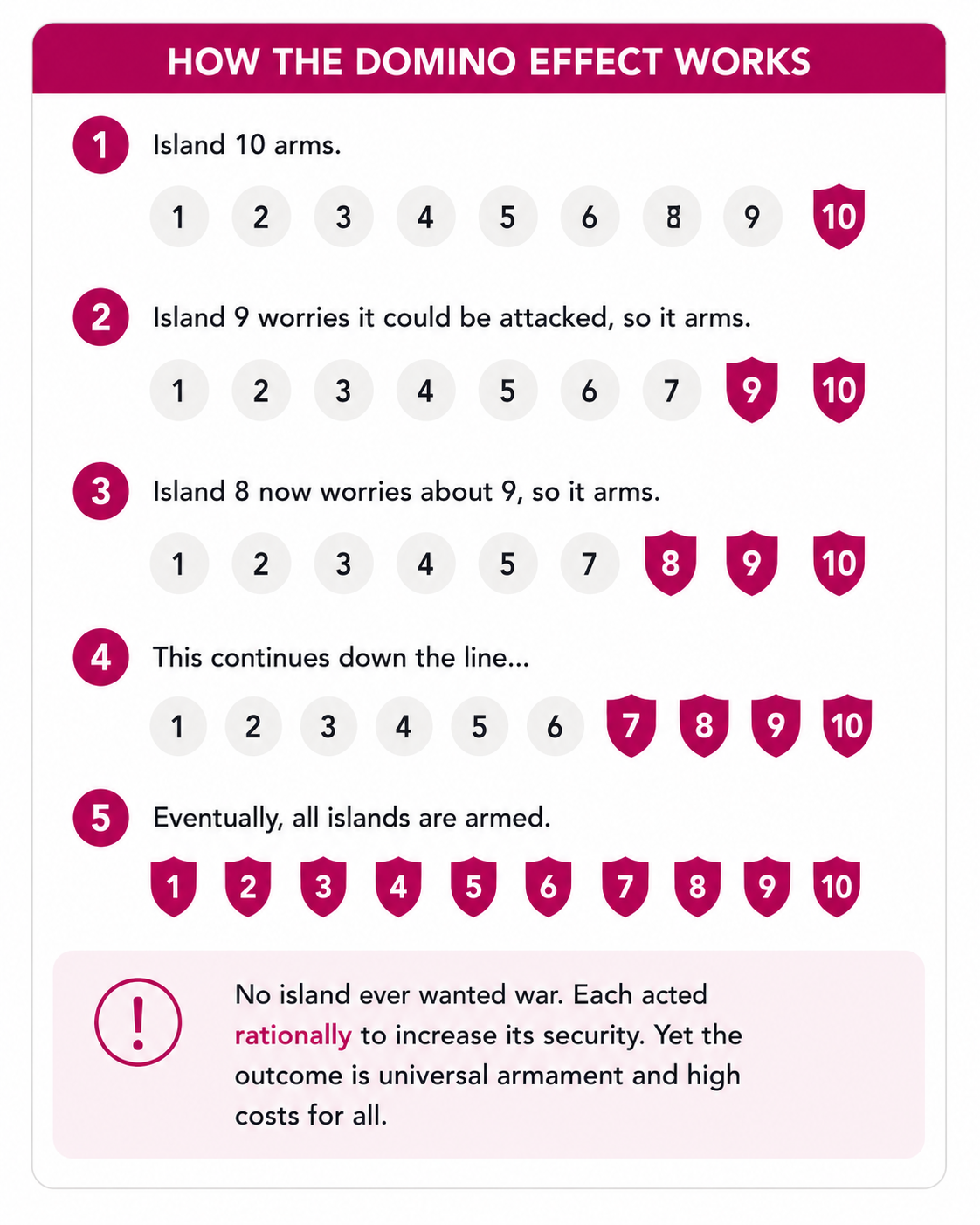
Then Island Ten begins to arm. Its leaders may describe the decision as defensive. They may fear future instability, want insurance, or distrust the world around them. The motive stays inside Island Ten, but the weapons change the world outside it.
Island Nine now sees new ships, ports, radars, training grounds, and missiles. It faces the problem at the center of security politics: intentions are private, while capabilities are visible. A cautious government can become ambitious. A defensive buildup can become offensive leverage. A friendly neighbor can change leadership. Weapons remain after speeches change.
So Island Nine faces a choice. Waiting saves money, while arming consumes resources that could have gone elsewhere. Exposure, however, carries a price of its own. Island Nine arms.
Island Eight studies Island Nine. Island Seven studies Island Eight. Each island explains its decision as defensive, and each can point to the island before it as evidence that the world has changed. The chain transforms through ordinary caution rather than a master plan. A peaceful archipelago becomes an armed one because fear, proximity, and uncertainty have begun to govern everyone’s choices.
That is what makes the model useful. It removes cartoon villains and shows a controversial truth:
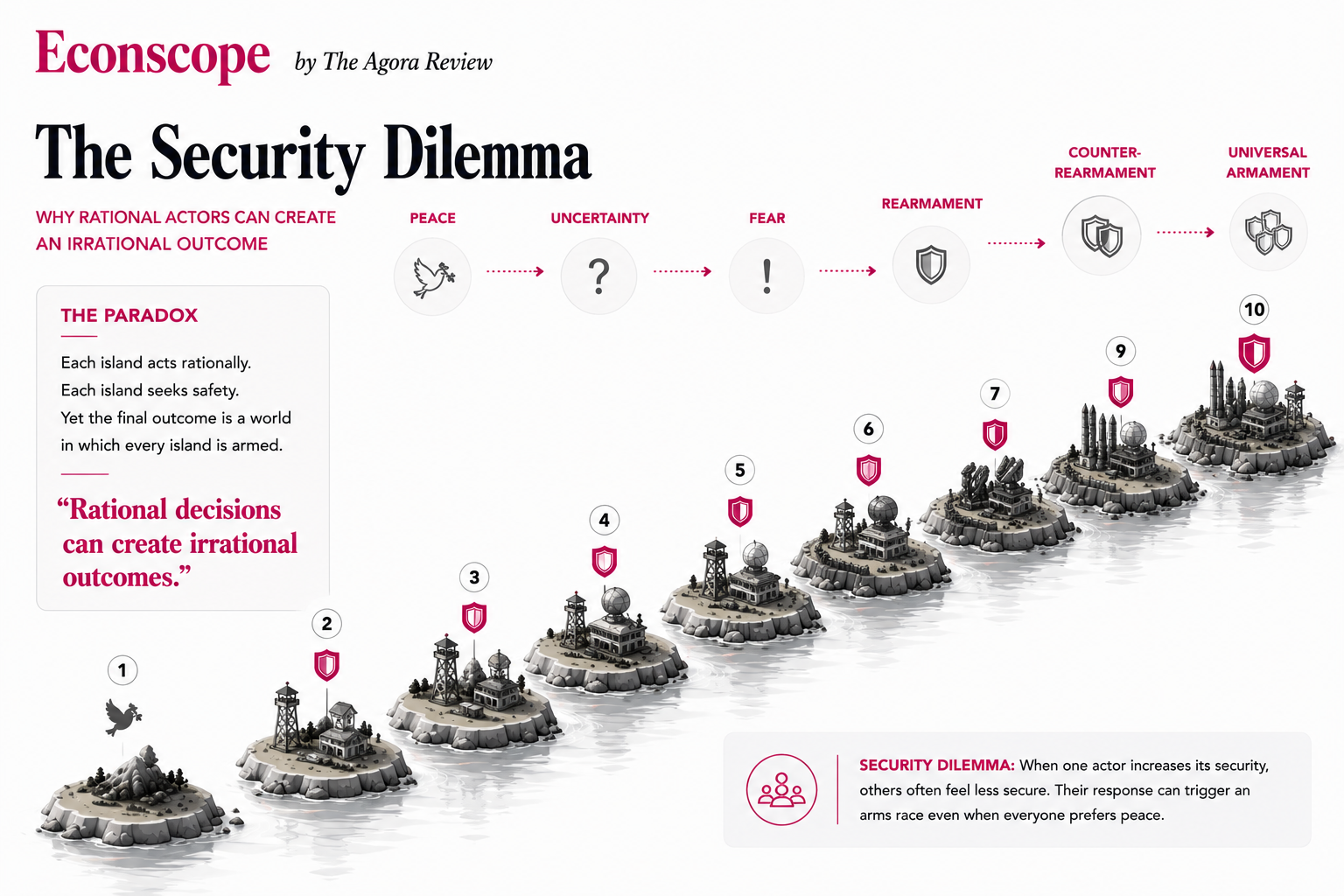
Peaceful actors can collectively produce an arms race
When Protection Becomes Pressure
The first island experiences its buildup as protection. Its neighbor experiences the same buildup as a change in the balance around it. This gap drives much of international politics because governments see intentions imperfectly. They see exercises, budgets, bases, procurement, alliances, and weapons.
A missile can deter an attack and threaten a neighbor. A fortified port can protect trade and project force. A larger army can reassure one public while alarming another. The same capability carries different meanings depending on where one stands.
Each step becomes evidence for the next. Island Ten arms, Island Nine reacts, and Island Ten reads that reaction as confirmation that its original caution was justified. Island Eight reacts to Island Nine, and the chain begins to interpret itself through fear.
Political scientists call this the security dilemma. The phrase is dry, but the experience is familiar: one actor’s search for safety changes the fears of everyone around it.
Europe is living through a version of this logic. Russia’s invasion of Ukraine changed what many governments considered plausible. Once plausibility changes, budgets follow. Air defense, ammunition production, drones, logistics, cyber resilience, and military industry move from specialist circles into public politics.
Citizens want hospitals, schools, energy security, and lower prices. They are asked to finance weapons everyone hopes will remain unused. That is the discomfort at the center of the debate: the spending is visible, while the avoided disaster leaves little public evidence.
The Invoice and the Exposure
Defense spending attracts criticism because it appears in public. A government announces a plan, journalists calculate the cost, opposition parties compare it with unmet social needs, and citizens imagine the same money spent elsewhere.
That criticism matters. Societies can overspend on weapons. Defense industries can gain excessive influence. Leaders can confuse toughness with judgment. Fear can become a permanent budget strategy.
Europe spent decades benefiting from a peace dividend. Many governments reduced military capacity and relied heavily on American protection, which allowed other priorities to dominate: welfare, climate, debt, infrastructure, industrial competition, migration, and democratic stability.
Ukraine disturbed that bargain. The question returned with a harsher edge: what happens when the guarantee feels less automatic and the threat becomes more concrete?
That is why Europe’s readiness debate feels larger than procurement. It reflects stockpiles that ran down, industrial capacity that weakened, and military systems that take years to rebuild. The bill is painful because the gap is large.
Still, vulnerability has its own arithmetic. A country can save money by delaying defense, but the saving lasts only while stronger actors believe pressure will fail. Once pressure looks useful, the cheap choice can become expensive quickly.
Deterrence begins there. An adversary considering aggression asks practical questions before acting. Can this work? How much will it cost? Will allies respond? Will retaliation follow? Can the conflict stay limited?
Military capability changes those answers before the conflict begins. Air defenses make strikes harder. A credible alliance makes coercion riskier. A trained army raises the cost of invasion. A survivable nuclear force makes even a successful first strike dangerous.
The public often sees weapons when they are used. Deterrence works earlier, inside planning rooms and crisis meetings. Plans are rejected. Threats are softened. Timelines are delayed. Options die before citizens ever know they existed.
A deterred crisis leaves little evidence. The invasion fails to begin, the blockade stays on paper, and the ultimatum remains unwritten. The spending remains visible.
France and the Nuclear Promise
France’s nuclear debate matters because it asks Europe to confront the hardest promise in security politics: who would risk destruction for whom?
For decades, Europe’s ultimate protection rested heavily on the American nuclear umbrella. That arrangement depended on belief. Adversaries had to believe the United States might defend allies with extraordinary force, while allies had to believe the promise enough to build their own policies around it.
A nuclear umbrella is a military capability joined to a political promise. While the weapons can be counted and accounted for, the promise has to be believed.
That is why a larger French role in European deterrence is sensitive. France has nuclear weapons, but extended protection requires more than possession. It requires doctrine, consultation, political consent, public trust, and an adversary’s belief that the promise would survive a crisis.
Would Paris risk itself for Warsaw, Tallinn, Berlin, or Bucharest? Would Moscow believe the answer? Would European publics accept the obligations that follow?
Those questions show why deterrence is psychological as well as military. A submarine can carry missiles, but doctrine tells others what the missiles mean. Credibility decides whether the doctrine changes behavior.
The island model helps here. An island that lacks its own ultimate deterrent may rely on another island’s promise. That can work when the promise is believed. It becomes fragile when the promise looks conditional or reversible.
Europe’s defense debate is therefore also a debate about dependence. How much protection can the continent produce for itself? How much protection must it still borrow? How much does borrowed protection cost when the lender’s politics change?
Iran and the Crowded Reality of Deterrence
Iran shows how messy deterrence becomes in the real world. It is a state, a regime, a revolutionary project, a regional network, an energy-route problem, and a nuclear-threshold problem at the same time.
A strike can be military action and political signal. A proxy attack can test resolve while preserving distance. A nuclear program can create bargaining power before a bomb exists. A maritime threat can move energy prices. A limited retaliation can satisfy domestic politics while trying to contain a wider war.
This world is more crowded than ten islands, but the model still helps because it identifies the pressure underneath the complexity. Actors prepare for threats they only partly observe. Credibility matters. Weakness can invite pressure. Strength can trigger fear. Escalation can be used to show resolve, then contained before it spreads.
Iran also shows how quickly simple moral language collapses in security politics. A weapon can deter one action and provoke another. It can reassure one ally and alarm another. It can reduce one risk while increasing another.
The better questions are practical. What pressure is this capability meant to resist? What fear does it create? What happens if it is absent? What happens if it grows?
The Nuclear Turn
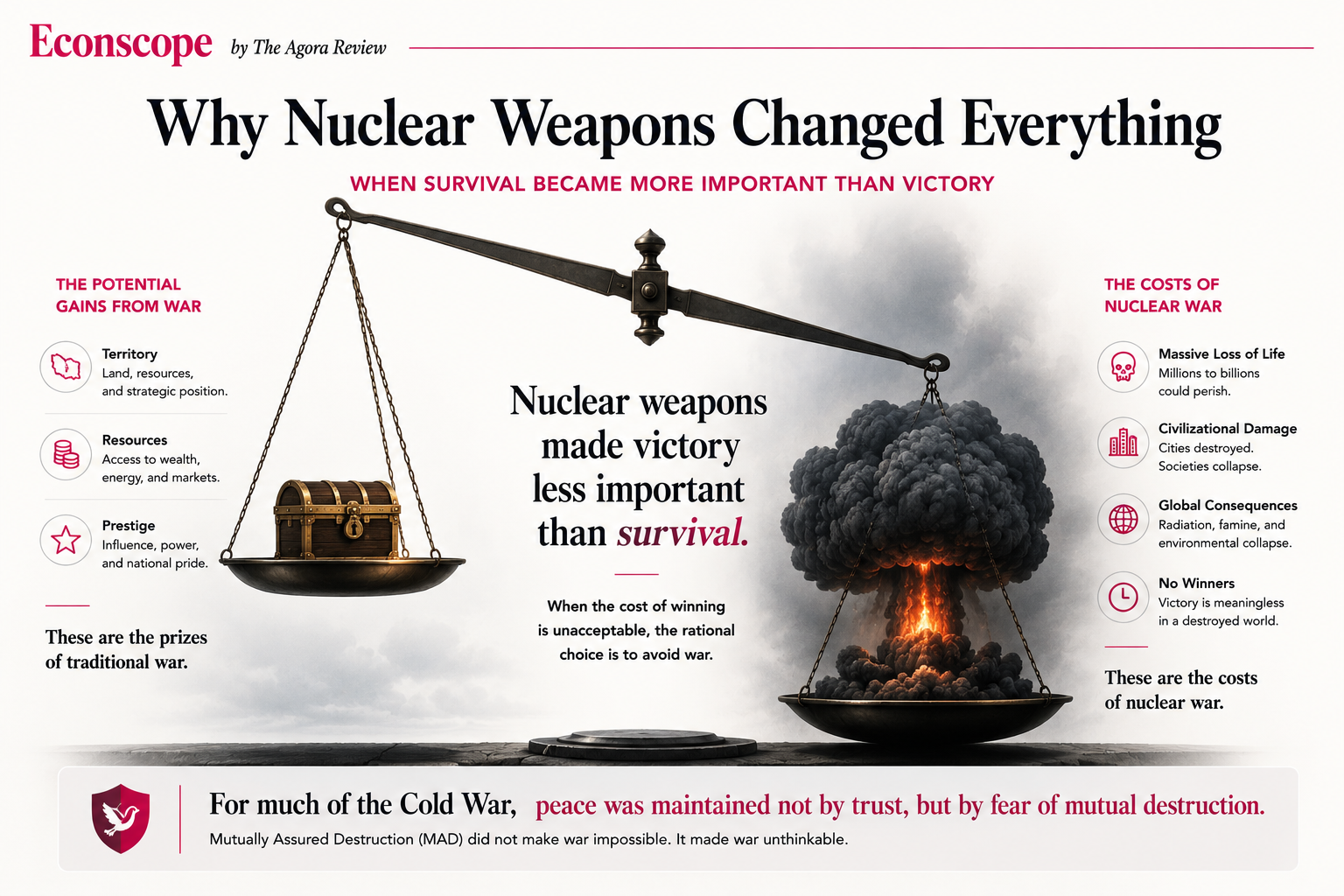
Nuclear weapons changed deterrence because they changed victory
Before the nuclear age, war could be catastrophic and still leave room for winning. A state could gain territory, resources, influence, or bargaining power. The prize could still be imagined.
Nuclear war attacks the prize itself. A state can win a battlefield and lose its cities. A leader can destroy an enemy and inherit a poisoned world. A government can survive formally while the society it governs is shattered.
That is why second-strike capability became central. A nuclear force must remain able to retaliate after absorbing an attack. Submarines, hardened silos, mobile launchers, dispersed forces, and command systems all serve that grim purpose. The aggressor has to believe that a first strike would still invite unacceptable damage.
The Cold War built an entire order around this fear. The United States and the Soviet Union competed across ideology, technology, espionage, proxy wars, prestige, and global influence. They prepared for direct war while working to avoid it. Their arsenals made victory harder to separate from catastrophe.
The world remained violent. Korea, Vietnam, Afghanistan, Angola, Latin America, the Middle East, and many other places carried the violence of the broader confrontation. Nuclear deterrence restrained direct superpower war while leaving room for proxy wars, repression, intervention, and crisis.
The logic was brutal: a weapon designed for catastrophe could prevent catastrophe by making the first move unbearable.
The Trap After Rearmament
The island story has a second lesson. Once the islands arm, returning to the earlier world becomes difficult.
Weapons create institutions. Institutions create budgets. Budgets create interests. Interests create arguments for continuity. Military planning changes what governments notice, and threat perception becomes part of national identity.
A society can preserve peace through deterrence while narrowing its imagination of peace. Diplomacy starts to look secondary. Arms control starts to look naive. Trust-building starts to look sentimental. Every concession can be described as exposure, and every rival move can be treated as confirmation.
The security dilemma becomes a habit.
This danger matters because preparedness can be necessary and still politically corrosive. A country can need air defenses and still lose something if every problem becomes a military problem.
Diplomacy has limits too. Communication loses power when missiles are already in flight. Arms control fails when one side sees advantage in breaking it. Trust grows slowly in a world where governments fear betrayal.
The hard work sits between these failures. Preparedness has to be real, and diplomacy has to remain alive. The islands needed defenses once the chain began changing, but they also needed ways to stop each defensive step from becoming the reason for the next one.
The Cost People Notice Too Late
The question that began the conversation still matters.
Why spend so much money on weapons?
Because peace in an armed world often rests on capacity, credibility, and the belief that pressure will fail. Societies may prefer peace, but their preferences matter less when others see an opportunity to threaten, coerce, miscalculate, or test limits.
This answer should make readers uneasy. Weapons absorb money, talent, industrial capacity, political attention, and public trust. They can make fear permanent, empower institutions that benefit from threat perception, and become symbols of seriousness even when their value deserves scrutiny.
Vulnerability carries its own bill: lost territory, coercive diplomacy, disrupted trade, energy shocks, emergency spending, strategic dependency, and political humiliation. A country that lacks credible protection may discover that peace depended on assumptions others stopped sharing.
That is why these conversations keep returning. A friend asks about Europe. Another asks about France. Someone else asks about Iran. Beneath the headlines sits the same pressure: societies are trying to understand why they must spend heavily on things they hope will remain unused.
The island model makes that pressure visible while leaving the discomfort intact. Peace can be desired by everyone and still require preparation for the moment desire fails. Deterrence can prevent war and still leave societies living under fear. Rearmament can be rational and still produce a world poorer, harder, and more dangerous than the one people wanted.
Politics lives in the space between the cost of weapons and the cost of vulnerability.