
Still Not Broken Enough
A bad workplace, a strained company, and a war economy can all survive pressure for longer than expected, until one more shock reveals that the system has been spending hidden buffers all along.
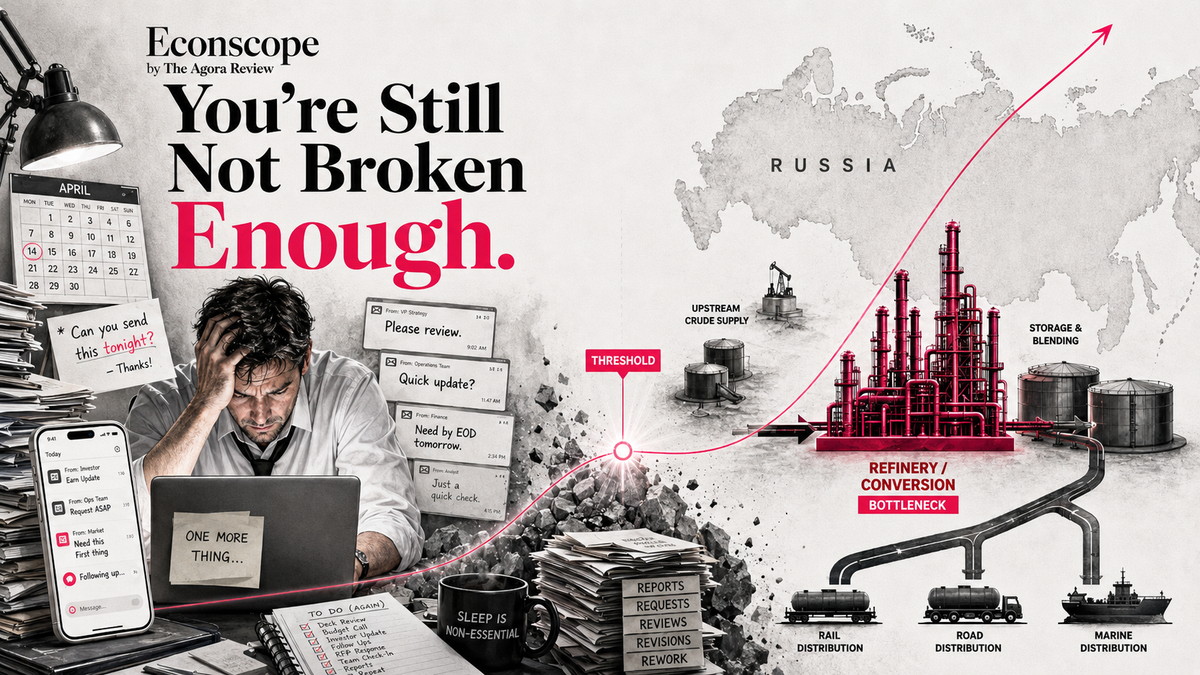
From bad workplaces to Russia’s fuel crisis, why systems absorb pressure until one more shock turns endurance into revolt
Have you noticed how long people can remain inside systems that are already costing them something?
Smaller problems can be harder to solve because they do not always become large enough to justify the cost of solving them.
A bad workplace rarely announces itself as a crisis. More often, it becomes visible through a series of accommodations that seem reasonable in isolation: the message answered after dinner, the deadline accepted because challenging it would take more energy than meeting it, the meeting endured while tired, the moment of disrespect filed away because naming it would make the day heavier than simply moving on. The person adapts, and because adaptation produces output, the system mistakes endurance for stability.
That is how many bad environments survive. They do not need loyalty, belief, or enthusiasm. They only need the people inside them to remain functional long enough for the next demand to be made.
At first, this functionality can look almost indistinguishable from maturity. The person who stays calm seems professional. The person who absorbs ambiguity seems resilient. The person who keeps rescuing the process seems reliable. Over time, the organization learns to depend on the very traits it is draining: patience, judgment, conscientiousness, fear of letting others down, and the quiet hope that the next cycle will finally restore fairness.
The pressure builds in small increments. One late-night request becomes normal once it is answered. One careless message becomes part of the tone once it is absorbed. One unreasonable deadline becomes “just this week” once everyone reorganizes around it. A small humiliation becomes too minor to name without sounding dramatic, although its repetition slowly changes the way someone feels before opening an inbox.
The person adapts because every alternative carries a cost. Leaving has a cost. Confronting has a cost. Escalating has a cost. Refusing has a cost. Even telling the truth has a cost when the system has been quietly rewarding silence.
So the person waits, and the waiting begins to look like patience.
They wait through the next request, the next meeting, the next promise, the next cycle, the next moment when they are asked to be flexible by people who have made flexibility a one-way obligation. They may even tell themselves that patience is maturity, that the situation is temporary, that the next decision will correct the last one, that the system will eventually recognize what it has been consuming.
Then something happens that may look small from the outside.
It might be a sentence in a meeting, delivered with the harmlessness of ordinary managerial language. It might be an email written with the casual entitlement of someone who assumes your time is permanently available. It might be another task added without any memory of the previous ten. It might be a decision that confirms what the person had been trying not to believe.
Observers may ask why this moment mattered so much. Why now? Why this email? Why this sentence? Why this request, after so many larger things had already been tolerated?
Because the final event is rarely the full cause. It is the moment that changes the meaning of everything before it.
The late nights stop looking like commitment and start looking like extraction. The patience stops looking strategic and starts looking wasted. The promises stop sounding delayed and start sounding hollow. The person reacts to the latest incident, but what really changes is their interpretation of the entire pattern.
That is when endurance turns into revolt.
In ordinary language, we call this “having enough.” Economics describes a similar shape with colder terms: thresholds, fixed adjustment costs, inaction bands, bottlenecks, S-curves, and nonlinear change. Psychology has its own vocabulary for accumulated stress and delayed response. The labels differ, but the pattern is familiar: systems do not always respond smoothly to pressure. They absorb it, normalize it, reroute it, and hide it inside whatever still works.
Then one more shock arrives, and behavior changes quickly.
🔽 Click to Expand: Why bad situations can last longer than worse ones
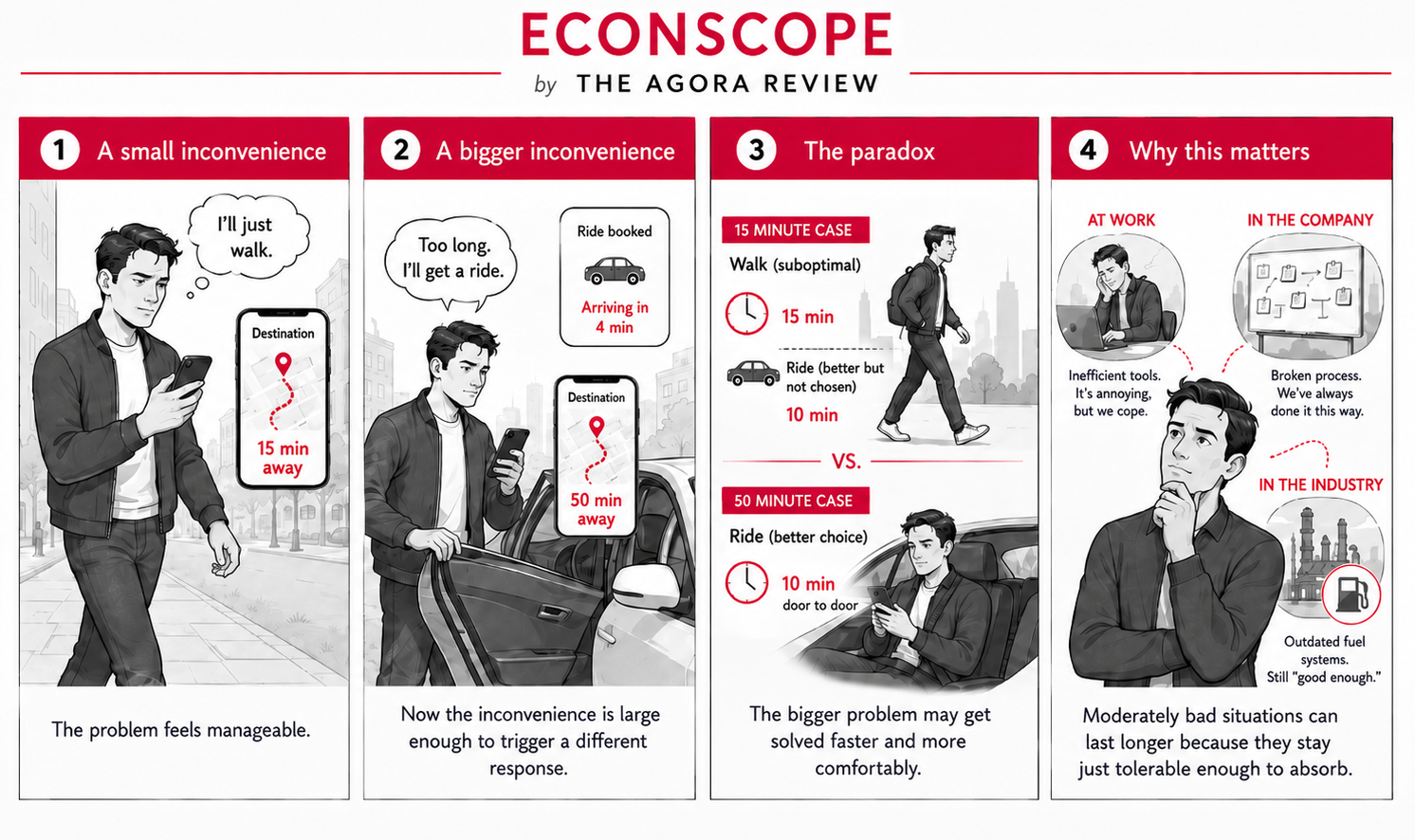
A useful psychological starting point is the region-beta paradox, developed by Daniel Gilbert and coauthors in their 2004 paper, “The Peculiar Longevity of Things Not So Bad”. Their insight helps explain why the fifteen-minute walk can survive while the fifty-minute walk gets solved. The worse situation triggers a stronger response. The moderately bad situation lingers because it remains just tolerable enough to absorb.
That idea travels well into economics.
Economists have long studied situations where action does not happen continuously, even when conditions are deteriorating. If adjustment carries a fixed cost, people and organizations often tolerate discomfort until the benefit of changing course finally exceeds the cost of action. This is the logic of an inaction band.
Eytan Sheshinski and Yoram Weiss explored fixed costs of price adjustment in their classic work on inflation and menu costs. Giuseppe Bertola and Ricardo Caballero developed related models of kinked adjustment costs and aggregate dynamics. Ricardo Caballero and Eduardo Engel later showed how lumpy micro-level decisions can create nonlinear aggregate patterns in investment dynamics. Avinash Dixit and Robert Pindyck gave the investment version of the same intuition in Investment Under Uncertainty: when action is costly and uncertainty remains high, waiting itself can have value.
This explains why “not yet” can become so powerful.
A person may know a job is bad and still delay leaving. A company may know a process is broken and still delay restructuring. A government may know a system is under strain and still delay emergency action. The problem is already real, but the threshold for decisive change has not yet been crossed.
The result is a long period of visible endurance followed by what looks like a sudden break.
The most important part of a tipping point is usually the part nobody sees.
By the time a worker finally refuses, the exhaustion has often been developing for months. By the time a company admits that its operating model is broken, the workarounds have often become so familiar that people mistake them for process. By the time a supply chain becomes fragile, its weak points have often been carrying pressure quietly for a long time. By the time a political system loses trust, the public has usually spent years collecting small reasons to believe that the rules no longer work as advertised.
The visible moment arrives late because the system has been spending hidden buffers.
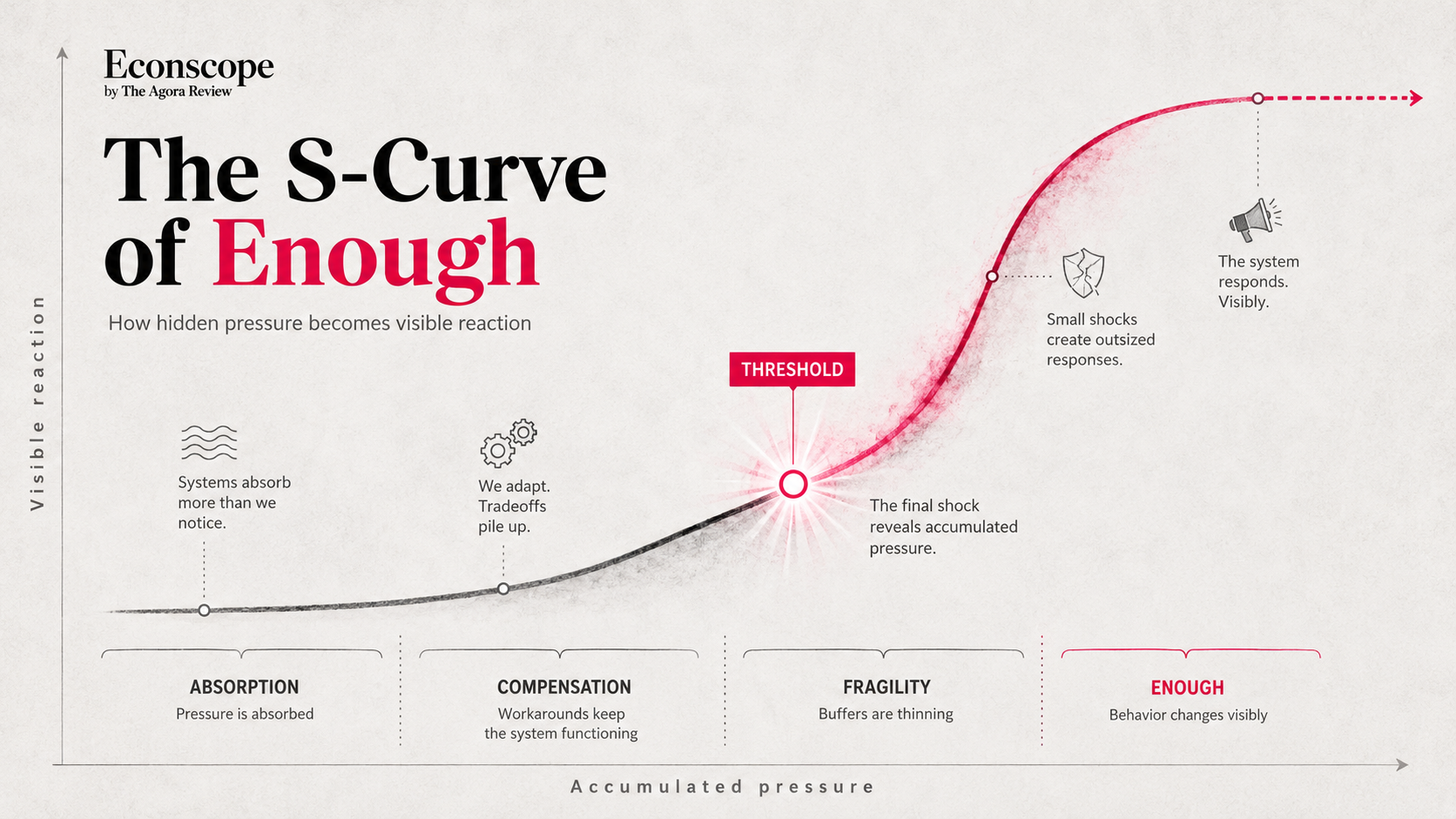
In a workplace, those buffers may be attention, dignity, trust, goodwill, stamina, or belief that the system will eventually correct itself. As long as those buffers remain, the person keeps functioning. They may be tired, disappointed, or angry, but they continue to translate those feelings into professional behavior. Their output gives the system evidence that the arrangement can continue, even when the emotional and cognitive basis of that output is already deteriorating.
This is why functionality can become so misleading. Managers often confuse output with health, organizations confuse silence with consent, and systems confuse adaptation with loyalty. As long as the work continues, they assume the underlying arrangement can continue too. The deeper change comes when a person loses belief that the system is capable of fairness or repair.
At that point, the scarce resource is no longer time. It is cooperation. And once cooperation becomes scarce, the whole system changes.
🔽 Click to Expand: Why change can look sudden even when it has been building for years
The S-curve is one of the simplest ways to understand delayed visible change.
In diffusion research, the S-curve describes a process that starts slowly, accelerates through the middle phase, and then stabilizes. Frank Bass formalized this logic in his 1969 model of new product growth, “A New Product Growth for Model Consumer Durables”. Everett Rogers popularized the broader study of staged adoption and critical mass through Diffusion of Innovations.
The same shape appears in many systems because early pressure often disappears into buffers. Later pressure produces a larger response because those buffers have thinned.
I used a similar S-curve logic in an earlier Econscope by The Agora Review article on humanitarian aid, where the question was how pressure can remain stabilizing for a long time and then suddenly become counterproductive once it crosses a threshold. In that case, the curve described the “Aid Overshoot Paradox”: below the threshold, aid and pressure can sustain dependence; above it, the mechanism can invert and produce legitimacy for the very actor it was meant to contain.
W. Brian Arthur’s work on increasing returns, especially “Competing Technologies, Increasing Returns, and Lock-In by Historical Events”, shows how systems can become self-reinforcing once a path gains momentum. Paul David’s work on path dependence explains why past choices can shape present constraints long after the original conditions have changed.
That is why the final event often receives too much credit. It is visible, memorable, and easy to narrate. But the system had already been moving along the curve.
The last shock matters because the system was already close to its threshold.
A bad workplace usually pretends that the constraint is workload. There are too many tasks, too many meetings, too many messages, and too many requests that arrive wrapped in urgency. On the surface, the problem looks like time management. The employee needs to prioritize better, communicate earlier, manage expectations, become more resilient, or find a better way to handle ambiguity.
Yet time is often only the surface constraint. Beneath it sits something more fragile: trust, dignity, stamina, and the belief that effort still has a reasonable relationship to reward.
A person can keep working after losing sleep because exhaustion can be managed for a while. They can keep working after losing enthusiasm because professionalism can outlive excitement. They can even keep working after losing patience because most people know how to behave politely long after they have stopped feeling generous. The deeper change comes when they stop believing that the system will correct itself.
That is when cooperation becomes the bottleneck.
The employee may still have talent, discipline, institutional knowledge, and the technical ability to do the work. But the limiting input has moved. The question is no longer whether they can keep producing. The question is whether they are still willing to protect the system from the consequences of its own design.
This is the part of tipping points that bad systems understand too late. They assume that because someone can keep functioning, the system still has spare room. They continue consuming the hidden buffer because the visible machine still runs. Then the buffer is gone, and the person who always translated chaos into order begins to let the chaos show.
That shift may look emotional. It is also economic.
A scarce input has been exhausted.
🔽 Click to Expand: Bottlenecks, supply chains, and why abundance can still fail
The best economic lens for Russia’s fuel problem is bottleneck production.
In fixed-proportion production models associated with Wassily Leontief, output is limited by the scarcest essential input. Extra abundance in one input cannot compensate for the missing bottleneck. A car factory with plenty of steel cannot ship cars if a critical chip is missing. An oil producer with ample crude cannot satisfy gasoline demand if refining, blending, or distribution capacity is impaired.
The general idea is explained in this overview of the fixed-coefficients production function. Modern network economics develops the same logic in more sophisticated form. Matthew Elliott, Benjamin Golub, and Matthew Leduc analyze how production networks can become fragile when firms depend on essential inputs in “Supply Network Formation and Fragility”. The BIS discusses how supply-chain disruptions can amplify through the economy in “Global supply chain disruptions: evolution, impact, outlook”. The OECD’s Supply Chain Resilience Review develops the policy version of the same concern.
Russia’s fuel problem fits this logic because crude oil is only one stage of the system. The useful output is not crude in the abstract. It is gasoline, diesel, jet fuel, and other products delivered to the places that need them.
Once the constrained stage sits downstream, upstream abundance becomes less reassuring.
In a workplace, the hidden buffers are human: patience, trust, sleep, pride, attention, the willingness to keep translating pressure into output. A person can keep functioning long after those reserves have started to thin, because the visible work still gets done. The system looks stable because someone inside it is quietly absorbing the cost.
The same logic applies when the system is larger, colder, and made of infrastructure rather than emotion. A war economy has buffers too. They are less intimate, but they serve the same function. Inventories absorb shortages. Spare refining capacity absorbs outages. Repair crews absorb damage. Rail routes and ports absorb rerouting. Export controls absorb domestic pressure. Political authority absorbs the conflict over who gets supplied first.
Russia’s fuel crisis belongs in that family of stories. Russia remains one of the world’s major oil powers. The U.S. Energy Information Administration describes a vast system: 9.2 million barrels per day of crude oil production in 2024 and major refining plants across Omsk, Kirishi, Ryazan, Nizhny Novgorod, Yaroslavl, Moscow, Tuapse, Angarsk, and Komsomolsk. [EIA]
The pressure point sits downstream from that abundance. Oil has to become gasoline, diesel, jet fuel, lubricants, and delivered supply. It has to move through refineries, blending systems, storage tanks, rail links, trucks, ports, spare parts, repair schedules, and regional distribution networks. A broad resource has to pass through narrow systems before it becomes usable power.
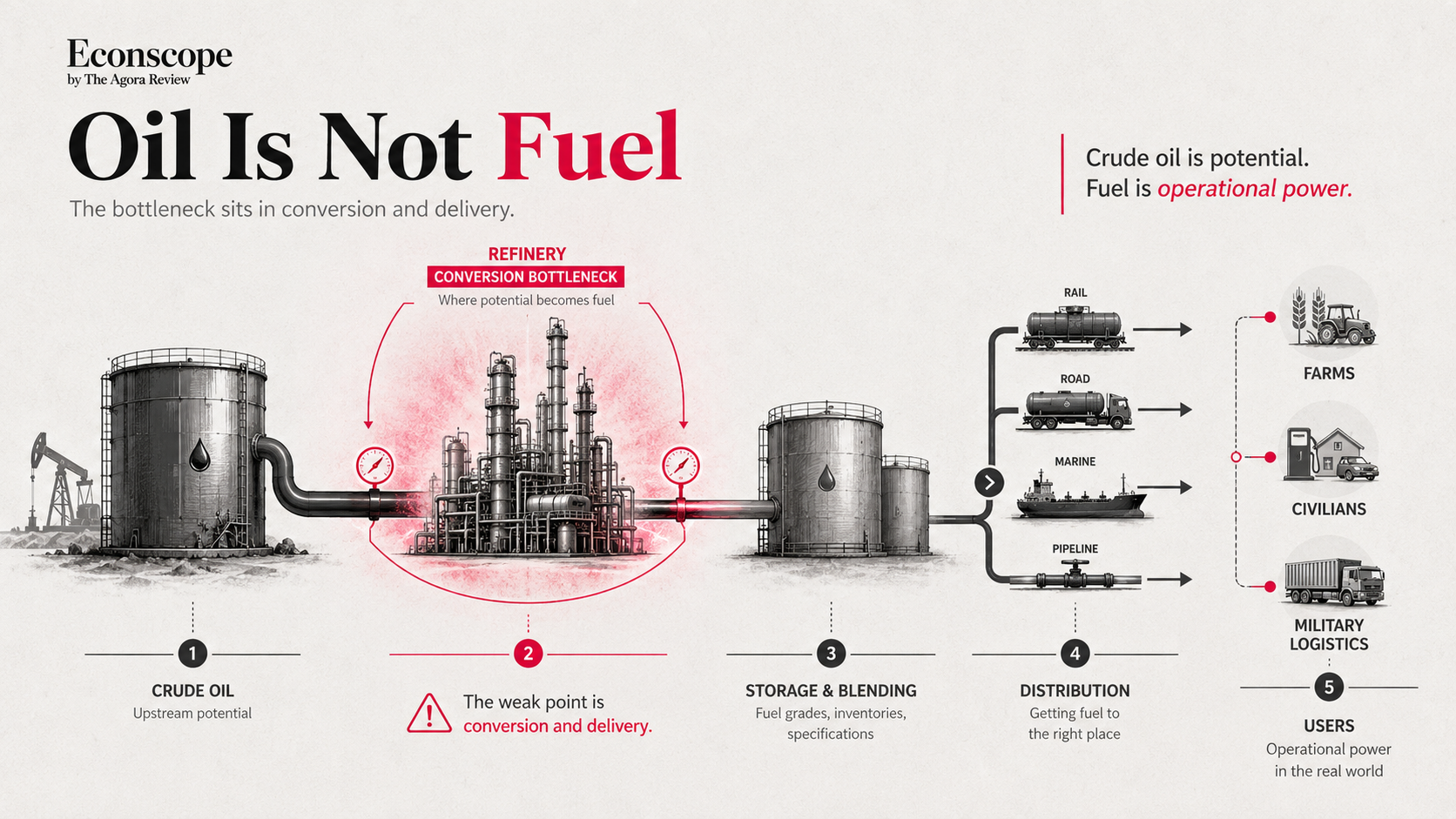
Ukraine’s refinery campaign presses on those narrow systems. The Baker Institute describes Ukraine’s strikes as an effects-based campaign across Russia’s energy value chain, including refineries, pumping stations, storage sites, loading ports, and other infrastructure that turns energy resources into revenue and usable capacity. [Baker Institute]
This is where the S-curve becomes concrete. In the early phase, damage can disappear into buffers. A refinery unit is hit. Repairs begin. Inventories are drawn down. Exports are adjusted. Officials insist that supply remains manageable. The system takes the hit, while its visible behavior changes only slightly.
That was still partly true in 2024. Reuters reported that Ukrainian drone attacks had idled almost 14% of Russia’s refining capacity by the end of March, while Russia restored some damaged capacity quickly enough to bring the idled share down to roughly 10% by mid-April. [Reuters] The damage was real, but repair capacity, rerouting, inventories, and slack kept much of the pressure below the surface.
The curve steepens when the same kind of pressure stops vanishing into the system and starts changing behavior. By 2026, the strike pattern had become broader and more repeated. Reuters reported that Ukraine had doubled the number of Russian refineries targeted since the start of the year, with attacks also affecting pipelines and storage facilities. It calculated that about 700,000 barrels per day of refining capacity had been hit between January and May across 16 refineries, with affected primary refining capacity reaching nearly or above 1 million barrels per day in March and April. [Reuters]
Then the pressure moved from damaged infrastructure into public management. Reuters reported regional fuel-sale restrictions and queues as Ukrainian strikes disrupted supply. [Reuters] It reported that Russia was preparing rare gasoline imports by sea as shortages loomed. [Reuters] It also reported talks with Kazakhstan for about 50,000 metric tons of AI-92 gasoline to ease shortages. [Reuters]
The clearest signal came when damage became allocation. Reuters reported that Russia’s parliament approved fuel-market measures including import subsidies, looser fuel-quality rules, and delays to refinery modernization work, while gasoline output had fallen to around 90,000 metric tons per day, about 25% below the June 2025 daily average. [Reuters] Days later, Putin publicly acknowledged shortages, queues at gas stations, regional supply problems, and the need for a round-the-clock task force to manage fuel availability, especially for agriculture. [Reuters]
Vladimir Putin said Russia was ready for peace talks with Ukraine
after strikes on its infrastructure had led to fuel shortages, with Russian regions also facing fuel-sale restrictions, rising oil-product prices, and queues at filling stations. [Sky News]
That is the strategic meaning of the fuel crisis. Ukraine does not have to make Russia run out of oil for the strikes to matter. It has to make Russia spend more effort turning oil into usable power or fuels for the military, farmers and civilians.
Export markets generate revenue. Refineries need repair. Logistics need rerouting. Once those claims compete more visibly, Russia’s energy advantage becomes less automatic and more administrative. This is the S-curve in practice: damage is absorbed, then compensated for, then converted into visible choices. Before the threshold, the system keeps functioning. After the threshold, the state has to decide who gets priority.
Russia is still powerful, still producing crude, still repairing infrastructure, and still capable of directing fuel toward selected uses. The change is more precise than collapse. Ukraine is pushing a resource-rich state toward the point where abundance has to pass through damaged, defended, and politically managed infrastructure before it becomes power.
In war, strength is what a state can convert, deliver, and sustain under pressure.
🔽 Click to Expand: Oil is not fuel
Oil and fuel belong to the same energy system, but they play different economic roles.
Crude oil is extracted. Fuel is manufactured.
The U.S. Energy Information Administration’s Russia country analysis shows Russia’s continuing importance as a major oil producer, while its refinery data highlight the large industrial network needed to turn crude into usable products. Bruegel’s Russian crude oil tracker gives a useful prewar baseline for Russia’s refining and product-export system. The Oxford Institute for Energy Studies explains the refinery vulnerability more directly in Russian Oil Refining: In the Crosshairs.
The distinction matters because crude abundance does not automatically solve downstream scarcity. Gasoline, diesel, jet fuel, and other refined products require functioning refineries, blending capacity, storage, transport, and regional distribution.
If one of those stages is damaged or congested, the whole system can become constrained even while crude output remains large.
In bottleneck terms, the abundant input does not control the final output. The scarce essential stage does.
Ukraine’s refinery campaign is often described as a sequence of strikes: one facility hit, another fire reported, one unit repaired, another plant taken offline. That event-level view is useful, but it misses the larger economic logic of the campaign.
This is a war on throughput.
Refineries matter because they convert crude into usable products. Storage and blending sites matter because fuels must meet specifications and move through inventories. Ports, pumping stations, depots, rail links, and logistics nodes matter because a refined product that cannot reach the user remains an accounting figure rather than operational power.
The campaign matters because it attacks the chain between possession and use.
That is also why the visible signs matter so much. A refinery strike is damage. A queue, an import discussion, an export control, a blending compromise, or an emergency task force shows something more advanced: the system has begun to change its behavior around the constraint.
Tipping points become visible when pressure changes behavior.
🔽 Click to Expand: The Russia evidence
The strongest evidence supports a constraint story rather than a collapse story.
Reuters reported on June 28, 2026 that Putin acknowledged fuel shortages, queues at gas stations, regional supply problems, and the creation of a task force to manage supplies: Reuters, June 28, 2026. AP reported the same broad acknowledgment of a fuel deficit and additional Ukrainian strikes on Russian oil infrastructure: Associated Press, June 28, 2026. The Financial Times also covered Putin’s admission of shortages as Ukrainian drones struck refineries: Financial Times, June 28, 2026.
Reuters had already reported Russia preparing gasoline imports by sea as shortages loomed: Reuters, June 17, 2026. It also reported talks with Kazakhstan for gasoline supply: Reuters, June 24, 2026. Russian tax changes to address shortages, including lower-quality blending and import subsidies, were reported here: Reuters, June 24, 2026.
On infrastructure damage, Reuters reported a drone strike affecting the Moscow refinery: Reuters, June 16, 2026, and later reported that the Moscow refinery was unlikely to resume production that year: Reuters, June 24, 2026. Reuters also reported NORSI’s suspension after a drone attack: Reuters, June 25, 2026, and tracked Ukraine’s wider campaign against Russian energy sites: Reuters, updated June 26, 2026.
The best interpretation is not that Russia has run out of fuel everywhere. The evidence points to regional shortages, product stress, refining disruption, forced policy responses, and visible allocation problems.
That is already strategically meaningful.
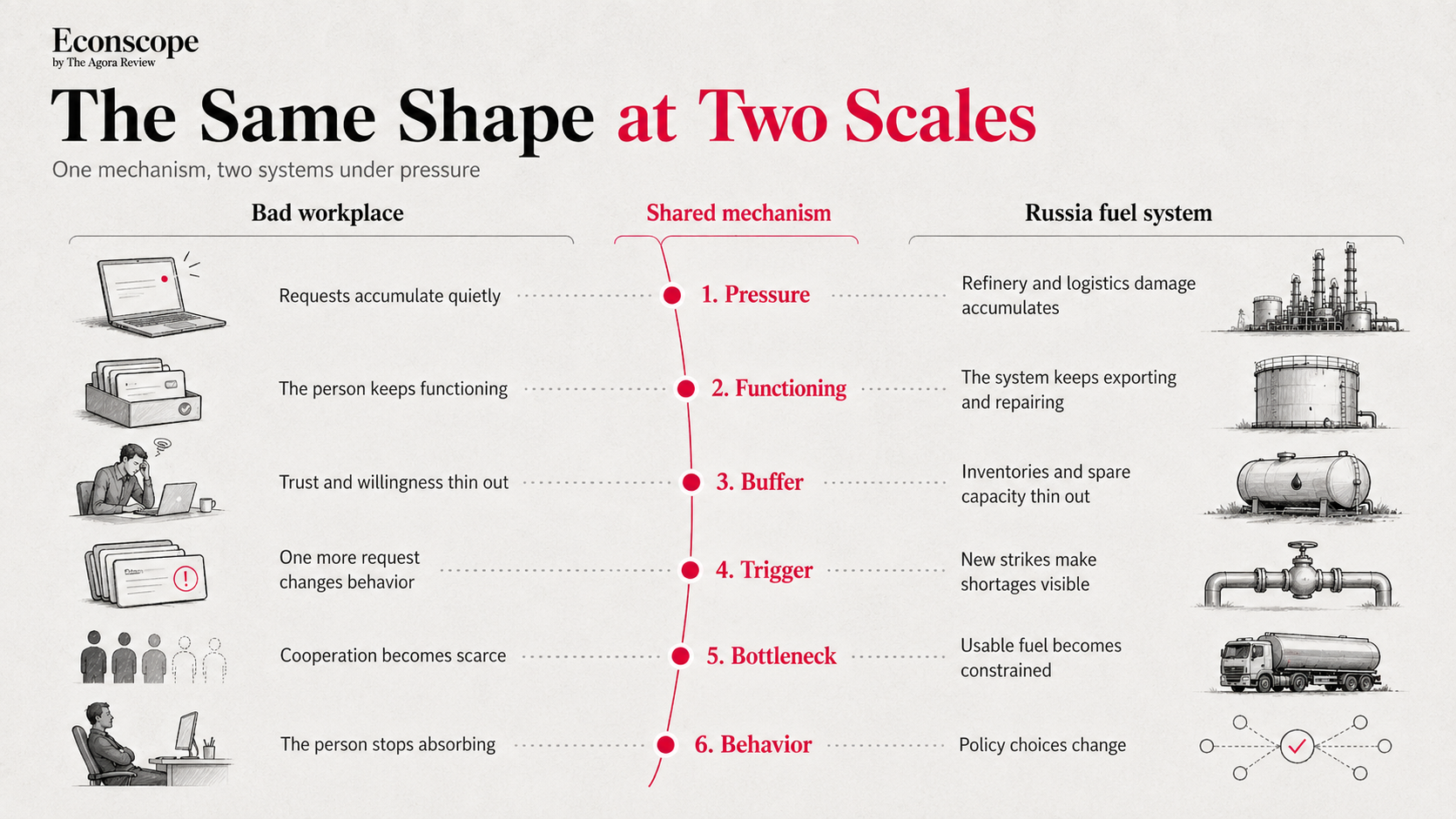
A system can keep moving long after the cost of movement has changed. In a workplace, that cost is carried by the person who keeps answering, smoothing, staying late, absorbing the mood, and turning pressure into output. In a war economy, the same hidden work is done by inventories, repair crews, spare units, rail schedules, export restrictions, emergency rules, and political authority. They allow the system to look continuous while the machinery underneath begins to run hotter.
Russia’s fuel pressure begins with a distinction that ordinary oil headlines often blur. Russia remains one of the world’s largest crude producers. The U.S. Energy Information Administration described it as the world’s second-highest producer of crude oil and condensate in 2023, and reported crude oil production of 9.2 million barrels per day in 2024. (EIA) Yet oil in the ground, or crude moving through export channels, is only potential. For energy to become power, crude has to pass through refineries, blending systems, storage tanks, rail links, trucks, ports, spare parts, repair schedules, and regional distribution networks.
That passage from resource to use is where Ukraine has been applying pressure. The Baker Institute describes Ukraine’s campaign as an effects-based approach across Russia’s energy value chain, including upstream production assets, pipeline pumping stations, power plants and substations, storage sites, loading ports such as Novorossiysk, and especially refineries. (Baker Institute) The target is larger than one refinery tower or one fire on a map. It is the chain that turns Russian energy into revenue, movement, and usable fuel.
At first, that kind of pressure can disappear into the system. A damaged refinery unit is repaired. Inventories are drawn down. Exports are adjusted. Fuel is rerouted. Officials reassure the public. The visible system keeps moving, so the damage still looks manageable.
That was the early shape of the curve. In April 2024, Reuters reported that Russia had been able to repair some key refineries hit by Ukrainian drones, reducing idled capacity to about 10% from almost 14% at the end of March. (Reuters) The pressure was real, but the system still had enough slack to absorb much of it.
The curve steepens when repetition starts to change behavior. By May 2026, Reuters reported that Ukraine had doubled the number of Russian oil refineries targeted since the start of the year, with attacks cutting Russian oil output, pressuring the budget, and hitting about 700,000 barrels per day of refining capacity between January and May. (Reuters) At that point, the story had moved beyond isolated damage. The same system that had repaired, rerouted, and absorbed now had to manage a more persistent squeeze.
The signs appeared in ordinary public life. Reuters reported that Russian regions had begun restricting fuel sales, citing shortages of certain gasoline and diesel grades and long queues at filling stations as Ukrainian attacks disrupted supply. The restrictions reached central Russia, the south and west, Crimea and Sevastopol, the Volga region, Siberia, and the Far East. In Irkutsk, officials moved toward manual distribution that prioritized emergency services, public transport, municipal utilities, and agriculture. (Reuters)
The signs also appeared in policy. Russia’s parliament approved tax-code changes aimed at growing fuel shortages, including subsidies for fuel imports and permission to use lower-quality fuel in blending. Reuters also reported that gasoline output had fallen to around 90,000 metric tons per day, about 25% below the June 2025 daily average, while seaborne oil-product exports were down about 15% in the first half of June compared with the first half of May. (Reuters) Days later, Putin publicly acknowledged shortages, queues at gas stations, regional supply problems, and a round-the-clock task force to manage fuel supplies, with agriculture singled out as a priority. (Reuters)
This is the moment when damage becomes allocation.
A refinery strike is damage. A queue is allocation. A fuel-import subsidy is allocation. Lower-quality blending is allocation. A diesel export-ban discussion is allocation. A task force for agricultural fuel is allocation. Each measure may be practical on its own. Together, they show a state deciding how to spread constraint across regions, sectors, exports, farms, civilians, and the war machine.
Ukraine’s leverage lies in making Russian abundance less automatic. It does not have to make Russia empty of oil for the campaign to matter. It has to make each unit of usable fuel require more protection, repair, rerouting, compromise, and political management before it reaches the place where it is needed.
That is a change in power. A state remains strong when its resources move smoothly from possession to use. It becomes constrained when more of its strength has to be spent keeping that movement ordinary.
In war, power is what a state can convert, deliver, and sustain under pressure.
What breaks first is the slack
This is the same curve seen from another distance.
At the human level, the hidden buffer may be willingness.
A person keeps producing because professionalism can outlast belief, because habit can outlast fairness, and because the cost of refusing still feels higher than the cost of enduring. The outside world sees output and calls the system stable.
At the level of a company, the hidden buffer may be coordination.
People invent workarounds, repair broken processes by hand, translate confusion into deliverables, and protect the organization from the consequences of its own design. The company keeps moving, although motion has slowly replaced health.
At the level of a war economy, the hidden buffer may be inventories, spare refining capacity, repair crews, logistics, administrative control, and public tolerance.
A country can keep exporting crude while its fuel system becomes more strained, because aggregate strength can hide a downstream bottleneck until that bottleneck changes behavior.
This is why tipping points are so often misread. The eye goes to the visible moment: the final email, the final insult, the refinery outage, the fuel queue, the public admission. Those moments matter, but they arrive after a quieter process has already spent the system’s slack.
The S-curve is the shape of that delayed visibility. The early pressure looks flat because the system is absorbing it. The middle rises quickly because the same pressure now lands on thinner buffers. The new level appears when behavior adjusts around the constraint.
Russia’s fuel crisis sits in that middle movement. The country remains powerful, and it still has crude, refineries, exports, repair capacity, and the ability to direct resources. The change is that more of that power now has to pass through damaged, defended, and politically managed infrastructure before it becomes usable fuel.
A worker who has reached “enough” may still be capable of doing the work. The scarce input has become cooperation.
A state under fuel pressure may still have oil. The scarce input has become smooth conversion.
For a long time, the system can say: not yet. Then the buffer thins, the curve steepens, and not yet becomes enough.