
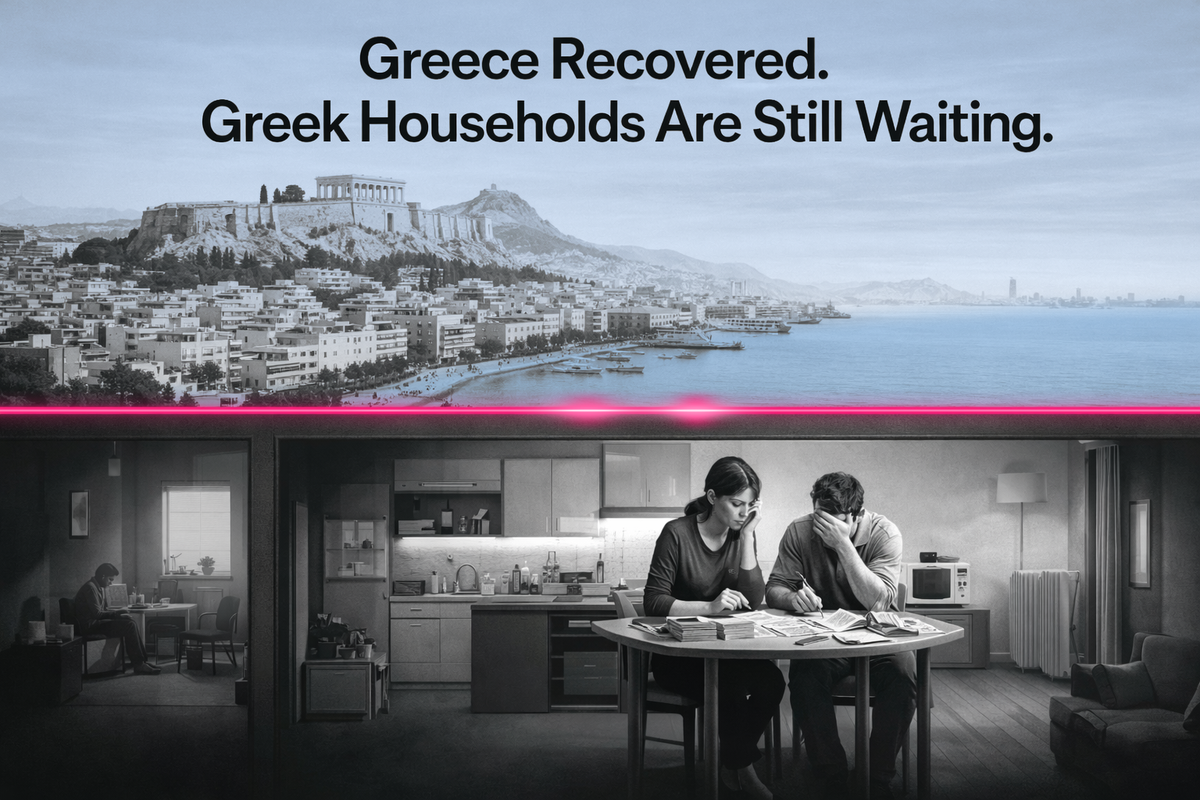
Greece Recovered. Greek Households Are Still Waiting.
Greece’s economy recovered, but Greek households still face weak wages, high housing costs, and a widening prosperity gap.
Prologue
A year ago, I wrote about Greece’s economic paradox in a piece called Decoupling Growth from Prosperity. The argument was already visible then. Growth had returned, the macro indicators were improving, and the lived experience of many households still refused to move in step with the recovery story. Over the past year, that argument only became sharper. Greece kept producing more evidence of recovery at the national level, and more reasons for households to feel that the relief had arrived unevenly, late, or not at all.
Greece is still often described from thirty thousand feet: GDP growth, debt ratios, sovereign upgrades, investor confidence. That story is real. GDP has outperformed the EU average, debt has fallen dramatically from its crisis-era peak, and Greece has regained investment-grade ratings from the major agencies. At the same time, real wages remain about 30 percent below 2009 levels, adjusted disposable income per person remains far below the EU norm, 28.9 percent of households are overburdened by housing costs, and 26.9 percent of the population was at risk of poverty or social exclusion in 2024. Greece moved forward in the aggregate. Many households kept living inside the lag.
The distance between statistical recovery and lived experience.
Above EU average of ~0.9%. Driven by tourism, exports, and private investment.
Eurostat [tec00115], 2024ESM restructuring and primary surpluses driving deleveraging, though still highest in the EU.
Eurostat [gov_10dd_edpt1], 2024Investment grade restored: S&P BBB (Apr 2025), Moody's Baa3 (Mar 2025), Fitch BBB (Nov 2025).
S&P / Moody's / Fitch (2024–25)Net FDI reached €5.2 billion in 2024, reflecting improved sovereign credibility, Hellinikon development, and data center investments.
Bank of Greece / UNCTAD, 2023–24 est.Nominal gains since 2017 largely absorbed by inflation. Gap vs. 2009 peak remains structural.
Eurostat [nama_10_lp_ulc]Household adjusted disposable income in PPS. Greece stands at roughly 65% of the EU average — a widening gap.
Eurostat [tec00113], 2023 est.Share spending >40% of income on housing. Highest in the EU — 3.5× the EU average.
Eurostat EU-SILC [ilc_lvho07a], 2024More than one in four Greeks at risk of poverty or social exclusion. Improvement is marginal.
Eurostat [ilc_peps01n], EU-SILC 2024The Divergence at a Glance
Two economies measured by the same statistics bureau.
Since 2017, Greece's GDP has grown at 2–3% annually. Real wages have recovered less than 5% of their crisis-era losses. The divergence is not a data artifact — it reflects structural choices about who bears the cost of adjustment.
Macro Stability
The numbers that earned applause in Brussels — and obscure the view from Athens.
Annual real GDP growth for 2024, above the EU average of ~0.9%. Driven by tourism receipts, exports, and private investment.
Eurostat [tec00115], annual 2024Down from ~206% peak (2020). ESM restructuring and primary surpluses have accelerated deleveraging, but level remains highest in the EU.
Eurostat [gov_10dd_edpt1], 2024Primary surplus of 2.1% of GDP, exceeding the ESM programme target and enabling gradual spending normalization. Third consecutive surplus.
EC Autumn Forecast 2024 / Bank of GreeceNet FDI reached €5.2 billion in 2024, reflecting improved sovereign credibility, Hellinikon development, and data center investments. Still below pre-crisis FDI potential.
Bank of Greece / UNCTAD, 2023–24 est.10-year sovereign spread versus German Bund has narrowed to approximately 120 basis points, reflecting improved creditworthiness and ECB backstop expectations.
ECB / Bloomberg, 2024–25Household Prosperity
What recovery looks like when wages haven't moved and rents have doubled.
Real wages remain approximately 30% below their 2009 pre-crisis peak. Nominal wage growth since 2017 has been largely absorbed by inflation.
Eurostat [nama_10_lp_ulc], index 2015=100Household adjusted disposable income per capita in purchasing power standards. Greece stands at roughly 65% of the EU average — a widening gap.
Eurostat [tec00113], 2023 est. / [nasa_10_nf_tr]Share of population spending more than 40% of disposable income on housing costs. Greece's rate is 3.5× the EU average — highest in the EU-27.
Eurostat EU-SILC [ilc_lvho07a], 2024Income inequality index. Greece sits above the EU mean with no meaningful improvement trend. The crisis compressed the distribution via across-the-board cuts; recovery has not rebalanced it.
Eurostat [ilc_di12], EU-SILC 2023More than one in four people at risk of poverty or social exclusion. This rate has barely moved in five years despite GDP growth, highlighting the distributional failure of the recovery.
Eurostat [ilc_peps01n], EU-SILC 2023Labor Market
Unemployment is falling. Quality of work is a separate question entirely.
General unemployment rate, down from a 27.5% peak in 2013. Improvement reflects tourism-led demand and services expansion, though still above EU avg of ~6%.
Eurostat [une_rt_m], harmonized, 2025Youth unemployment remains well above the EU average, reflecting skills mismatch, brain drain, and a segmented labour market with limited entry points.
FRED [SLUEM1524ZSGRC] / ILO estimate, 2025Share of employed persons working part-time against their preference. Above the EU average (3.2%), indicating a persistent quality-of-employment gap.
Eurostat [lfsa_eppgai], 2023Estimated net emigration of skilled workers aged 25–44. Germany, UK, and Australia are primary destinations. The departure of educated labour constrains long-run productivity.
Bank of Greece estimates / academic literatureEmployment rate for the core working-age population, approaching but still below the EU-27 average of ~76%. Gap reflects structural features: low female participation, weak services sector.
Eurostat [lfst_r_lfe2emprt], 2024Affordability
Housing and energy costs have diverged sharply from wage growth, compressing household budgets.
Harmonized consumer price inflation. Eased from 2022 peak but accumulated price level remains elevated relative to stagnant wages.
Eurostat [prc_hicp_manr], 2024 annualPrice level of household final consumption expenditure relative to EU average. Greeks face near-EU prices on far-below-EU wages — a core affordability paradox.
Eurostat [prc_ppp_ind], 2023Residential property prices continue sustained annual increases. Athens prices have more than doubled since 2017 trough, driven by Airbnb, FDI, and Golden Visa demand.
Bank of Greece RPPI, full-year 2024When food prices are adjusted for disposable income, Greece ranks among the top four OECD economies for food cost burden — reflecting the wage-price mismatch.
OECD / EconScope analysisHousehold electricity prices remain above the EU median despite market reforms. Energy poverty affects an estimated 17–20% of households, concentrated in northern regions and islands.
Eurostat [nrg_pc_204]Regional Balance
Recovery is geographically concentrated. Beyond Attica and the islands, little has changed.
Attica (Greater Athens) accounts for 48.8% of national GDP (€95.8B of €196B) while comprising ~35% of population. This concentration exceeds Paris's share of French GDP.
ELSTAT Regional Accounts 2023 / Eurostat [nama_10r_2gdp]Greece ranks 9th highest in regional economic disparities among 30 advanced economies. Recovery has sharpened rather than reduced this dispersion.
OECD Regional Statistics / Eurostat [nama_10r_2gdp]S. Aegean (€5.7B), Attica (€4.8B), Crete (€4.6B), Ionian Islands (€2.0B), C. Macedonia (€1.5B). Total tourism receipts €21.6B (2024).
Bank of Greece tourism statistics, 2024Highest dependency ratio among major Greek islands. 2.5M overnight visitors + 800K day-trippers in 2024. One poor season can trigger acute local recession.
Destination management reports / GTP, 2024Most island economies experience 60–70% employment seasonality. Off-season unemployment dramatically exceeds mainland rates. Year-round job creation remains minimal.
ELSTAT Labour Force Survey / EconScope analysisThe island economy is Greece's most visible success story and its deepest structural vulnerability. Tourism receipts reach €21.6 billion (2024), but the concentration in five regions and extreme seasonal dependency create a fragile prosperity that a single bad summer — pandemic, geopolitical shock, or climate event — can reverse overnight.
Structural Transformation
Tourism is not a development strategy. The diversification gap is growing wider, not narrower.
R&D spending rose to 1.54% of GDP in 2024 (€3.66B), up from 0.9% in 2013. Still roughly half the EU target of 3%. Business R&D particularly weak at 0.5% of GDP.
EKT (National Documentation Centre), preliminary 2024Tourism's direct contribution: €30.2B (12.7% of GDP). Including indirect and induced effects: 28–34% of GDP. One in five jobs is tourism-dependent.
WTTC Economic Impact Report 2024EC Digital Economy and Society Index. Particular weakness in digital skills integration (rank 25) and ICT specialists in workforce (1.8% vs EU avg 4.5%).
European Commission DESI 2024Export basket dominated by petroleum products, olive oil, aluminium, and tourism services. High-tech export share (4.2%) is among the lowest in the EU-27.
Atlas of Economic Complexity / Eurostat ComextThe Greek economy's structural profile in 2025 is not materially different from 2007. Tourism receipts have replaced construction as the demand driver, but the underlying productivity challenge — low R&D, weak digital integration, modest export complexity — persists. Recovery Fund programmes offer a window, but absorption rates suggest the window may not be fully used.
What It Measures
The Prosperity Gap Score (PGS) measures the divergence between Greece's macroeconomic recovery and household wellbeing. It is not a recovery meter or a prosperity attainment score — it captures how far apart the two dimensions have moved.
Formula
PGS = MRI − HWI
The Macro Recovery Index (MRI) is a weighted composite of: Real GDP Growth (30%), Debt-to-GDP improvement (30%), Net FDI Inflows (20%), and Sovereign Credit Rating trajectory (20%).
The Household Wellbeing Index (HWI) is a weighted composite of: Real Compensation per Employee (30%), Adjusted Disposable Income growth (25%), Housing Overburden Rate — inverted (20%), and At-Risk-of-Poverty Rate — inverted (25%).
Normalization
Each sub-indicator is normalized using min-max scaling on a 0–100 range, anchored to the 2009–present reference period. "Bad when high" indicators (housing overburden, poverty) are inverted before scoring. The PGS itself is the simple arithmetic difference between MRI and HWI — not bounded to any fixed range.
How to Read It
PGS = 0: Macro and household indicators moving in lockstep — no divergence.
PGS > 0: Macro recovery outpacing household wellbeing — the gap is widening.
PGS < 0: Household conditions improving faster than macro indicators — catch-up phase.
Current reading (+24): Moderate divergence. Greece's macro fundamentals have improved significantly more than the lived economic conditions of most households.
The Recovery Is Real
Let’s start with what is true.
Greece’s macroeconomic recovery is real and externally recognized. GDP growth has averaged roughly 2 to 3 percent a year, above the EU average of around 0.9 percent. The debt-to-GDP ratio has fallen from about 206 percent in 2020 to roughly 153.6 percent by the end of 2024. Sovereign credibility has been rebuilt to the point that Greece now carries investment-grade ratings from S&P, Moody’s, and Fitch. After the deepest economic collapse in modern European history, those are serious achievements.
This matters because the Greek story is sometimes told as if the whole recovery were cosmetic. It is not. The country is no longer living inside the emergency logic of the bailout years. Markets know that. Institutions know that. The official data knows that. Greece repaired the macro side of the state more than many people expected it could.
The Household Economy Tells a Harder Story
Now the other truth.
A country can recover on paper faster than it recovers in daily life. Greece is exactly that story.
Average annual salaries stand at roughly €17,000, against an EU average of €37,900. Adjusted disposable income per capita is around €15,500 in purchasing power standards, against an EU average near €24,000. Real wages remain roughly 30 percent below their 2009 level. These are not background details. They tell you how recovery feels once it leaves the bond market and enters the paycheck.
Then comes housing, the part of the story that makes everything immediately concrete. Around 28.9 percent of households spend more than 40 percent of disposable income on housing, against an EU average of 8.2 percent. You do not need a theory to understand what that means. It means the monthly arithmetic still feels punishing in a country that is supposed to be doing better.
Poverty risk completes the picture. In 2024, 26.9 percent of the population was at risk of poverty or social exclusion, compared with 21.0 percent across the EU. More than one in four people still live close enough to economic insecurity that the language of recovery sounds distant, technical, and slightly unreal.
Greece’s Core Problem Is the Distance Between Two Economies
This is the point where the Greek story changes shape.
The problem is no longer simply whether Greece grows. Greece does grow. The problem is the distance between the economy that appears in the headline indicators and the economy that appears in household life. Macro recovery has moved faster than household recovery. Debt improved faster than wages. Sovereign credibility improved faster than affordability. Investor confidence improved faster than everyday confidence.
That distance can now be measured directly. A simple way to think about it is this: compare macro recovery with household wellbeing and ask how far apart they have drifted. Greece currently sits at a level that signals significant divergence. The official recovery is real. The household catch-up is partial. That is the whole argument in one line.
And that is why so many Greeks can look at the same country and see two different realities. One of them is visible in the sovereign narrative. The other is visible in the rent payment.
Housing Turned Recovery Into Pressure
If one theme makes the gap impossible to ignore, it is affordability.
Greeks live with incomes that remain well below the European norm, inside a price environment that often feels much closer to Europe than their wages do. Residential property prices rose by 8.7 percent in 2024. Inflation cooled from the earlier shock years, but the cooling landed on households that were already carrying weak incomes into a more expensive world. The result is not just frustration. It is a structural squeeze.
This is why housing matters so much in the Greek debate. It turns a macroeconomic discussion into something intimate and relentless. It is one thing to hear that spreads have narrowed. It is another to calculate what remains after rent, utilities, and food.
Employment Improved. The Feeling of Security Did Not Recover at the Same Speed.
The labor market has undeniably improved. Unemployment is now around 9 percent, far below the 27.5 percent crisis peak of 2013. That alone marks a major change in the country’s trajectory.
But labor improvement and labor security are not the same thing. Youth unemployment remains around 21 percent. That is still a generational scar. And even where employment has returned, the larger question stays open: what kind of work is the economy producing, how stable is it, how well is it paid, and does it create the conditions for households to feel that life is finally widening again?
That is where the Greek story still feels unfinished. The labor market healed. The social confidence that should follow from a healthier labor market has been slower to arrive.
Athens Is Still Carrying Too Much of the National Story
There is also the geography of recovery.
Attica accounts for about 48.8 percent of national GDP. Nearly half the economy sits in one region. That matters because national averages flatten internal imbalance. Athens is not Greece, even though Greece’s statistics often read as if it were. Growth that concentrates heavily in one part of the country will always feel broader in the spreadsheet than it does on the ground.
This is part of the emotional politics of the recovery as well. People do not live inside national averages. They live in places. Where growth happens matters. Who captures it matters. Whether it spreads matters.
The Structure of Growth Still Decides the Future
Then there is the question underneath everything else: what kind of economy is Greece actually building?
Tourism remains central. Research and development remain weak by European standards. Tourism’s direct contribution to GDP stands at 12.7 percent, while R&D expenditure is 1.54 percent of GDP. Those numbers do not mean Greece failed. They mean the next chapter depends on whether the country can broaden the structure of growth beyond a model that still leans heavily on a narrow set of strengths.
This matters because the composition of growth shapes wages, resilience, productivity, and the kind of social future an economy can support. Stabilization was a huge achievement. It was never going to be the final one.
What the Numbers Add Up To
Put the whole picture together and the conclusion becomes hard to escape.
Greece’s recovery is genuine. Its household catch-up is partial. The distance between those two facts is now large enough to shape politics, trust, and the emotional credibility of public success. This is why so many people can hear that the country is doing better and still feel that the statement belongs to someone else’s life.
That gap is the real national story now. It explains the frustration, the skepticism, the fatigue with upbeat language, the sense that the country improved and ordinary life somehow remained stuck in negotiation with the same pressures.
Epilogue
So the question is no longer whether Greece recovered. It did.
The real question is what kind of recovery it achieved, who absorbed its gains, who kept carrying its costs, and how long a country can live with a widening distance between its statistical narrative and its household experience. That distance is where public trust thins out. That distance is where political anger starts looking reasonable. That distance is where official success begins to sound correct and incomplete at the same time.
Greece’s prosperity gap is no longer a footnote to the recovery story. It is the recovery story.