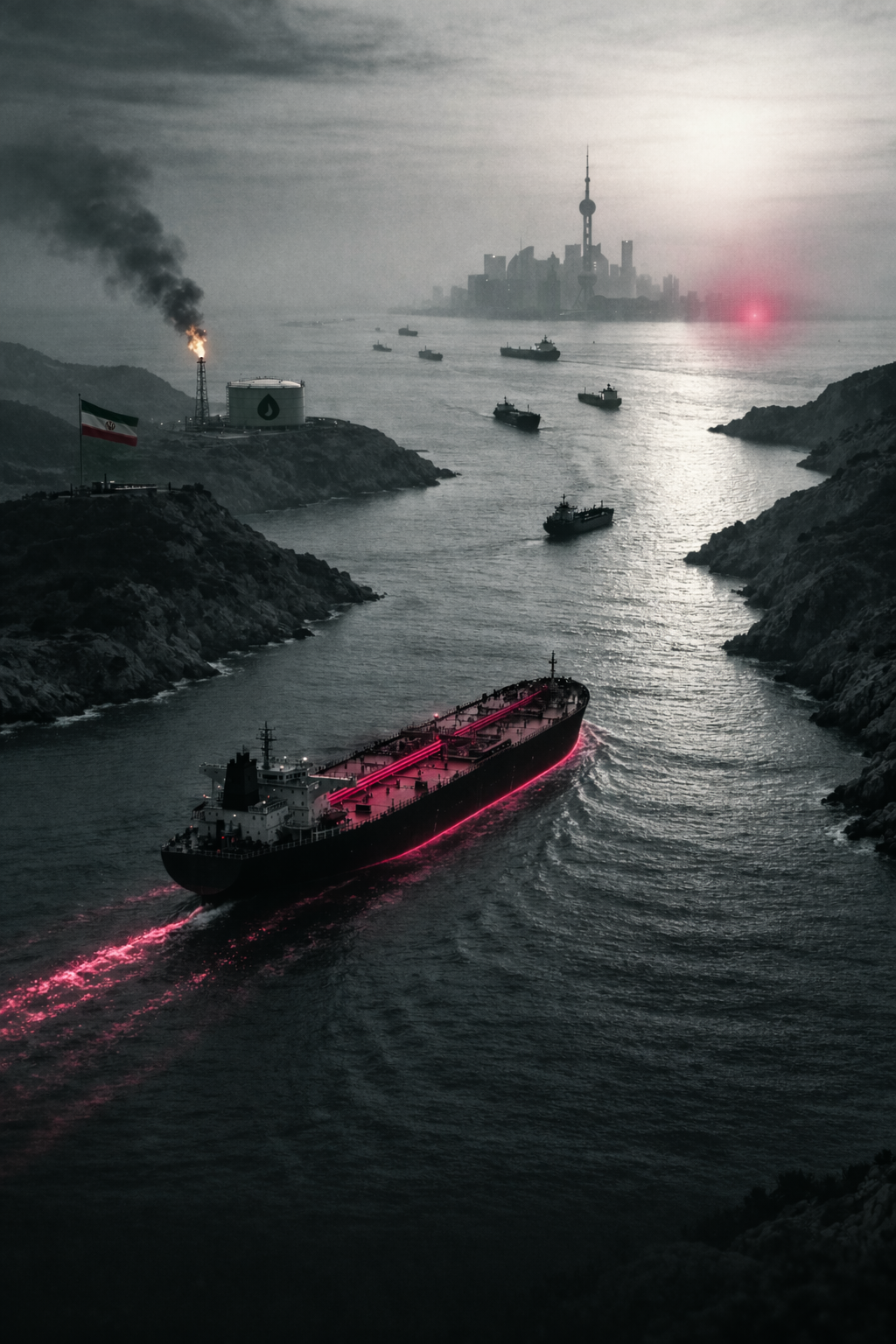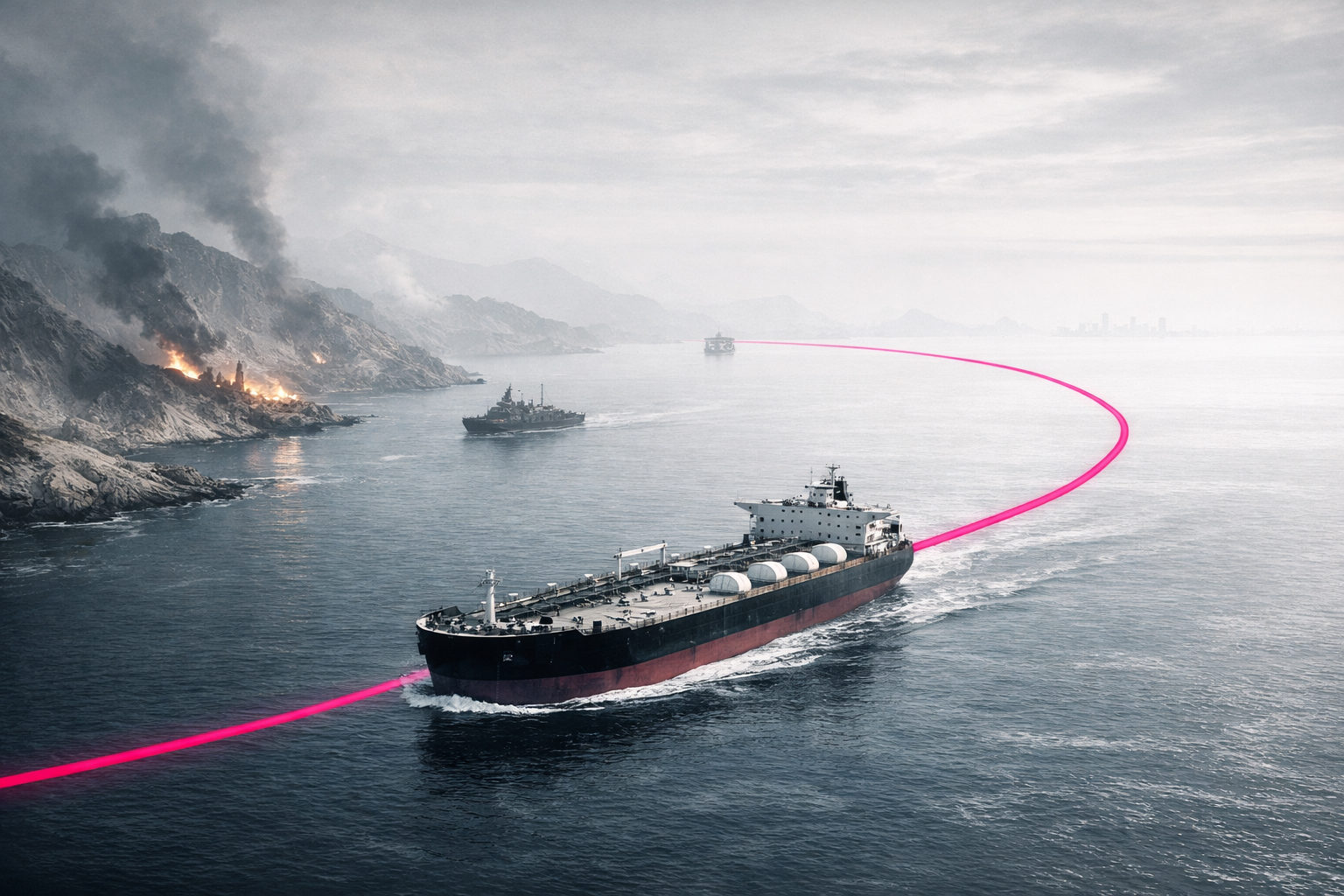
The Hidden China Front in the War on Iran
Iran is not a pillar of Chinese power, but it is useful enough to Beijing that war on Iran can raise China’s costs through oil, sanctions-adapted trade, and Hormuz exposure.

Prologue
I wanted to test a hypothesis around the motives of the war:
Was China one of the quieter strategic targets behind it?
The numbers behind China's exposure inside the Iran war
These figures show where the exposure sits: in discounted barrels, concentrated buyers, and a Gulf chokepoint that can push a regional war into China's cost base.
China crude imports
11.1 mb/d
Total crude imports in 2024.
EIA
Iran in the mix
11%
Share of China's crude + condensate imports.
EIA
Iran's export reality
~90%
Iranian crude exports sold to China.
EIA
Teapot concentration
~90%
China's Iran barrels taken by independents.
EIA / Reuters
2025 buying pace
1.38 mb/d
Chinese purchases of Iranian oil in 2025.
Reuters
Seaborne share
13.4%
Iranian share of China's seaborne oil imports.
Reuters
Hormuz throughput
~20 mb/d
Oil moving through the strait.
EIA / IEA
Bypass outside Hormuz
3.5-5.5 mb/d
Alternative capacity around the chokepoint.
IEA
Source spine: EIA, IEA, Treasury / OFAC, Reuters
🔽 Click to Expand: Key Numbers Sources
Key numbers
- 11.1 million barrels per day — China’s crude oil imports in 2024, a scale that keeps external supply central to the system. (U.S. Energy Information Administration)
- 11% — Iran’s share of China’s 2024 crude and condensate imports, according to EIA. (U.S. Energy Information Administration)
- ~90% — The share of China’s Iranian crude imports absorbed by independent teapot refiners. (U.S. Energy Information Administration)
- 1.38 million barrels per day — China’s average purchases of Iranian oil in 2025, according to Kpler as reported by Reuters. (Reuters)
- 13.4% — The share of China’s seaborne oil imports represented by Iranian barrels in 2025. (Reuters)
- Nearly 20 million barrels per day — Oil exported through the Strait of Hormuz in 2025. (IEA)
- 3.5 to 5.5 million barrels per day — The estimated spare export capacity on Gulf bypass routes outside Hormuz. (IEA)
- 0.2% — Iran’s share of Middle East major-arms imports in 2021–25, with Russia as its only supplier of major arms in that period. (SIPRI)
China sits far from the battlefield and close to the consequences because Iran occupies a useful place inside China’s external energy map. That place has three layers. The first is discounted crude flowing into Chinese refining. The second is a gray commercial corridor that keeps sanctioned barrels moving through ships, brokers, storage nodes, and refiners. The third is the Strait of Hormuz, where nearly 20 million barrels per day moved in 2025 and where alternative export routes offer only partial relief. Together, those layers turn war on Iran into a China cost story, with pressure spreading through import bills, refinery margins, freight, insurance, and supply planning. (U.S. Energy Information Administration)
That pressure already shows up in operating decisions. Reuters reported in early March that Chinese refiners had begun cutting runs as the war tightened crude supply, with Zhejiang Petrochemical bringing forward maintenance on a 200,000-barrel-per-day unit and Fujian Refining and Petrochemical shutting its smallest crude unit. The same reporting described China as highly exposed through its reliance on Middle Eastern supply and through the refining system’s dependence on discounted Iranian and Russian barrels. (Reuters)
Iran’s place in China’s oil system begins with concentration and discount. EIA says Iran accounted for 11 percent of China’s crude and condensate imports in 2024, while roughly 90 percent of those barrels went to independent teapot refiners. Reuters, citing Kpler, says China bought an average of 1.38 million barrels per day of Iranian oil in 2025, equal to 13.4 percent of its seaborne oil imports, and took more than 80 percent of Iran’s shipped oil. These figures place Iran firmly inside the Chinese supply mix, with enough weight to matter and enough concentration to create pain quickly when flows are disrupted. (U.S. Energy Information Administration)
What matters is not only volume, but the type of barrel Iran supplies. Iranian crude arrives at a discount and flows through channels that large Chinese state firms generally leave alone. Reuters’ March 23 report on Sinopec captured that divide clearly: Sinopec chose strategic reserves and additional Saudi supply via Yanbu while steering clear of Iranian purchases, even under temporary U.S. relief. Under stress, China’s oil system splits in two:
- State majors prioritize continuity and compliance.
- Independent refiners chase discounted feedstock and margin relief.
War on Iran tightens both, with sharper immediate pain in the second group and broader cost pressure in the first. (Reuters)
Brookings places the relationship in clearer proportion. Iran gives China discounted barrels and a flexible commercial outlet, but Beijing’s wider energy system still runs across Russia, Saudi Arabia, Iraq, Brazil, the UAE, and Oman. Iran matters inside that mix. It does not carry the system on its own. (Brookings)
Iran matters inside a broader Chinese import mix
Iran's importance sits in discount, buyer concentration, and sanctions-linked trade channels, rather than outright dominance of China's supply.
Roughly 90% of China's Iranian crude imports are taken by independent refiners rather than the big state majors.
Source spine: EIA and Reuters
How sanctioned Iranian crude still reaches Chinese buyers
The strategic issue is not only how much oil moves, but how a shadow shipping and intermediary system keeps discounted barrels flowing into Chinese teapot refiners.
Stage 1
Iranian crude origin
Stage 2
Shadow fleet transfer
Stage 3
Relabeling and routing
Stage 4
Chinese teapot buyers
Stage 5
Discount advantage
Sources: Treasury / OFAC and EIA
The deeper story sits in the corridor that makes Iranian crude usable in China. Treasury’s April 2025 sanctions action against Shandong Shengxing Chemical described a China-based teapot refinery that had purchased more than a billion dollars’ worth of Iranian crude, including supply linked to an IRGC-QF front company. Treasury’s February 2026 action went wider, targeting more than 30 individuals, entities, and vessels involved in Iranian petroleum sales and missile-related procurement networks. These actions make the trade legible: vessels, front companies, refiners, and payment channels together form a corridor that keeps Iranian crude moving under pressure. (U.S. Department of the Treasury)
OFAC’s April 2025 maritime advisory explains how the corridor works. Iran often uses three to five ship-to-ship transfers in a single shipment, alongside falsified documents, AIS manipulation, opaque ownership chains, and layered payment routes. The advisory points to transfer activity around Malaysia, Indonesia, Singapore, and the South China Sea, which helps explain why the trade survives even as formal customs reporting fails to capture it cleanly. This corridor turns sanctions into friction rather than a full shutdown. For China’s commercial edge, that means continuing access to discounted barrels. For Iran, that means continuing revenue. (U.S. Department of the Treasury)
USCC’s March 2026 fact sheet places China inside this architecture even more explicitly. It describes Chinese banks, front companies, intermediary firms, technology transfers, dual-use trade, and shadow-fleet support as part of the system that helps Iran mitigate sanctions. That makes the corridor itself a strategic asset. Pressure on Iran therefore reaches farther than export terminals and oil fields. It also hits the machinery of access: ships, brokers, payment routes, storage nodes, and refineries. (USCC)
Hormuz is the largest strategic amplifier
Iran matters to China as a supplier. Hormuz matters more because disruption there pushes oil, freight, and insurance costs across the wider Gulf system.
Why Hormuz matters
A narrow Gulf chokepoint can turn a regional war into a broader cost shock for China.
The shock does not stop with Iranian barrels. It spreads through oil prices, freight, insurance, and rerouting pressure across the wider Gulf export system.
Nearly 20 mb/d
Oil moved through Hormuz in 2025
One of the world's most consequential energy chokepoints.
3.5–5.5 mb/d
Bypass capacity outside Hormuz
Alternative routes reduce pressure at the margin, but cannot absorb a full disruption.
System risk
China is exposed through the wider Gulf flow
The main channel is not only Iranian supply, but freight, insurance, and price pressure across the regional export system.
Source spine: IEA, Reuters, Brookings
EIA says oil flow through the Strait of Hormuz averaged 20 million barrels per day in 2024 and stayed broadly flat in early 2025. The IEA says nearly 20 million barrels per day of oil moved through the Strait in 2025, while available bypass capacity on alternative routes amounted to only 3.5 to 5.5 million barrels per day. That gap is what gives the chokepoint its force. Alternatives exist, but their spare capacity is limited. (U.S. Energy Information Administration)
China’s position inside that geography amplifies the shock. Reuters reported in March that China gets about half its crude from the Middle East and continues to rely heavily on Iranian supply as part of that broader intake. Another Reuters explainer on Asia’s dependence described China as the world’s largest crude importer and largest LNG importer, with roughly a third of its LNG also coming from the Middle East. Once Hormuz comes under stress, the damage spreads far beyond Iranian barrels. Freight rises, insurance rises, rerouting becomes harder, and replacement cargoes cost more. China’s wider import bill comes under pressure. (Reuters)
This is where the strategic meaning becomes clearer. A supplier can be substituted over time. A chokepoint that carries a quarter of global seaborne oil trade reshapes the economics of the market itself. The strongest China exposure therefore lives in the wider Gulf system that Iran helps imperil through geography, escalation risk, and its ability to push the market into a higher-cost equilibrium. (IEA)
EconScope by The Agora Review
Iran sits inside a larger Gulf system, and Hormuz is the amplifier
Conflict around Iran becomes a China problem when it threatens the Gulf shipping system.
Iran gives Beijing more than cheap feedstock. Brookings describes China’s interests in Iran as focused on stability, continued oil access, and the political orientation of Tehran. USCC adds a broader set of functions: low-cost energy, sanctions mitigation, dual-use support, and alignment inside anti-Western or non-Western forums such as BRICS and the Shanghai Cooperation Organization. That gives Iran diplomatic utility, symbolic value, and a role in the wider regional friction that Beijing finds useful. (Brookings)
The broader hierarchy remains visible at the same time. Brookings characterizes Iran as important to China while placing it below the level of existential interest, and Reuters’ regional supply reporting shows the much larger aggregate weight of Saudi Arabia, Iraq, and the UAE in Asia’s oil map. China’s Middle East posture works through diversification, buffers, and multiple Gulf relationships. Iran is a valuable node inside that structure. The wider Gulf system is what gives the story scale. (Brookings)
This balance gives the relationship its true size. Iran provides Beijing with a sanctioned partner, a source of friction against U.S. influence, and a commercial lane that softens some of the costs of sanctions politics. The Gulf monarchies and the wider Gulf energy system provide market depth, continuity, and larger aggregate exposure. War on Iran can hurt China in two ways at once: by damaging a useful node and by destabilizing the wider Gulf system around it. (Brookings)
The security relationship exists, but its strongest open-source evidence sits in procurement and dual-use channels rather than major arms transfers. Treasury’s April 2025 action against a China-Iran procurement network said it had facilitated transfers of sodium perchlorate and dioctyl sebacate from the PRC to Iran for ballistic missile propellant production. Treasury’s November 2025 action described additional China-linked procurement for missile and UAV reconstitution. These links matter because they extend the relationship beyond oil into industrial inputs with direct military relevance. (U.S. Department of the Treasury)
SIPRI’s 2026 fact sheet places the outer boundary on that relationship. Iran’s imports of major arms accounted for 0.2 percent of Middle East arms imports in 2021–25, and Russia was Iran’s only supplier of major arms in that period. The main analytical weight still sits in oil, shipping, commerce, and strategic geography. The security layer adds a narrower line of connection. (SIPRI)
How the bill reaches Beijing
The ranking places the biggest pressure on shipping, prices, and discounted barrels, while lower-order channels sit further down the chain.
Primary channels
Hormuz disruption
Shipping risk at the chokepoint moves quickly into freight, insurance, and delivery uncertainty for China's import system.
Higher oil and LNG prices
The broadest macro channel. China pays more across the Gulf system even when missing Iranian barrels can be partly replaced.
Loss of discounted Iranian crude
The first concentrated pain point is in teapot refining, where cheap sanction-risk barrels support margins and feedstock flexibility.
Pressure on the shadow corridor
Enforcement or wartime disruption can jam the transfer, routing, storage, and payment architecture that keeps Iranian crude moving.
Secondary channels
Reduced regional optionality
A weaker Iran narrows one of Beijing's useful regional nodes, even if it does not overturn China's wider Gulf position.
Security-network disruption
Procurement links and limited security ties can be interrupted, but this remains a lower-ranked channel than oil, shipping, and commerce.
Source spine: EIA, IEA, Treasury / OFAC, Reuters, Brookings, USCC, SIPRI
This ranking is an inference built from the source record: EIA and the IEA for Hormuz and trade flows, Reuters for operating and market effects, Treasury and OFAC for the sanctions corridor, Brookings and USCC for regional utility, and SIPRI for the military layer. The hierarchy matters. Hormuz and broad price effects carry the largest strategic force. Discounted crude and shadow-commerce friction carry the sharpest commercial pain. Regional leverage and security links add another layer on a longer horizon. (IEA)
Epilogue
The Iran war does not sit in isolation. Seen after Venezuela, it begins to look like a second blow against an oil-based geopolitical node that mattered to China. Venezuela had become useful to Beijing as an energy and influence platform in the Americas, and useful to Iran through the swap relationships that helped keep Venezuelan heavy crude moving, a pattern I explored earlier in “Did you know? Venezuela’s oil became a geopolitical payment rail.”
Iran carries greater strategic weight. The war can still raise China’s costs in clear ways, above all through Hormuz risk, higher energy prices, pressure on the sanctions-adapted oil corridor, and the loss of discounted Iranian barrels that matter to independent refiners. The wider Gulf system is what gives Iran’s usefulness to Beijing its real strategic weight. (U.S. Energy Information Administration)
Read together, Venezuela and Iran point to a mightier strategic move. Pressure is being applied not only to hostile states themselves, but to the oil systems, workaround networks, and geopolitical links through which China extends resilience abroad. The larger lesson sits in the structure of modern power: strategic exposure often lives inside shipping lanes, workaround networks, and discounted flows long before it appears in treaty language. (IEA)