
War, Oil, and the Price of an Office Chair
Prologue
I wanted to understand what a war in Iran could actually do to the economy. The global answer was too abstract to hold onto, so I followed one ordinary object instead, a mid-range office chair, and traced how energy, shipping, freight, margins, and tax can turn a regional war into a price shock in everyday life.
One Chair Under War Stress
Three scenarios. Two geographies. One ordinary object carrying a global shock.
BASELINE
LOGISTICS & ENERGY SHOCK
FULL ECONOMIC WAR
Why I chose a chair
I wanted to understand what a war in Iran could actually do to the economy.
That sounds like a simple question until you try to answer it without disappearing into vague macro language. A conflict threatens oil production, or the sea passages that move energy through the region. Shipping risk rises. Insurance rises. Fuel rises. Freight rises. Input costs rise. Prices start moving. Everyone understands that outline in the abstract. The problem is that the global economy is too large to picture clearly at that level. It becomes a blur of arrows, headlines, and phrases about markets reacting, which is another way of saying that people are expected to believe the consequences before they can really see them.
So I went looking for something smaller.
I wanted one ordinary object, something almost everyone could picture and complicated enough to absorb an energy shock, a freight shock, and a geopolitical shock all at once. That is how I ended up with the office chair.
It is a good object for this because it is both familiar and exposed. It contains metal, plastics, foam, mesh, packaging, transport, warehousing, margin, and tax. It depends on energy to be made, and then depends on energy all over again to be moved. It also belongs to a category of goods that are bulky enough for shipping pain to matter quickly. If a war-driven shock is real, it should show up here too. The underlying model treats this as one fixed mid-range ergonomic chair moving through two different downstream systems, a U.S. importer-retail system and an EU regional-finishing-plus-VAT system.
Download methodology here:
Download full operational cost model here:
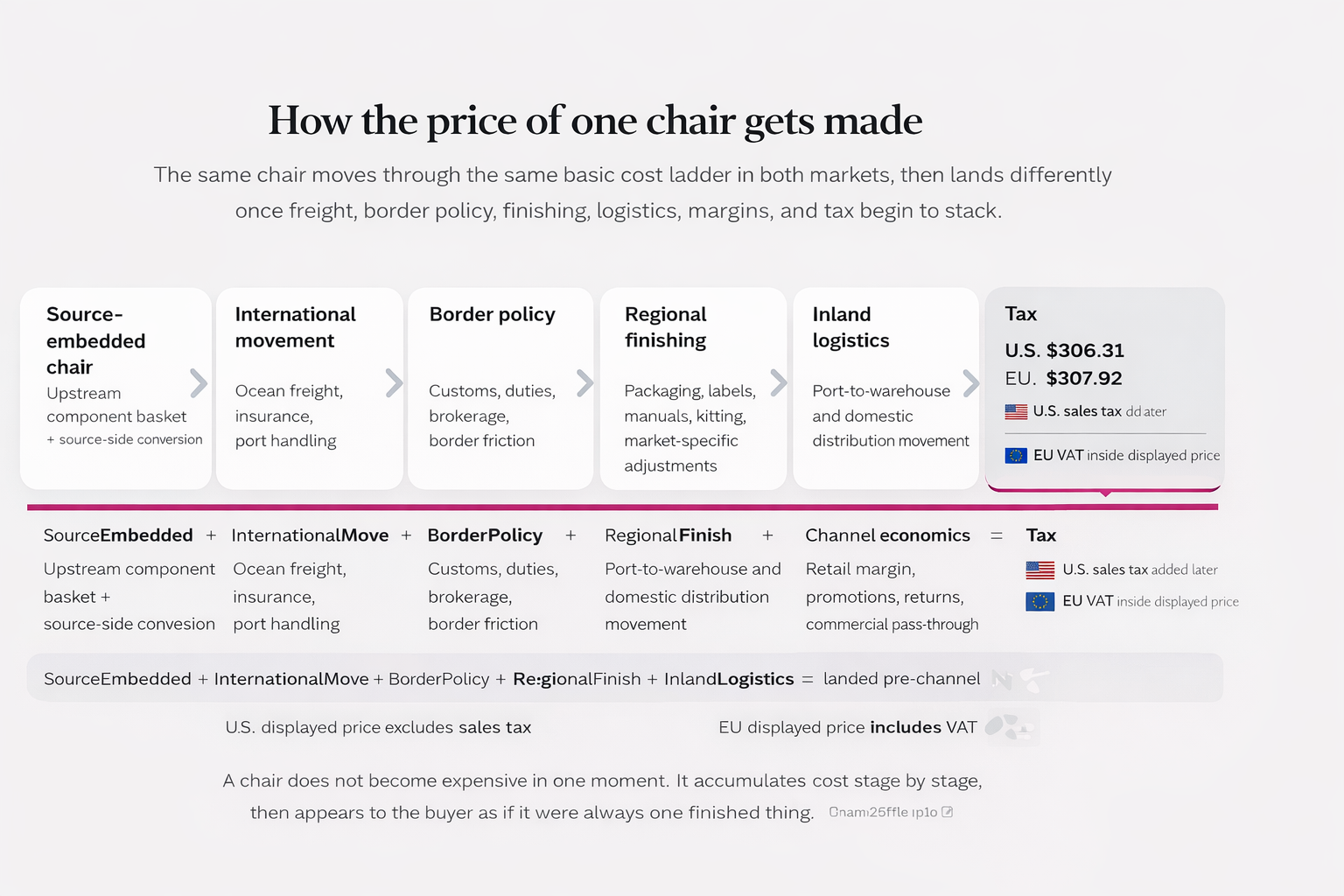
At a high level, this chair passes through seven economic stages. The methodology defines the ladder clearly, from source-embedded cost through to final consumer price.
- Source-embedded chair
The upstream object before it enters the destination market, including its component basket and source-side conversion. - International movement
Freight, insurance, port handling, and the costs of moving a bulky boxed product across distance. - Border policy
Customs, tariffs, brokerage, and policy risk. - Regional finishing
Packaging, manuals, labels, kitting, compliance, and the adjustments that make the chair legible in a particular market. - Inland logistics
Movement from port to warehouse and through domestic distribution. - Channel economics
Retail margin, promotions, returns, and the commercial logic that turns a landed product into a sellable one. - Tax
The final pricing layer, where the U.S. and Europe become visibly different to the shopper.
The chair begins as a source-cost object. It becomes a freight object, then a customs object, then a finishing object, then a warehouse object, then a retail object, and finally a tax object. The cost ladder is explicit: source-embedded chair, international movement, border policy, regional finishing, inland logistics, channel economics, and consumption tax.
How the costs were identified
Not every cost in the model comes from the same kind of evidence, and that is part of what makes it readable.
- Direct anchors
Trade shares, freight benchmarks, packaging dimensions, retailer margin references, return benchmarks, customs treatment, and tax architecture are anchored directly in the methodology and evidence pack. - Proxy-based evidence
The most exposed hard modules are supported through customs-code proxies. Casters are the strongest direct proxy. Mechanisms and gas lifts are strongly likely through broader furniture-fittings buckets. Five-star bases and armrest plastic sets remain less cleanly isolated and should stay more cautious in the wording. - Transparent assumptions
Scenario multipliers, pass-through behavior, and parts of the channel effect are not presented as observed truths. They are explicit stress assumptions layered on top of the verified context. That separation is one of the model’s strengths.
At the component level, the hard hardware core remains the most defensible exposure set: casters, mechanisms, gas lifts, and related fittings. Foam, upholstery, packaging, manuals, labels, and final kitting are the most regionalizable parts of the product.
Before the war scenarios even begin, the same chair already lands differently in America and in Europe.
- U.S. baseline: $188.24
- EU baseline: $195.85
Europe starts higher because VAT and visible regional finishing are built into the consumer-facing price. America looks lighter at first glance because sales tax usually sits outside the sticker and more of the burden is carried through importer and channel economics. The methodology states that the EU baseline lands higher because VAT and visible regional finishing are built into the final price architecture, while the U.S. shelf price excludes sales tax.
The trade and pathway evidence tighten that story further. The U.S. route is concentrated in a three-origin core, with Vietnam, China, and Mexico dominating recent imports and Mexico functioning as the main regional valve. The EU remains heavily dependent on extra-EU imports in the relevant chair line, with China dominating that extra-EU supply, while also retaining a more visible regional production and finishing belt across Central and Eastern Europe led by Poland.
This is the important starting point. One chair can move through two different downstream systems without becoming two different products.
Explore how the shock moves through the chair components
For a better experience, please use your laptop
Each scenario works in two layers.
- The verified context
Trade Friction is grounded in concentrated import exposure and border-policy risk. Logistics & Energy Shock is grounded in freight-rate sensitivity, bunker surcharges tied to Middle East risk, fuel sensitivity, and the fact that the chair behaves like a bulky good rather than a tiny parcel. Full Economic War uses the same direct source base as the two milder scenarios and turns it into a more severe compound stress case. - The assumption layer
Each scenario applies explicit pressure to the stages most likely to move. Trade Friction hits tariff-sensitive modules, international movement, border policy, and a small amount of channel reaction. Logistics & Energy Shock hits freight- and petro-sensitive modules, international movement, regional finishing, inland logistics, and modest channel reaction. Full Economic War compounds tariff pressure, movement pressure, border pressure, regional finishing pressure, and commercial pass-through much more aggressively.
This is how a geopolitical event becomes an ordinary price.
Three modeled states of the world, seen through one ordinary chair
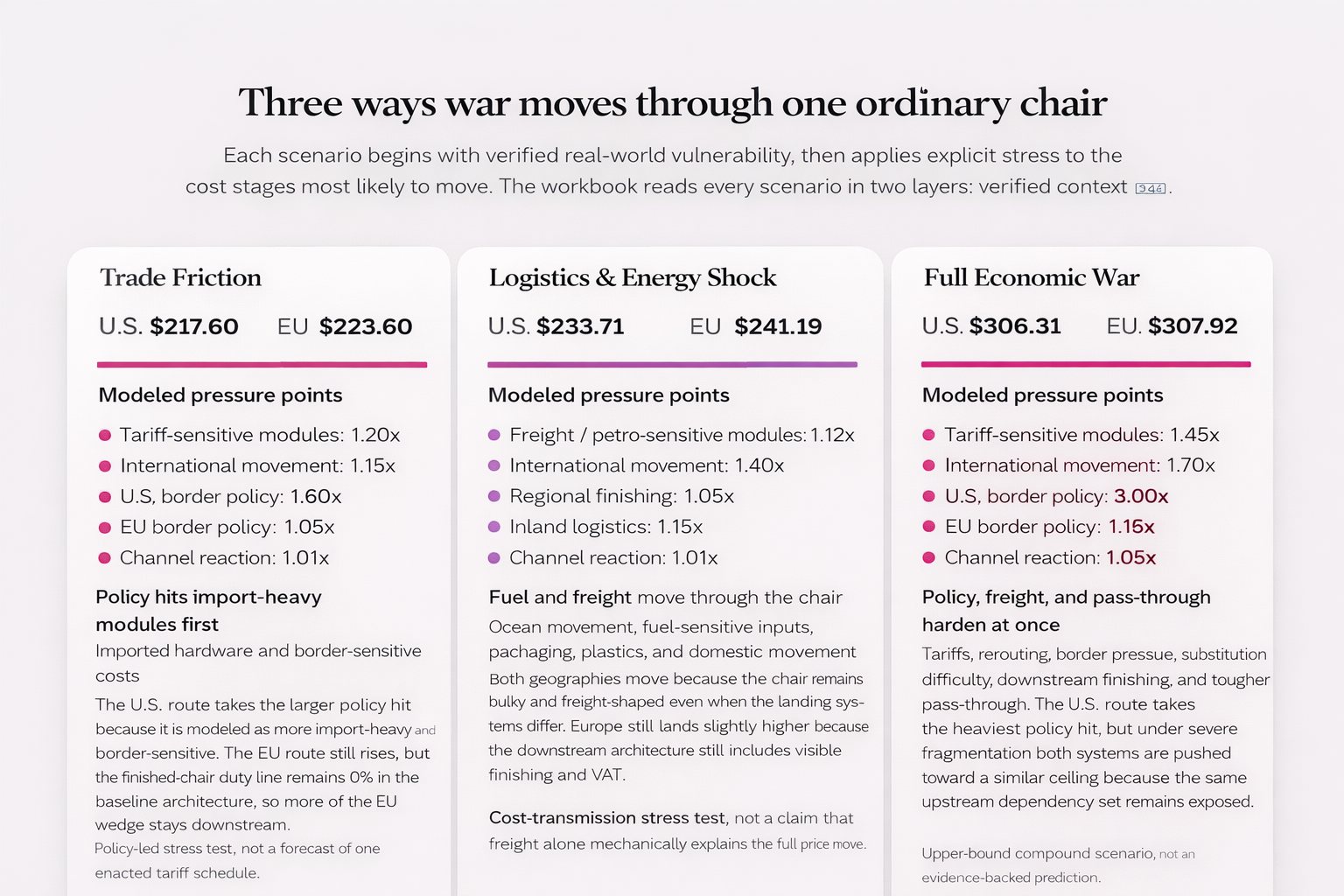
- U.S. $217.60
- EU $223.60
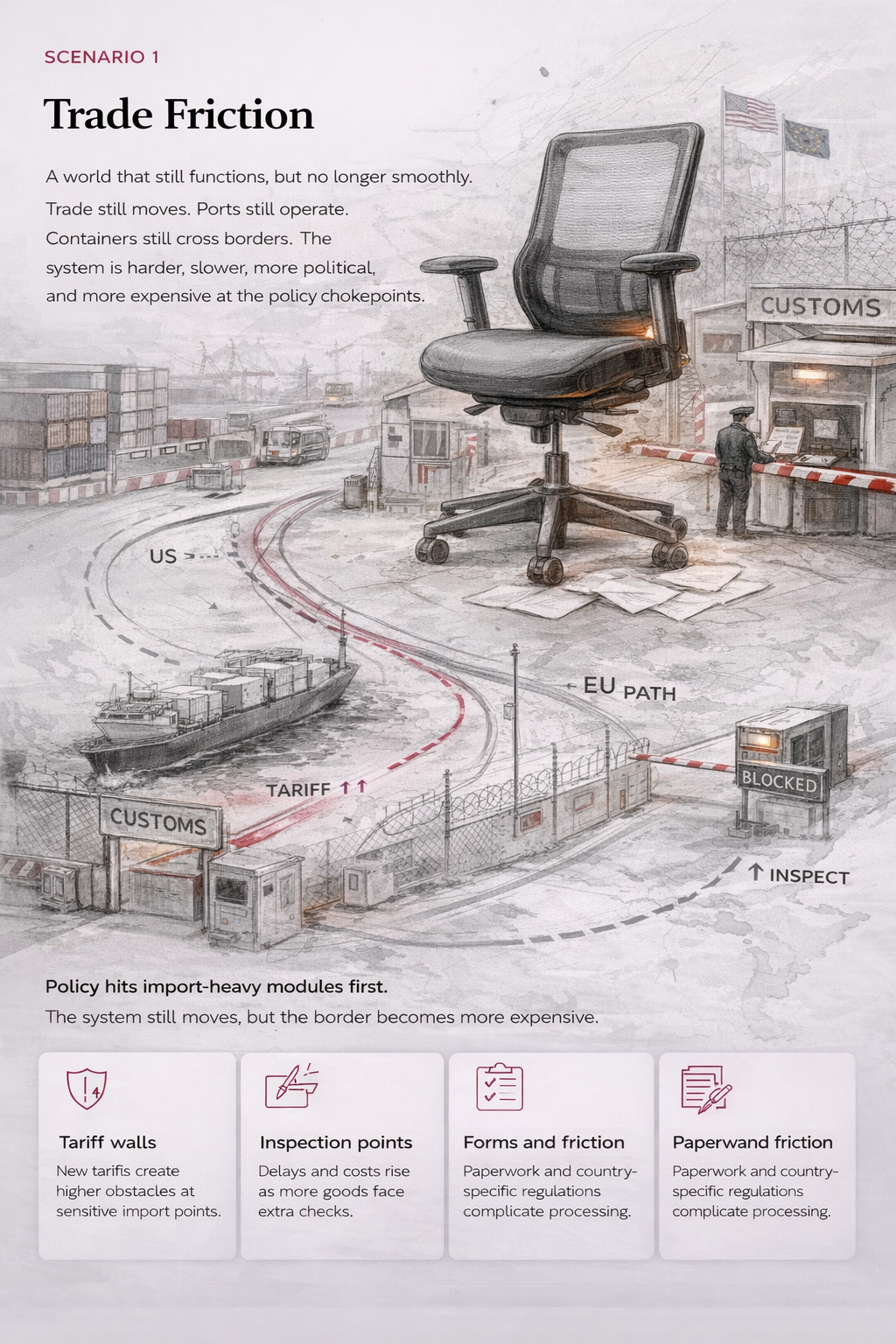
This is a policy-led stress test.
It asks what happens when the commercial system hardens before the physical system fully breaks. Tariff-sensitive modules matter more. Border-policy costs matter more. Import concentration matters more. The U.S. moves harder because the model treats it as the more import-heavy and border-policy-sensitive landing system. Europe still rises, but more of the burden remains downstream, inside finishing and consumer-price architecture, rather than inside a large finished-chair tariff wall.
At the center of the model, Trade Friction applies a 1.20x stress to tariff-sensitive modules, a 1.15x uplift to international movement, a much larger 1.60x border-policy shock in the U.S. versus 1.05x in the EU, and only a 1.01x channel-margin reaction.
In plain English, the model is saying that mild trade conflict hits imported hardware first, adds some extra freight friction, pushes the U.S. border step much harder than the EU one, and assumes retailers pass through only a small part of the shock in the mild case
- U.S. $233.71
- EU $241.19
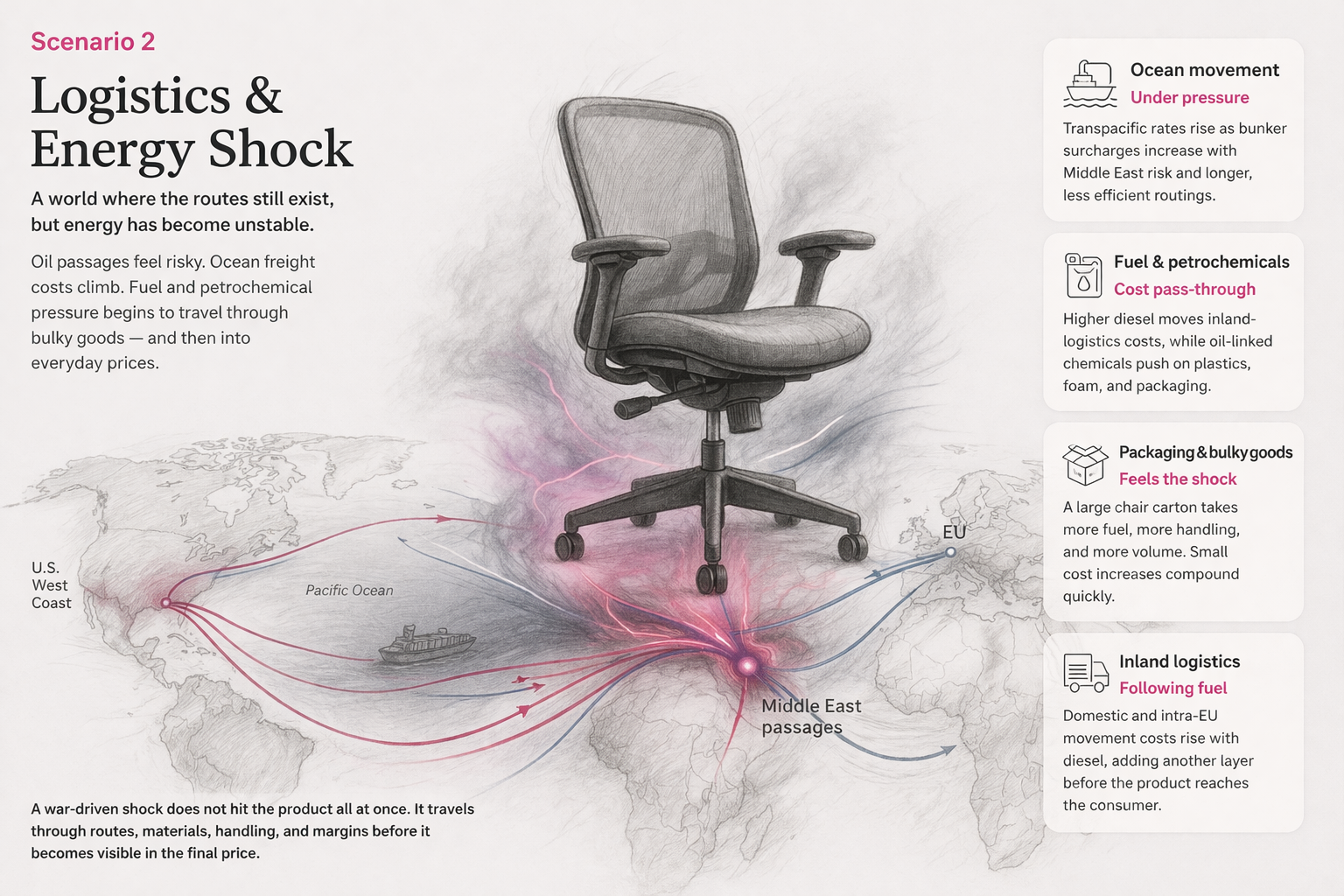
This is the scenario closest to the current war-risk world.
Here the shock becomes an economic event through freight, fuel, petrochemicals, packaging, and inland movement. The chair rises by about 24.2% from baseline in the U.S. and 23.1% in the EU. The important thing is not just the size of the increase. It is the mechanism. You do not need a total collapse of trade for a serious price jump to happen. You just need enough cost layers to start moving in the same direction at the same time. This is a cost-transmission stress test, showing what happens when a bulky chair moves through a more expensive transport and materials environment.
At the center of the model, Logistics & Energy Shock applies a 1.12x stress to freight- and petro-sensitive modules, a much larger 1.40x hit to international movement, a 1.05x uplift to regional finishing, a 1.15x uplift to inland logistics, and only a 1.01x channel reaction. That is a useful level of transparency because it shows where the model thinks the pressure really sits: not mainly at the tariff line, but in the ocean leg, the fuel-sensitive materials inside the product, and the domestic movement that follows after the chair lands.
- U.S. $306.31
- EU $307.92
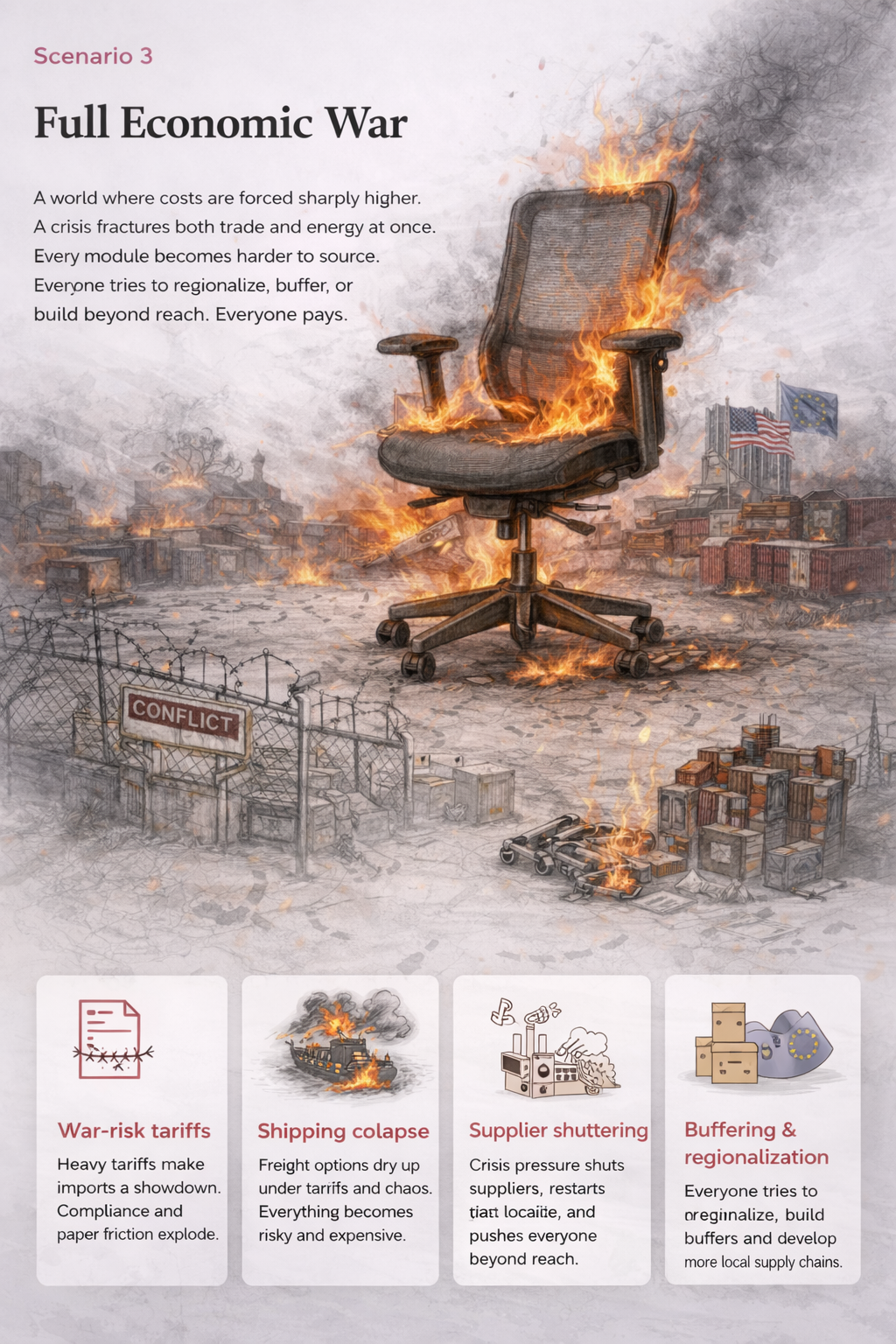
This is the compound case.
Policy pressure rises. Freight pressure rises. Inventory, requalification, and pass-through pressure rise with them. Firms become less willing to absorb the hit themselves. This is an upper-bound compound scenario, not an evidence-backed prediction. Under severe stress, the U.S. and EU end up in almost the same place. Different routes. Similar pain. That is one of the most revealing findings in the entire model.
At the center of the model, Full Economic War applies a 1.45x stress to tariff-sensitive modules, a 1.70x hit to international movement, a very large 3.00x border-policy shock in the U.S. versus 1.15x in the EU, a 1.12x uplift to regional finishing, and a stronger 1.05x channel-margin reaction. In other words, this is the scenario where tariffs, rerouting, bunker pressure, substitution difficulty, downstream finishing, and firmer pass-through all start reinforcing one another at once.
The chair is not the whole economy. It is one readable slice of it.
That is enough.
It lets you watch a war move through energy, freight, components, finishing, warehousing, margins, and tax without disappearing into abstract language about global markets. It shows how an ordinary product can become much more expensive without any dramatic single point of failure, simply because:
Enough stages of the journey become more expensive at once. And that is the unsettling part.
A quarter more for one chair is manageable. Sixty percent more for one chair is uncomfortable. But the chair is not the real reason to worry. The real reason to worry is the possibility that many ordinary goods are carrying similar exposure, quietly, all at the same time.
That is when a regional war stops looking regional.
That is when it starts looking economic.