
Greece, Turkey and the New Eastern Mediterranean Game
Greece–Turkey tensions are part of a wider Eastern Mediterranean game. This article examines how NATO, the US, France, Israel, Cyprus, energy infrastructure and grey-zone competition are reshaping deterrence, alliance incentives, escalation risk and the costs of open conflict.
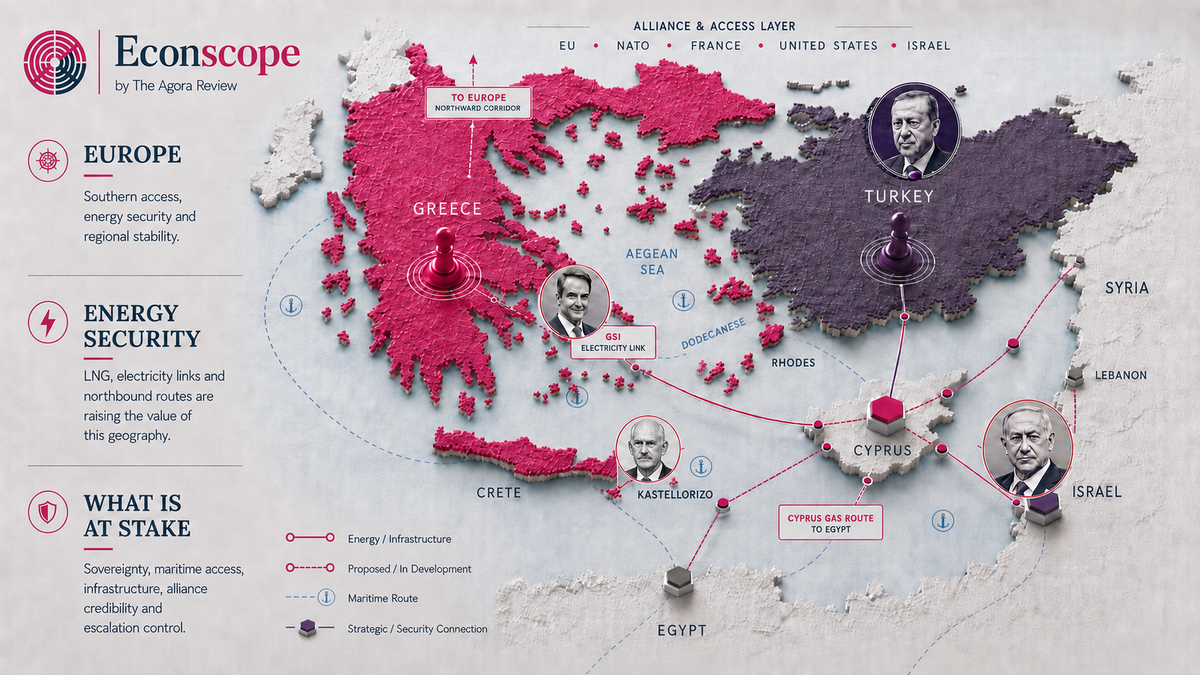
Why the most dangerous moves may be the ones that stop short of war
Geopolitics / Strategic analysis
On 11 February 2026, Greece and Türkiye recommitted to direct communication and confidence-building measures. By summer, marine-park decrees, a Greece–Cyprus electricity-link survey framework and reported U.S. work towards a Türkiye–Israel–Syria contact/deconfliction process had created three new practical pressure points in the region.
The calm has the structure of competitive détente. Diplomatic contact and unresolved rivalry operate at the same time, giving officials a route to establish place, sequence and identity before public accounts harden around an ambiguous act, making restraint politically harder.
The underlying puzzle is how actors seek advantage when a clearly attributable first strike may carry a larger political cost than a limited tactical gain. The sections that follow show the conditions that make that logic stronger or weaker.
Eight-topic overview
Eight questions shaping the next move.
Each topic opens a short visual summary. From there, go deeper into the matching analysis below or test the same issue in the strategic game.
How evidence is labelled
01 / Current settingWhat does the present calm contain?
Swipe or scroll through all eight summaries.
Direct contact above separate questions
Communication can create time without deciding the legal question.
- Maritime delimitationGreece identifies continental-shelf and EEZ delimitation where claims overlap as the bilateral legal difference.
- Turkish stated claimsClaims on sovereignty, islands, airspace, demilitarisation and administration remain Turkish positions Greece rejects.
- Practical conductA survey, patrol, aircraft or close encounter still requires a verified account of location, identity and harm.
- Administrative actsA notice, map, permit or decree matters strategically when it changes somebody’s conduct.
01 / Calm waters
What does the calm consist of?
On 11 February 2026, Greece and Türkiye recommitted themselves to communication, confidence-building measures, and cooperation in electricity, renewables and transport. During an ambiguous encounter, direct diplomatic/confidence-building contact and the NATO military deconfliction mechanism give officials time to establish place, sequence, identity and harm before public accounts harden.
The declaration gives officials direct contact for managing practical activity. It does not resolve the distinct legal positions or predetermine a response to a later incident. Its value will show when surveys, patrols or other activity test those arrangements.
- Documented fact
- 11 February joint declaration and the NATO military deconfliction mechanism.
- Function
- Communication can create time to establish location, sequence, identity and harm.
- Still open
- The specific incident facts and separate national or institutional decisions they may create.
The February declaration
The declaration establishes a contemporary framework for cooperation and communication. Its political value lies in the interval it creates for officials to establish location, sequence and harm before public attribution takes hold. It neither changes Greece’s stated legal position nor decides the response to a particular incident.
Greece–Türkiye Joint Declaration; NATO deconfliction mechanism; Greece’s stated position: Greek MFA legal-position record; Türkiye’s stated position: Türkiye MFA background note.
Seven histories sit behind a modern signal
Layered records shape how places, maps and messages are received.
- 332–30 BCE
Alexandria
and encounterGreek-language civic life
Egyptian institutions
Jewish communities - 330 CE onwards
Constantinople
and ByzantiumByzantine capital
Eastern Roman state language - 7th century
Changing
provincesAuthority shifted region by region
Communities remained varied - 1453
Ottoman
captureNew imperial capital
Enduring political memory - Ottoman era
Ports and
communitiesRomaniote continuity
Sephardic refuge
Thessaloniki - 1941–74
Rupture
and conflictHolocaust in Greece
Separate Cyprus security rupture - 1981–2010
Diplomatic
repositioningPLO representation
Kastellorizo 2010
Greece–Israel realignment
Memory shapes reception. Current rights and decisions require current law and facts.
02 / History and memory
What histories can a modern signal invoke?
Alexandria, Constantinople, Cyprus and Kastellorizo carry compressed records of conquest, community, rupture and diplomatic choice. Those records can shape how a visit, map or declaration is received.
The historical material belongs to political reception and domestic room. Contemporary law, institutions and the event itself determine legal title and alliance choices.
- Record
- Cited historical layers, communities, ruptures and diplomatic records.
- Interpretation
- Historical memory can affect political reception, symbolism and domestic room.
- Boundary
- Historical memory does not determine contemporary legal title, maritime rights or alliance decisions.
The historical sources
The atlas moves from Hellenistic political space through Byzantine, Arab, Ottoman and modern national settings. It includes Greek-speaking Jewish traditions, the destruction of Greece’s Jewish communities during the Holocaust, Cyprus’s distinct security history, and the later turn in Greek diplomatic positioning. These records give symbols historical resonance; a maritime title or future alliance decision rests on its own evidence.
The Met on Ptolemaic Egypt; Cambridge on Byzantine and Eastern Roman identity; The Met on the Eastern Mediterranean; Jewish Museum of Greece on Ioannina; The Met on the Greater Ottoman Empire; USHMM on Greece during the Holocaust; UNFICYP; LSE research on Greek–Israeli realignment.
One place can contain five different legal questions
Which legal question is actually being raised?
The same setting can carry several questions at once. Greece identifies shelf and EEZ delimitation where claims overlap as the bilateral legal difference; other Turkish claims must be identified as Turkish positions Greece rejects.
Sovereignty
What treaty title applies?Title to territory, including islands, is a distinct legal question.
Entitlement
What maritime zones may a coast generate?Territorial sea, EEZ and continental shelf are separate legal categories.
Delimitation
Where might an agreed final line fall?Greece identifies shelf/EEZ delimitation between overlapping claims as the bilateral legal difference.
Waters and airspace
What rules are claimed to govern conduct now?Navigation, overflight, safety and passage involve distinct Greek and Turkish legal positions.
Administration
Who purports to permit, manage or enforce?Permits, zoning, surveys and enforcement do not by themselves settle sovereignty.
Classify a permit or survey first. Its practical effect does not itself decide title, entitlement or delimitation.
03 / Legal questions
Which legal question is actually being raised?
The same stretch of water can carry several legal questions at once. Sovereignty concerns treaty title to land. Maritime entitlement concerns the zones a coast or island may generate. Delimitation concerns a final shelf or EEZ line where claims overlap. Waters, airspace and administration govern immediate conduct. Greece identifies shelf/EEZ delimitation where claims overlap as the sole bilateral legal difference; Turkish claims on sovereignty, islands, airspace, demilitarisation and administration remain Turkish positions Greece rejects. Kastellorizo makes the distinction concrete: the 1947 Treaty establishes Greek sovereignty and, under Greece’s stated position, the island has territorial-sea, EEZ and continental-shelf entitlements. Delimitation is a separate question.
A permit or survey needs legal classification before it is treated as a strategic incident. The material distinguishes title, entitlement, delimitation and conduct rather than drawing a bilateral boundary or treating every Turkish claim as a mutually accepted legal agenda.
- Documented fact
- Treaty, convention and sovereignty material.
- Official positions
- Greece and Türkiye set out different public legal accounts; the article attributes each rather than merging them.
- Open question
- Final shelf/EEZ delimitation where claims overlap, and incident-specific application.
Treaties and positions
The 1947 Treaty places Kastellorizo under Greek sovereignty. Under Greece’s stated position, the island has territorial-sea, EEZ and continental-shelf entitlements. Greece identifies continental-shelf and EEZ delimitation where claims overlap as the sole bilateral legal difference. Türkiye advances a broader stated Aegean agenda which Greece rejects. A final bilateral maritime line remains unadjudicated.
Treaty of Peace with Italy, Article 14; UNCLOS Articles 74, 83 and 121; Greek MFA delimitation position; Türkiye MFA background note.
Two maritime instruments, one later decision question
Two bilateral instruments enter a wider decision.
2019 · UN record
Türkiye–Libya
memorandum
2020 · UN record
Greece–Egypt
agreement
What could happen next
notice · route · survey04 / Blue Homeland and Libya
How do maritime framing and a memorandum change the field?
Mavi Vatan, or Blue Homeland, is public Turkish maritime vocabulary, including the defence ministry’s dated Mavi Vatan-2026 exercise record. The 2019 Türkiye–Libya memorandum and the 2020 Greece–Egypt agreement place distinct bilateral references into the diplomatic record. They matter when a ministry, company or partner must decide which claim to contest, accommodate or organise around.
For companies and outside governments, the immediate effect lies in the claims they must address when approving a survey, a route or a diplomatic response. The texts place those claims in view; their final legal effect for third states and any maritime line remain contested. Libya’s fragmented political setting makes implementation actor-specific: the strategic consequence depends on which Libyan authority acts, what Turkish or other access exists, and what practical activity follows the document.
- Record
- The 2019 Türkiye–Libya and 2020 Greece–Egypt instruments are in the public treaty record.
- Contested
- Their effects for third states and the wider pattern of overlapping claims remain contested.
- Practical consequence
- A later notice, route, survey or permit may force another actor to decide which reference to accommodate or contest.
- Open
- Implementation and final legal consequences.
The two agreements
UN registration establishes that both instruments exist. Their consequences for third states remain contested: the European Council rejects legal effects for third states, while Türkiye rejects that assessment.
UN Treaty Collection: Türkiye–Libya memorandum; UN Treaty Collection: Greece–Egypt agreement; European Council conclusions; Türkiye MFA response.
From paper to physical world
When paper acquires a footprint
Administrative acts become strategically consequential when they change someone else’s conduct.
Paper
Announcement
A stated policy or intention.
Decree
Domestic legal authority.
Coordinates
Where the rule is meant to apply.
Physical world
Activity
A vessel, survey, patrol or other physical use.
Enforcement
Another actor may have to alter conduct.
Physical footprint begins with activity
What changes strategically?
Another actor must now decide whether to:
- change course
- seek clearance
- accept a restriction
- bear a response cost
The decisive record is the transition from paper to practice.
05 / Parks and practice
When does an administrative act become a strategic encounter?
Marine parks become strategically consequential when they alter conduct at sea. An announcement, decree, coordinate, permit, survey and enforcement action each creates a different record.
Türkiye’s decrees are domestic acts; Greece alleges that their claimed application has an external reach. Neither a decree nor a Greek process alone establishes international title. Practical significance begins only when an operator, vessel or authority must change course, seek clearance, accept a restriction or bear a response cost.
- Documented fact
- Greek administrative process, Turkish domestic decrees, coordinates and official objections.
- Official positions
- Greece alleges that the decrees claim external reach; Türkiye’s published instruments are domestic acts.
- Interpretation
- Strategic consequence grows only where a measure changes conduct.
- Disputed
- Jurisdiction and the alleged external reach.
- Open question
- Operative coordinates, notices, implementation, enforcement and any actual change in conduct.
From decree to practice
The Greek Environment Ministry reports that the draft South Aegean presidential-decree text has reached the Council of State. That is the current published stage of the Greek process. A final decree, operative coordinates and any enforcement record await later official documents. Türkiye’s August 2026 decrees publish domestic coordinate and map annexes; Greece alleges that their claimed application reaches beyond domestic administration and formally rejects that alleged effect. Any assessment of overlap, practical constraint or international consequence must rest on operative coordinates, notices to mariners, evidence of implementation and reproducible GIS analysis.
A Turkish domestic decree may become strategically relevant only if implementation changes conduct. Greece alleges that the decree claims external reach. The decree itself does not establish international entitlement.
Greek Environment Ministry consultation record; Greek South Aegean process record; Türkiye Fethiye–Kaş decree; North Aegean decree; Greek MFA response, 16 August; EU Maritime Spatial Planning Directive.
How far four energy assets have progressed
Asset maturity determines which disruption and response questions exist today.
- Operating
LNG / IGB
flows · users · continuity
- Developing
GSI
contracts · surveys · financing
- Exploratory
Offshore acreage
information · value of keeping future choices open
- Proposed
EastMed
commercial case · expectation
Maturity changes what can actually be disrupted today.
06 / Energy and infrastructure
Which assets shape the board now, and which remain contingent?
Energy is four stories with four clocks. Alexandroupolis and IGB operate. GSI has a documented development record, including a construction order, cable manufacture, shareholder arrangements and survey-work agreements. Exploration preserves the value of future development choices. EastMed remains a proposed pipeline.
Exposure becomes concrete when people, power flows, contractors or routes depend on an asset. Commercial relevance can strengthen the incentive for attention and deconfliction; the public material records GSI development steps, while installation, energisation, finance and security arrangements remain later decisions.
- Current status
- Operating, developing, exploratory and proposed are materially different conditions.
- Meaning
- Maturity changes present exposure, users, contractors, financing and response questions.
- Open
- Installation, energisation, finance, timetable and any security arrangements.
GSI and the asset stages
LNG, IGB, GSI, offshore exploration and EastMed occupy distinct technical and commercial stages. IPTO’s first-quarter 2026 report records the December 2023 order, payments to Nexans, cable manufacture and a marine-survey record, while also saying that the full notice to proceed had not been issued because regulatory matters remained unresolved. The 5 August record adds an agreement for Meridiam’s intended entry and an IPTO–GSI–Nexans framework for survey work on the Greece–Cyprus leg. On 13 August, IPTO said it had filed an investment-approval request for the Cyprus–Israel leg; it identified regulatory review, cross-border cost allocation, final investment decision and financing as later steps. Those records establish documentary momentum, not installation, energisation, a completed ownership transfer or a security guarantee. An operating asset has users and flows today; exploration creates a different chain of information and option risk. Commercial exposure can raise the cost of disruption, while security decisions remain case-specific governmental choices.
Gastrade operations; ICGB operations; IPTO first-quarter 2026 report; Greek Prime Minister’s Office on the Greece–Cyprus framework; IPTO on the Cyprus–Israel approval request; European Commission PCI/PMI record for EastMed; Greek exploration agreement record.
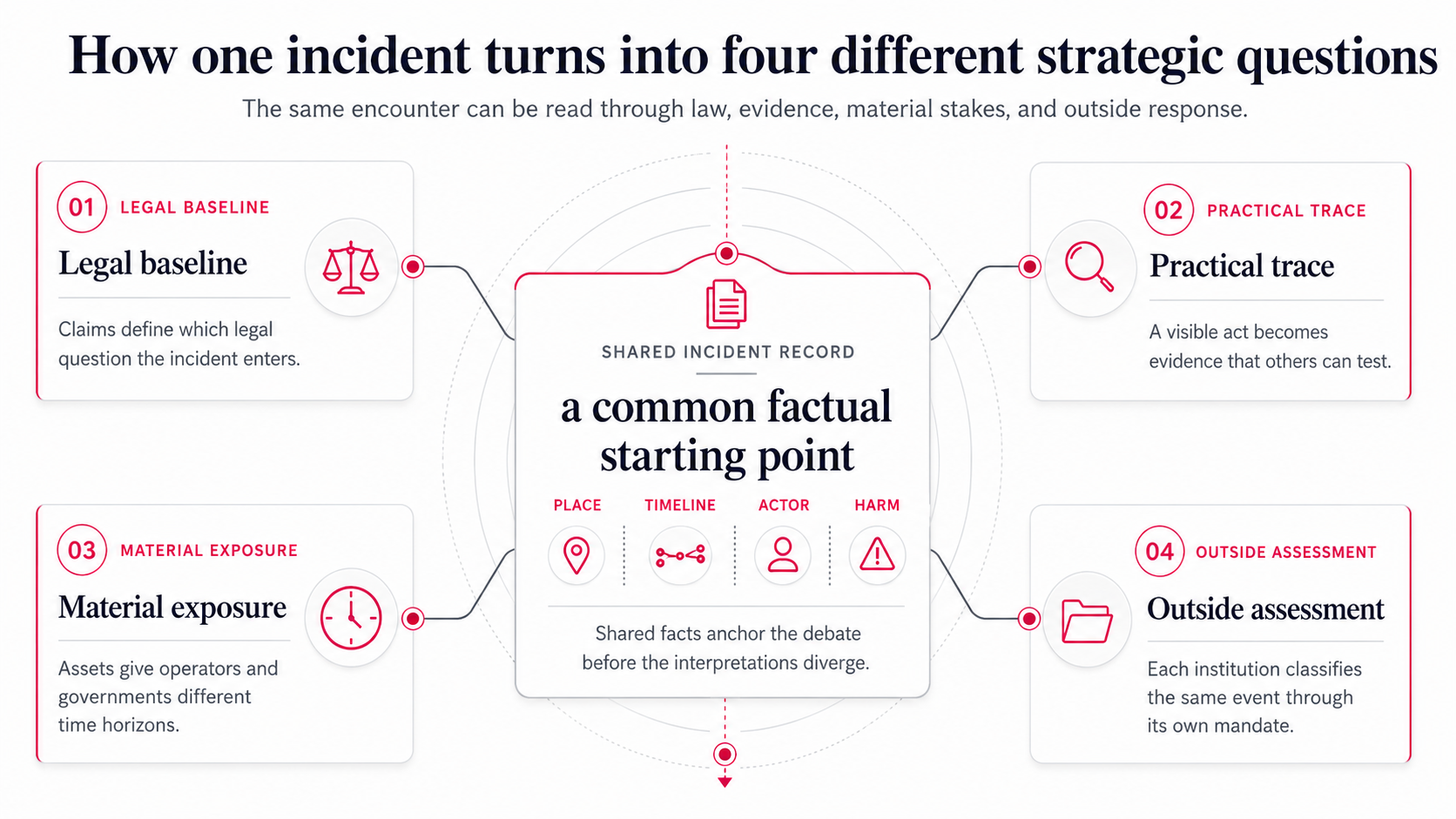
One incident, four separate institutional files
One incident can be assessed through four independent institutional mandates.
Shared incident record
place · status · harm- NATOConsultation / Treaty scope
- France / EUTerritory / Legal clause
- United StatesAccess / Force protection
- IsraelExposure / National judgment
07 / Alliances and institutions
Who is relevant in a crisis, and who decides?
Treaty text defines routes for consultation and assistance. A cable survey, a coast-guard encounter, an attack on recognised territory and a strike at a third-country site raise different questions under NATO Articles 4–6, the EU clause and the France–Greece agreement.
Treaty text creates paths for consultation and assistance. Location, status, attribution and harm determine whether a path becomes live. Greece–Israel defence integration, including Achilles’ Shield, does not create a Greece–Israel mutual-defence obligation or merge their decision-making in a Greece–Türkiye crisis. Washington’s relationships with Greece, Türkiye and Israel run through different access arrangements, alliances and military commands; a shared regional crisis does not merge them into one automatic U.S. decision.
- Rules
- Treaty procedures, consultation, access arrangements and national-security processes exist.
- Threshold
- Location, status, attribution and harm determine which institutional question becomes live.
- Decision
- Actual national or institutional responses remain incident-specific political choices.
Treaties and access
Treaty texts and access arrangements establish routes for consultation, assistance and logistics. Each institution then assesses the incident’s character, attribution and the response it considers necessary. A clear strike on recognised territory poses a different coordination problem from a survey or cable encounter.
North Atlantic Treaty; TEU Article 42(7); France–Greece agreement; US Navy on Souda Bay.
Regional files at an evidence gate
Regional arenas remain separate until a practical change crosses the evidence gate.
- CyprusUN mission · UK bases · GSI route
- Egypt / LibyaEEZ reference · Turkish access · fragmented authority
- Syria / Israelfacility/contact risk · Turkish-presence question · U.S. deconfliction
- Iran / Saudi / Pakistanforce protection · Makkah agreement · implementation uncertain
Evidence gate
Has a practical condition changed?
- access
- deployment
- exposure
- usable contact process
Bilateral arena · Greece–Türkiye
Reassess the next move.08 / Regional pressure
How can a crisis elsewhere change the next move here?
Cyprus combines a UN mission, UK sovereign bases and a GSI route. Egypt and Libya combine an EEZ reference, Turkish access and fragmented authority. Syria and Israel bring facility/contact risk, a prospective Turkish-presence question and proposed U.S.-facilitated contact/deconfliction work. Iran, Saudi Arabia and Pakistan add force-protection pressure around the Makkah agreement, whose implementation remains uncertain. These remain distinct theatres.
A separate regional crisis enters the Greece–Türkiye game only when a documented development changes access, deployment, force protection, infrastructure exposure, communications or bargaining options.
- Analytical baseline
- Cyprus, Egypt/Libya, Syria/Israel and Iran/Saudi/Pakistan are treated here as separate regional arenas unless evidence shows a practical connection.
- Link test
- Has a documented event changed access, deployment, force protection, infrastructure exposure, communications or bargaining options?
- Open
- Whether that practical change materially alters the Greece–Türkiye decision.
The regional theatres
Regional theatres connect through access, infrastructure, diplomacy and force-protection demands. A parallel crisis can absorb attention or introduce a new contact risk. A combined operational plan, permanent bloc or automatic intervention would require evidence of changed deployments, access, communications or bargaining options.
UNFICYP on Cyprus; UN Secretary-General on Libya; Reuters on U.S. work towards a safety process; Pakistan MFA on Makkah agreement.
A declaration, maritime plan, cable route or conservation measure begins as a political or administrative act. It enters the strategic field when it creates a new physical or political fact that another actor must accommodate, contest, protect or pause. Institutions often have to decide before they share a complete account of the event.
Full analysisTopic 01 of 08
01 / The current setting
The present calm rests on direct diplomatic contact.
The February declaration creates political and procedural space for officials to exchange views and organise confidence-building measures. NATO’s 2020 mechanism supplies a separate military precedent, designed to reduce immediate risk while Greece’s stated shelf/EEZ-delimitation position remains distinct from Turkish claims Greece rejects as additional bilateral legal differences.
The practical test arrives when an apparently ordinary measure creates a decision that cannot be deferred: who gives notice, who verifies location, which activity pauses, and whether a temporary procedure can withstand public pressure. A park measure, survey, patrol or cable-related activity can create that test.
Full analysisTopic 02 of 08
02 / History and memory
Historical memory shapes the political setting.
Modern maritime claims turn on treaty text, jurisdiction and institutional process. Historical memory can shape political reception and domestic room for manoeuvre. Maritime rights, alliance choices and a government’s response arise from current law, institutions and the facts of the encounter.
Alexander’s 332 BCE conquest of Egypt began a Hellenistic period that lasted until Cleopatra VII’s defeat and Rome’s takeover in 30 BCE. Alexandria combined Greek-language civic life, Egyptian institutions and a major Jewish population; translation, scholarship and commerce sat alongside unequal authority and political conflict. Rome later absorbed Egypt, while Constantinople became the eastern political centre of what historians commonly call the Byzantine Empire; its inhabitants and elite commonly described themselves as Roman. The Met’s account of the Hellenistic Near East and Cambridge research on the Cleopatras and Jewish subjects capture that layered setting.
In the seventh century, Arab-led forces took former Byzantine provinces including Syria and Egypt. Authority changed region by region; communities, languages and religious traditions remained varied. In 1453, Ottoman forces under Mehmed II captured Constantinople, ending Byzantine rule in the city and opening a new Ottoman imperial setting. The event remains a distinct historical reference in Greek and Turkish public life. Its political afterlife belongs to memory and reception, rather than contemporary legal title. The Met’s historical record.
Ottoman rule later reordered ports, taxation and communal institutions. Romaniote Jewish communities endured, while Sephardic refugees reshaped major centres including Thessaloniki.
The twentieth century requires a separate frame. German, Italian and Bulgarian occupation authorities persecuted Greek Jewish communities, and more than four fifths of Greece’s pre-war Jewish population was murdered in the Holocaust. Cyprus is another distinct setting: the 1960 independence arrangements, the 1974 coup and Turkish military intervention, ceasefire lines, and the continuing UN buffer zone created a security structure that still operates through its own institutions.
Modern diplomacy followed a different sequence. In 1981, during Yasser Arafat’s visit, Andreas Papandreou’s government raised the PLO office in Athens to diplomatic-representation status. Scholarship identifies public ideology, Cyprus-related reasoning, relations with Arab states, economic interests and regional competition as part of the setting for that shift. In 2010, George Papandreou’s financial-support announcement from Kastellorizo and reciprocal visits by George Papandreou and Benjamin Netanyahu were separate events in the same year. The first belongs to Greece’s financial crisis. The second marked rapid Greek–Israeli warming after changing security, energy and economic ties, alongside the deterioration of Türkiye–Israel relations.
Kastellorizo has a legal history and a political memory. The 1947 Treaty established Greek sovereignty. Under Greece’s stated position, the island has territorial-sea, EEZ and continental-shelf entitlements; delimitation of overlapping shelf/EEZ zones is a separate question. The 23 April 2010 support-mechanism announcement gave the island a second domestic political association. When a later signal touches that memory, it can change what a government can accommodate, contest or defer.
History matters here because it gives particular places different political charge. Alexandria carries intertwined Greek and Jewish histories; Constantinople and Cyprus can narrow domestic room in Greek and Turkish politics; the Papandreou years show how quickly diplomatic alignments can change when interests change. Those are pressures on bargaining, not inherited titles.
Four earlier crisis-management records
1974 Cyprus: a Greek-junta-linked coup preceded Türkiye’s intervention; a UN ceasefire demand did not restore the political order. 1976 Aegean crisis: UNSC Resolution 395 appealed for restraint while maritime-delimitation positions remained unresolved. 1996 Imia / Kardak: Turkish sovereignty claims over the features, which Greece rejected, unfolded amid flags, naval units and commandos, producing physical contact; U.S. mediation created withdrawal and a tactical status quo. 2020 Oruç Reis: NATO established a bilateral military deconfliction mechanism while dialogue returned without final delimitation.
These records leave a practical lesson: management can preserve diplomatic contact or a tactical pause while the underlying positions and delimitation question remain. UNSC Resolution 353; UNSC Resolution 395; Congressional Research Service on Imia / Kardak; NATO’s 2020 mechanism.
Full analysisTopic 03 of 08
03 / The legal lab
Law turns one encounter into different practical choices.
Five legal categories become strategic when they direct different actors towards different acts: a notice to mariners, a permit, an air-safety procedure, a patrol or a diplomatic claim. The same physical setting can therefore generate competing evidence, different authorities and different limits on a response. They are classifications for reading an incident, not five mutually accepted bilateral disputes.
Each issue directs people towards a different practical act. A vessel may receive a navigational notice, a survey contractor may be asked for a permit, an aircraft may enter a flight-safety procedure, and diplomats may dispute a final maritime line that no court has drawn. The physical setting can be identical while the legal question, evidence and available response differ.
Greece states that continental-shelf and exclusive-economic-zone delimitation is the sole bilateral legal difference. Türkiye advances a wider stated Aegean agenda involving island effects, territorial waters, airspace, demilitarisation and related matters; Greece rejects those as additional bilateral legal differences. UNCLOS supplies Athens’s legal vocabulary. Türkiye is outside the Convention and, in its stated position, advances equity and relevant-circumstances arguments in the same geography. The article treats those as attributed positions before any line is discussed.
Kastellorizo makes the distinction concrete. The 1947 Treaty of Peace with Italy settled Greek sovereignty over the island. Under Greece’s stated position, it has territorial-sea, EEZ and continental-shelf entitlements. Delimitation of overlapping shelf/EEZ zones remains the separate bilateral question Greece identifies. A cable route, environmental measure, survey or patrol can therefore acquire political force around an island whose sovereignty is settled.
Full analysisTopic 04 of 08
04 / Maritime framing, documents and maps
How maritime framing becomes a practical issue.
Mavi Vatan is the Turkish state’s public vocabulary for maritime policy, exercises and related claims. Treaties, jurisdiction and the act at issue determine the separate legal questions. The Defence Ministry’s dated Mavi Vatan-2026 exercise record shows the phrase in official use. Its practical relevance begins when a notice, permit, survey or escort requires another actor to decide whether to recognise, contest or manage an activity.
The 2019 Türkiye–Libya memorandum and the 2020 Greece–Egypt agreement turn that contest into competing bilateral reference points. Both appear in the UN Treaty Collection record for the Türkiye–Libya instrument and the record for the Greece–Egypt agreement. The European Council and Türkiye advance opposing views of their consequences for third states.
Libya turns a document dispute into an access problem through a divided political setting. The UN Secretary-General’s report describes continuing institutional fragmentation. During an August visit, Türkiye’s foreign minister met Tripoli/GNU and eastern actors and visited the Turkish Armed Forces Libya Task Group Command. These are records of access and engagement across the divide. A future maritime response would still require a specific Libyan authority, a specific activity and a visible decision.
The strategic consequence arrives when someone has to act on those references. A ministry considering a notice, a contractor planning a survey and a foreign government assessing a route may each confront a different legal and political question. Rival documents can therefore shape a later encounter without producing an agreed boundary.
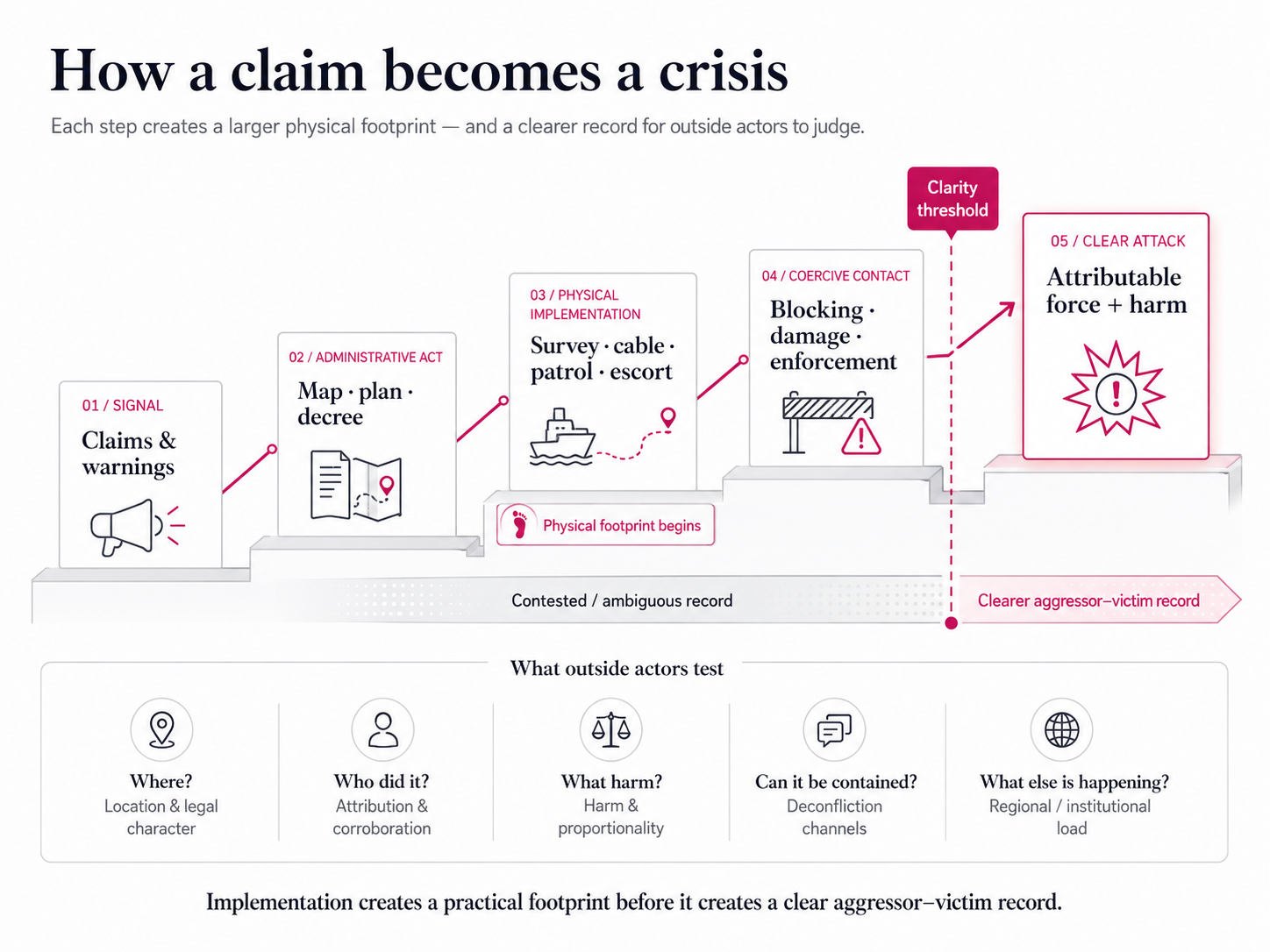
Open the escalation ladder at full sizeAnalytical synthesis of the public legal, practical and institutional records cited in Sources and method.
Full analysisTopic 05 of 08
05 / Parks and practical administration
From an administrative act to a practical encounter.
The decisive transition is from an asserted rule to conduct that somebody else must accommodate. An announcement expresses intent. A decree supplies domestic authority. Coordinates, permits and notices tell operators where that authority is expected to apply. Physical activity and enforcement reveal whether the measure has acquired a practical footprint.
The Greek Environment Ministry reports that the draft South Aegean presidential-decree text has reached the Council of State. That is the current published stage of the Greek process. A final decree, operative coordinates and any enforcement record await later official documents. Türkiye’s Fethiye–Kaş and North Aegean decrees publish domestic coordinate and map annexes. Greece alleges that their claimed application has an external effect and formally rejects that alleged effect. Any assessment of overlap, alleged external reach or practical constraint must rest on operative coordinates, notices to mariners, evidence of implementation and reproducible GIS analysis.
A park becomes strategically relevant when it changes conduct: a vessel alters course, a contractor seeks clearance, an operator accepts a restriction, or an authority bears the cost of enforcement. The EU Maritime Spatial Planning Directive leaves sovereign rights and boundary delimitation to other law. A Turkish domestic decree may become strategically relevant only if implementation changes conduct. Greece alleges that the decree claims external reach. The decree itself does not establish international entitlement.
Reading the park record
Greek process: consultation material and draft maps, followed by a ministerially signed presidential-decree text, Council of State review, any Gazette publication, operative coordinates, notices and enforcement evidence. Turkish decrees: domestic protected-area action on 15–16 August 2026 with coordinate and map annexes, followed by evidence relevant to Greece’s allegation of external reach, any reproducible GIS overlap and enforcement. State responses: Greece’s stated shelf/EEZ-delimitation question, Turkish claims Greece rejects, and the still-open factual record of implementation. The four-part grey-zone test requires a concrete sub-threshold action, a practical constraint or precedent, a response cost and strategically useful ambiguity.
Full analysisTopic 06 of 08
06 / Energy and infrastructure
Infrastructure creates different kinds of exposure.
Energy enters the dispute through assets at four different stages of maturity. Alexandroupolis and IGB already carry gas, creating immediate commercial and regulatory exposure. GSI remains a development project; offshore acreage creates option value; EastMed remains a proposal. Each stage gives officials a different practical problem when activity at sea becomes contested.
GSI remains in development. IPTO’s first-quarter report records an order, payments, cable manufacture and survey work, while saying that full notice to proceed remains pending. The August agreements gave the Greece–Cyprus leg a survey-work framework and set out Meridiam’s intended entry. The Cyprus–Israel leg has entered investment-approval review. The next public milestones are regulatory approval, cost allocation, final investment decision, finance, installation and energisation. Offshore exploration changes the value of future information; EastMed remains a proposal.
Greece’s 2026 Chevron–HELLENiQ agreements expanded exploration rights in maritime areas south of the Peloponnese and Crete. Exploration has political and commercial value because it invites capital and raises the value of future information. Recoverable reserves and future production require later evidence.
- OperatingAlexandroupolis LNG and IGB
- DevelopingGSI development record: order, cable manufacture and governance
- Exploratoryoffshore acreage
- ProposedEastMed concept
Maturity changes the decision created by an incident. An operating flow concentrates continuity, users and regulation. A developing project raises questions of finance, contractors, survey work and execution. Exploration raises the value of information, while a proposal concentrates political expectation. These conditions create reasons to clarify and deconflict; the form of any security response remains a decision for governments and institutions facing a particular event.
Full analysisTopic 07 of 08 · Part 1 of 2
07 / Alliances, access and decision
How partners assess an incident.
One incident can open several institutional routes. NATO has consultation and treaty procedures; France and the European Union use different legal instruments; U.S. decisions draw on access and force-protection records; Israel uses a separate national-security process.
The deepening Greece–Israel defence-technology relationship, including Achilles’ Shield, changes capability and industrial interdependence. It does not create a mutual-defence obligation or merge the two countries’ decision routes in a Greece–Türkiye crisis.
NATO Article 4 makes consultation available. Article 5 obliges Allies to assist after an armed attack within treaty scope, while leaving each Ally to take the action it considers necessary. Article 6 makes the location and status of territory, forces, vessels and aircraft central to that assessment. EU Article 42(7) frames aid and assistance for a Member State suffering armed aggression on its territory. Article 2 of the France–Greece agreement provides mutual aid and assistance, potentially including armed force, where the Parties jointly determine that armed aggression occurred against one Party’s territory. The partnership’s 2026 Greek record and French record describe a renewed partnership; its operational meaning remains incident-specific.
A cable survey in an area pending maritime delimitation, a strike at a third-country site, a reported impact within Türkiye and a corroborated armed attack on recognised Greek territory present different legal and political questions. Location, attribution and harm determine which consultation and assistance routes become relevant.
Snyder’s alliance dilemma is a useful lens here: partners weigh the credibility cost of withholding support against the risk of entrapment. Those calculations can produce deconfliction, fact-finding, logistical support, diplomatic pressure, public restraint or a stronger response. Alliance labels establish the available routes; incident facts determine which route comes into play.
Washington meets the region through three different sets of exposure. Souda Bay supports U.S. naval logistics in the eastern Mediterranean. Türkiye retains alliance, geographic and operational relevance through NATO. Israel sits within a distinct U.S. regional-security architecture centred on CENTCOM. A linked crisis can place access, alliance cohesion and force protection inside the same policy calculation while each route retains its own legal and political logic.
The public record shows separate access, alliance and force-protection relationships. Evidence of a combined operation would require its own documentation.
Full analysisTopic 07 of 08 · Part 2 of 2
Who decides, and on what clock?
Institutions turn authority into decisions.
Public authority and electoral timing mark the visible limits around an officeholder’s options. Cabinets, alliance councils, national armed forces, parliaments and bilateral mechanisms use different routes. Private thresholds remain outside the public record, so a future choice remains tied to the incident record.
- NATOConsultation · treaty scope
- France / EUTerritory · legal clause
- United StatesAccess · force protection
- IsraelExposure · national judgment
One incident↓several public clocks↓several institutional decisions
The Syria crisis and the Greece–Türkiye dispute create different institutional questions. In Syria, Washington, Ankara, Jerusalem and the host authorities face questions of access, force protection and deconfliction. In the Greece–Türkiye setting, NATO, France and the EU confront separate treaty, territorial and political tests. Those decisions follow separate records and institutional routes.
Decision dossier
Who holds which formal decision?
Decision questionHow do the national record, NATO consultation and European procedures frame Greece’s next institutional choice?
Select an office to follow its public decision route, political horizon and evidence boundary.Swipe or use the arrow keys for all five offices →
Greece · Prime Minister
Kyriakos Mitsotakis
Government coordination, ministerial portfolios, parliament and the constitutional chain of command determine whether a pause, fact-finding process or formal consultation can preserve Greece’s legal position while remaining politically sustainable. The public record identifies the formal route; the choice in a specific incident turns on its facts.
Greek constitutional and 2023 mandate recordPrime Minister’s Office
- Formal route
- Government coordination, ministerial portfolios, parliament and the constitutional chain of command.
- Public horizon
- Ordinary parliamentary-term horizon to 2027 after the 2023 election, subject to constitutional procedure.
- Evidence boundary
- The public record describes authority and process. Incident-specific choices remain a separate fact question.
Institutional decision routes
Greece · Prime Minister
Formal route: cabinet, ministries, parliament and the constitutional chain of command. Public horizon: ordinary parliamentary-term horizon to 2027, subject to constitutional procedure. Evidence boundary: a public record of authority does not establish the choice in a future incident. Institutional record.
Türkiye · President
Formal route: presidential executive, diplomatic and security authority under the constitutional order. Public horizon: ordinary presidential and parliamentary-term horizon to 2028, subject to constitutional early-election procedures. Evidence boundary: private room for compromise remains outside the public record. Constitutional record.
United States · President
Formal route: executive authority, alliance consultation, force protection, access arrangements, congressional powers and interagency process. Public horizon: federal presidential election on 7 November 2028. Evidence boundary: a pre-committed response lies outside the public record. Constitutional record.
Israel · Prime Minister
Formal route: prime minister, cabinet and national-security process, distinct from NATO and EU procedures. Public horizon: the official timetable lists 27 October 2026 for the Knesset election, subject to lawful change. Evidence boundary: a particular action still requires incident-specific evidence. Election timetable.
France · President
Formal route: presidential, governmental and military authority alongside the France–Greece agreement and European coordination. Public horizon: presidential election on 18 April and 2 May 2027. Evidence boundary: national and European assessment remain distinct decisions. France–Greece agreement.
Full analysisTopic 08 of 08
08 / Regional pressure
Regional pressure changes the choices available.
A regional theatre enters the Greece–Türkiye story when it changes a practical condition: access, deployment, force protection, infrastructure exposure, communications or diplomatic capacity. Cyprus concentrates three kinds of exposure. Its UN buffer-zone mission runs through 31 January 2027; the United Kingdom retains Sovereign Base Areas at Akrotiri and Dhekelia; and GSI is planned as an electricity link from Greece to Cyprus and then Israel. A cable problem, a base-security concern and a political dispute can therefore place different institutions in the same geography while still posing different response questions.
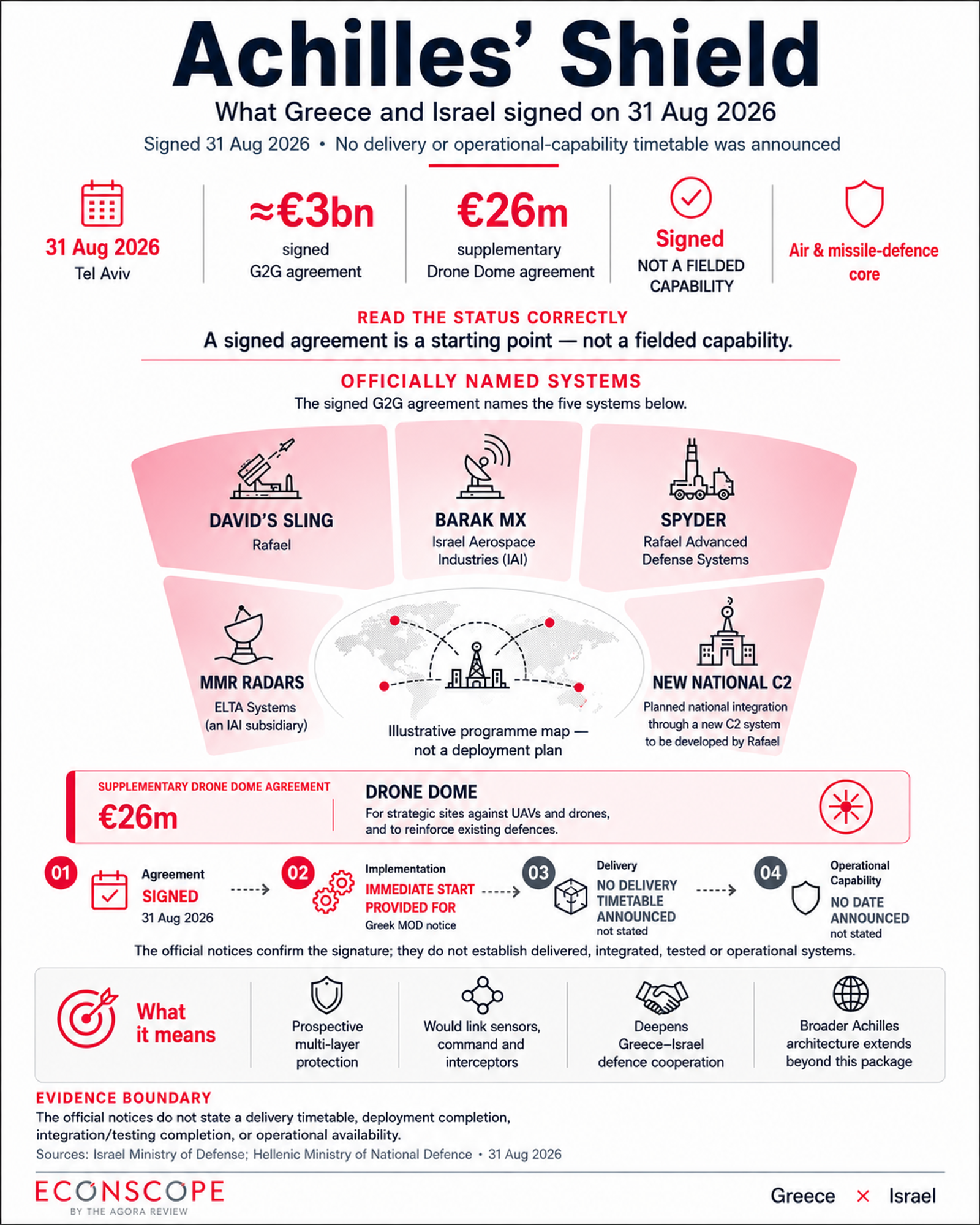
A Greece–Israel capability link is now a signed procurement commitment; delivery and operational capability remain separate questions. On 31 August, the Israeli Ministry of Defense said Greece and Israel signed an approximately €3 billion defence-export agreement in Tel Aviv for Achilles’ Shield. Its release lists David’s Sling, BARAK MX, SPYDER, MMR multi-mission radars and a national command-and-control system; it also records a supplementary €26 million Drone Dome deal. The Israeli release confirms a signed procurement, not present operational capability, a delivery timetable, source-code terms or a mutual-defence obligation. The Hellenic Ministry’s signing statement separately sets out the broader programme budget and industrial-participation framework; neither notice gives a delivery, integration or operational-capability date.
Its strategic significance lies in future capability and industrial interdependence, not in a new alliance guarantee. The signed procurement starts implementation and can tie sensors, command and control, Greek industry and Israeli defence technology more closely together. It does not merge Greek and Israeli decision-making or establish present combat performance. The 31 August official listing does not name anti-ship or anti-submarine elements, so this article does not treat those wider Greek-architecture layers as funded through this agreement.
30 August update: Netanyahu’s rhetoric links Cyprus to Türkiye–Israel tensions. Cyprus Mail reports that Benjamin Netanyahu again invoked Türkiye’s presence in northern Cyprus while accusing the EU of double standards. It was his second Cyprus reference in a little over a week; the earlier attack on Erdoğan also linked Cyprus and Syria. This is evidence that Cyprus is being rhetorically connected to the worsening Türkiye–Israel relationship. It is not evidence of an Israeli military commitment to Greece or Cyprus.
Egypt sits in several relationships at once. Its registered EEZ agreement with Greece is one maritime reference. Its August contacts with Türkiye concern trade, connectivity, and ministerial and intelligence engagement. Its public consideration of the Makkah agreement is a third, separate decision. EEZ and energy exposure, Gaza diplomacy, Libyan access and Syrian escalation engage different authorities.
Syria creates the sharpest risk of direct military contact. Public reporting describes a strike on runway and storage infrastructure, Syrian accounts of a Turkish delegation’s visit beforehand, and Türkiye’s later denial that a delegation had visited. Reuters reported U.S. work towards a Türkiye–Israel–Syria contact/deconfliction process. On 27 August, Türkiye’s Defence Ministry said it had received no formal request. The process should therefore be treated as proposed, not as a standing or operational mechanism. The key test is confirmed personnel exposure: a strike on infrastructure before deployment poses a different problem from direct Turkish casualties, retaliation or direct fire.
Reported Iran-related force-protection demands add pressure to attention and deployment. On 7 August, Türkiye, Saudi Arabia and Pakistan signed the Makkah Joint Defence Agreement. Its published text treats an armed attack on one as an attack on all three. Türkiye’s Defence Ministry later announced plans for political and military mechanisms, land, sea and air exercises, and deeper industrial and logistics cooperation. The published text supports a narrow inference: the agreement adds a consultation and signalling option. Its operational weight depends on later public evidence about procedures, forces, command arrangements and implementation.
The connection matters when a documented regional event changes a concrete choice in the Greece–Türkiye setting: access, deployment, protection, the NATO military deconfliction mechanism or another specifically identified contact process.
Regional evidence transfer
When does a regional arena change the bilateral field?
Separate regional developments matter here only when a documented practical change alters the next Greece–Türkiye decision.
01 / Separate arenas
- CyprusInfrastructure and mission
Cable, bases and the UN mission.
- Egypt / LibyaAccess and authority
EEZ claims, access and fragmented authority.
- Syria / IsraelContact management
Facilities, personnel status and deconfliction.
- Iran / Saudi / PakistanForce protection
Public defence architecture and deployment demands.
02 / Evidence gate
Has a documented change altered a practical condition?
- AccessCan an actor enter, use or supply the relevant setting?
- DeploymentHave forces, escorts or protection duties changed?
- ExposureHas infrastructure, personnel or a service become more exposed?
- Usable contact processIs there direct diplomacy, the NATO military deconfliction mechanism or another named safety process that can still work?
09 / The strategic game
Every move changes the choices that follow.
Strategic uncertainty lies in the price each actor is prepared to pay to defend its position, the domestic room available for compromise, and the response it expects from outside governments. A patrol, survey, administrative measure or strike reveals only part of that information. The next actor must respond before motives and outside support are fully known, and that response becomes new information for the following round.
Fearon and Powell provide the bargaining logic. Schelling explains how controlled risk can create leverage; Jervis shows how defensive preparation can appear threatening; Snyder explains abandonment and entrapment inside alliances; and Putnam shows why a choice that works internationally must also survive domestic politics.
Why this move may be rational
A visible move can test resolve, protect an activity, preserve a legal position or keep direct diplomatic contact usable without revealing the actor’s full tolerance for cost. The counterpart still has to decide whether it is seeing a limited act, a durable precedent or a signal intended for another audience.
Any accommodation must also survive the next round. A new physical fact at sea or on the ground can change access or bargaining power and create a commitment problem, while domestic politics can narrow the room for a pause. Achilles’ Shield illustrates the related security-dilemma risk: a state can present a capability as defensive while another actor still reassesses its later costs and choices.
Why outsiders care
Outside institutions do not receive one common question. Location, attribution, harm, access, force protection and the availability of a named crisis-management process determine which facts they must assess. NATO, France, the EU, the United States and Israel retain distinct legal, political and national decision routes.
Clearer facts can make their separate assessments harder to postpone. They do not turn relevance into automatic intervention or make a regional connection self-proving.
Evidence & theory
The game is a conditional decision exercise, not a forecast. A lower-threshold coercion result requires a concrete act, a practical constraint or precedent, a response cost and strategically useful ambiguity. A linked regional shock also requires a documented change in deployment, access, communications, exposure or bargaining options, rather than parallel headlines.
The framework combines repeated bargaining under incomplete information with focal points, the security dilemma, alliance abandonment and entrapment pressures, and domestic constraints. It keeps documented facts, official positions and analytical interpretations separate.
Achilles’ Shield illustrates the security-dilemma mechanism. Greece presents the architecture as defensive, designed to make its territory harder to attack, but a material improvement in defensive capability may still change the costs and expectations perceived by another player in a subsequent round.
Any accommodation also has to survive the next round. An act that changes access or bargaining power creates a commitment problem: the disadvantaged side has to decide whether the new condition is temporary or the beginning of a precedent. Putnam adds a second test. A pause, direct diplomatic process or compromise must remain viable in cabinets, parliaments, public politics and electoral calendars as well as at the negotiating table.
The game follows that sequence: a visible move, the counterpart’s dilemma, outside assessment and the next round. Each stage separates a supported fact from the decision that remains open.
Strategic decision exercise
Three questions about leverage, restraint and escalation
Counterfactual strategic simulation. Hypothetical choices are neither forecasts nor recommendations. Read each path as: known facts → first actor acts → only responses made possible by that move → outside actors assess separately → the next decision changes.
Aegean pressure: Can Türkiye gain leverage without becoming the clear aggressor?
- Begin with a concrete move: legal notice, administrative act, survey, cable obstruction, close air encounter, enforcement presence, limited force or a stipulated attack on recognised territory.
- Greece’s menu changes with the Turkish move. A map can trigger political or administrative responses; physical obstruction can trigger protection or limited force; an attributable attack can trigger restraint, defensive protection, bounded retaliation or wider war.
- NATO, France, the EU, the United States and Israel decide separately; none is programmed to support either side.
Syria: What changes once Turkish personnel could be exposed?
- Begin before the documented 18 August infrastructure strike, with an imperfect signal about possible Turkish access.
- Israel’s menu follows the visible Turkish signal. Talks allow warning, contact or waiting; infrastructure preparation can make a pre-deployment strike selectable; confirmed personnel create the separate post-deployment strike branch.
- Türkiye can retaliate only after an Israeli use of force. If Israel tolerates, warns, seeks talks or waits, Türkiye instead chooses whether to clarify, negotiate, pause, proceed or shift activity to Syrian partners.
- If direct Türkiye–Israel force has already occurred, a final high-threshold branch lets Israel stop, retaliate inside Syria, strike a Turkish military target on recognised Turkish territory or widen. Türkiye may then de-escalate, request Article 4 consultation, ask Allies to assess whether collective-defence obligations are engaged, or retaliate independently. Greece, NATO and the United States decide separately.
Two crises at once: When can pressure in Syria affect choices in the Aegean?
- Start with elevated pressure in both theatres but do not assume they are operationally connected.
- Actors may keep them separate, de-escalate one, exploit distraction, link them politically, test partners, retaliate asymmetrically or widen.
- Washington, NATO, France, the EU and Israel retain different objectives and may act at the same time.
Legal baseline. Greece identifies shelf/EEZ delimitation where claimed maritime zones overlap as the sole bilateral legal difference. Greece treats sovereignty and Greek islands’ maritime entitlements as settled in its stated position. Türkiye advances additional claims that Greece rejects. Strategic role reversal does not make those legal positions symmetrical.
THE GAME IN ONE VIEW
Where the choices lead
Across the playthroughs, the decisive question is whether an actor can change the practical situation before its actions make resistance easier to organise.
This figure brings the possible end states into one field. It describes the condition of the crisis as a whole. The same position can represent a gain for one actor, a loss for another and temporary relief for outside governments.

Open the outcome map at full size
Method: Conceptual synthesis of the Section 9 scenario model. The quadrants and arrows organise illustrative pathways. They carry no probability values and make no forecast.
Read the outcome map as text
How to read the field. The horizontal axis runs from limited practical change that is comparatively easy to reverse to a new fact that becomes costly to reverse. The vertical axis runs from ambiguity about facts, intent and responsibility to increasingly clear responsibility and harm.
Top lane: responsibility and harm are clear. Clear attribution makes it easier for outside actors to organise resistance or make decisions before a local gain settles.
Bottom lane: responsibility and harm remain disputed. Competing accounts of facts, intent or proportionality leave more room for a temporary arrangement, hedging or a gain to consolidate.
The four regions, their outcomes and their meaning.
- 1. The contest remains reversible — lower-left: little practical change; low clarity.
- Competitive détente. Pressure continues, but both sides retain room to step back.
- Managed incident. Direct contact or mediation absorbs the event without escalation.
- Negotiated limit. A temporary arrangement caps activity without resolving the dispute.
Meaning: The next move can still be managed without a major concession.
- 2. Costs outrun the gain — upper-left: little practical change; high clarity.
- Overreaction. A disproportionate response shifts outside support away.
- Deterrence succeeds. Pressure is stopped or reversed before a durable gain takes hold.
- Coercion fails. Political and diplomatic costs arrive before practical advantage.
Meaning: Clear attribution makes it easier to organise resistance before much is gained.
- 3. A new fact sticks — lower-right: large practical change; low clarity.
- Fait accompli. A new reality becomes the starting point for the next round.
- Grey-zone gain. Access or presence expands without a clear breach.
- Durable presence. Repeated activity becomes normal practice.
- Ratchet / reinforcement. Layered pressure hardens into an advantage over time.
Meaning: Reversing the gain now looks costlier than tolerating it.
- 4. Crisis becomes hard to contain — upper-right: large practical change; high clarity.
- Poisoned move. A tactical gain survives, but wider costs begin to mount.
- Reciprocal exchange. Force is answered in kind; the next move is harder to contain.
- Direct Türkiye–Israel crisis. Interstate confrontation raises the risk of wider war.
- Wider escalation. The conflict spreads across theatres, actors and domains.
Meaning: Retaliation and outside decisions become harder to delay.
What changes for outside actors. As the confrontation moves upward or rightward, outside governments and institutions face greater pressure to make independent political, alliance and national decisions.
- More room to hedge.
- Wait and watch.
- Offer mediation.
- Seek more facts.
- Pressure to take a position grows.
- Assign responsibility.
- Diplomatic pressure.
- Offer limited support.
- Harder to postpone.
- Defensive assistance.
- Sanctions or material pressure.
- Alliance consultation.
- Force protection.
Three illustrative paths, not forecasts.
- A. Pressure succeeds. Map / notice → Survey → Recurring presence → New fact sticks.
- B. Overreaction. Limited pressure → disproportionate response → costs outrun the gain.
- C. Escalation spiral. Close encounter → limited force → retaliation → territorial strike / casualties.
Interpretive limit. The pathways are illustrative, not predictive. Different actors can occupy different positions within the same crisis. Intervention is never automatic: each government and institution decides separately.
Timing determines which logic dominates. Ambiguity can give a local gain time to settle. Clear responsibility and visible harm can accelerate diplomatic alignment, alliance consultation and retaliation. A move may keep its value on the ground while creating larger costs elsewhere.
Continue: what does this mean for the region? →10 / Epilogue
The strategic contest now reaches far beyond the Aegean.
Greece states that its sole bilateral legal difference with Türkiye is the delimitation of the continental shelf and exclusive economic zone where their respective maritime zones overlap. Türkiye advances a wider set of Aegean claims, including claims concerning sovereignty, demilitarisation and airspace, which Greece rejects as additional bilateral disputes. Immediate security and incident conduct, Cyprus and the unresolved delimitation question still operate inside the same strategic rivalry.
That setting has become denser. Greece’s relationships with France, Israel, the United States, Cyprus and European energy infrastructure now intersect with Türkiye’s position inside NATO, its reach across several regional theatres and a relationship with Israel that has become increasingly adversarial.
This changes the significance of an incident. A survey, patrol, military encounter or coercive act can create choices in several capitals at once. The consequences increasingly depend on what happened, where it happened, how clearly responsibility can be established and what other governments decide is at stake.
Denser security relationships can deter war and, in some circumstances, make pressure below the armed-conflict threshold more attractive.
A clearly attributable attack can expose its initiator to retaliation, diplomatic isolation, economic pressure and stronger outside support for the other side. Those potential costs increase the value of actions that alter practical conditions while preserving uncertainty about intent and responsibility.
Maps, licences, environmental measures, surveys, escorts, aircraft and deployments can change access or expectations before they create an event that pushes outside governments towards a sharper choice. Sustained rivalry can therefore coexist with strong incentives to avoid an unmistakable opening attack.
Alliances shape choices before governments know how their partners will respond.
Greece and Türkiye enter a crisis without certainty about what their partners would do. NATO provides consultation and collective-defence mechanisms whose application depends on the event and the decisions of individual allies. France and the European Union operate through different legal and political commitments. Washington weighs alliance cohesion, access, force protection and several regional relationships. Israel reaches its own national-security judgement.
Those uncertainties influence choices before any commitment is tested. A government considering escalation has to estimate how much support the other side might receive. A government considering restraint has to estimate whether partners would support it later. These overlapping relationships can strengthen deterrence while also creating two risks: partners may withhold expected help, or become drawn into a crisis they did not choose.
- NATO
- Alliance cohesion, consultation and treaty scope.
- France
- National assessment and the separate France–Greece agreement.
- European Union
- Political, economic and mutual-assistance procedures involving member states.
- United States
- Access, force protection and competing regional relationships.
- Israel
- Independent security interests and regional exposure.
Each actor retains its own authority and interests. The possibility of support still enters Greek and Turkish calculations before its form is known.
Türkiye–Israel tensions add a second source of strategic pressure.
Syria creates a different problem from the Aegean. The importance of Turkish involvement depends partly on how durable and physically exposed it becomes. Training activity, temporary access, deployed systems and a lasting military presence create different costs for Israel and different incentives over when to tolerate, warn, negotiate or act.
The consequences sharpen once the presence of Turkish personnel is confirmed. Damage to Syrian infrastructure creates one set of calculations. Confirmed harm to Turkish forces would give Ankara, Israel and Washington a more direct escalation problem and could raise a separate question for NATO consultation.
- Turkish access remains uncertainIsrael and Türkiye are mainly managing a Syria access and security problem.
- Turkish personnel or systems are deployedAny Israeli action now carries a greater risk of direct Turkish exposure.
- Confirmed Turkish casualties occurTürkiye faces a sharper choice among restraint, reinforcement and retaliation.
The progression does not determine the response. It changes the costs attached to each available response.
A locally successful move can become strategically expensive.
A government may improve its immediate position by obstructing an activity, establishing a physical presence, creating a fait accompli or using limited force. The local benefit can be real, while its wider value depends on how the action changes everyone else’s incentives.
As location, attribution and harm become clearer, an incident becomes easier for other governments to interpret. A move that initially increased bargaining leverage can then strengthen the opponent’s diplomatic position, widen the support it can seek and make continued escalation more costly for the initiator. This is the mechanism behind the poisoned move: the immediate gain survives while the consequences triggered elsewhere become more expensive.
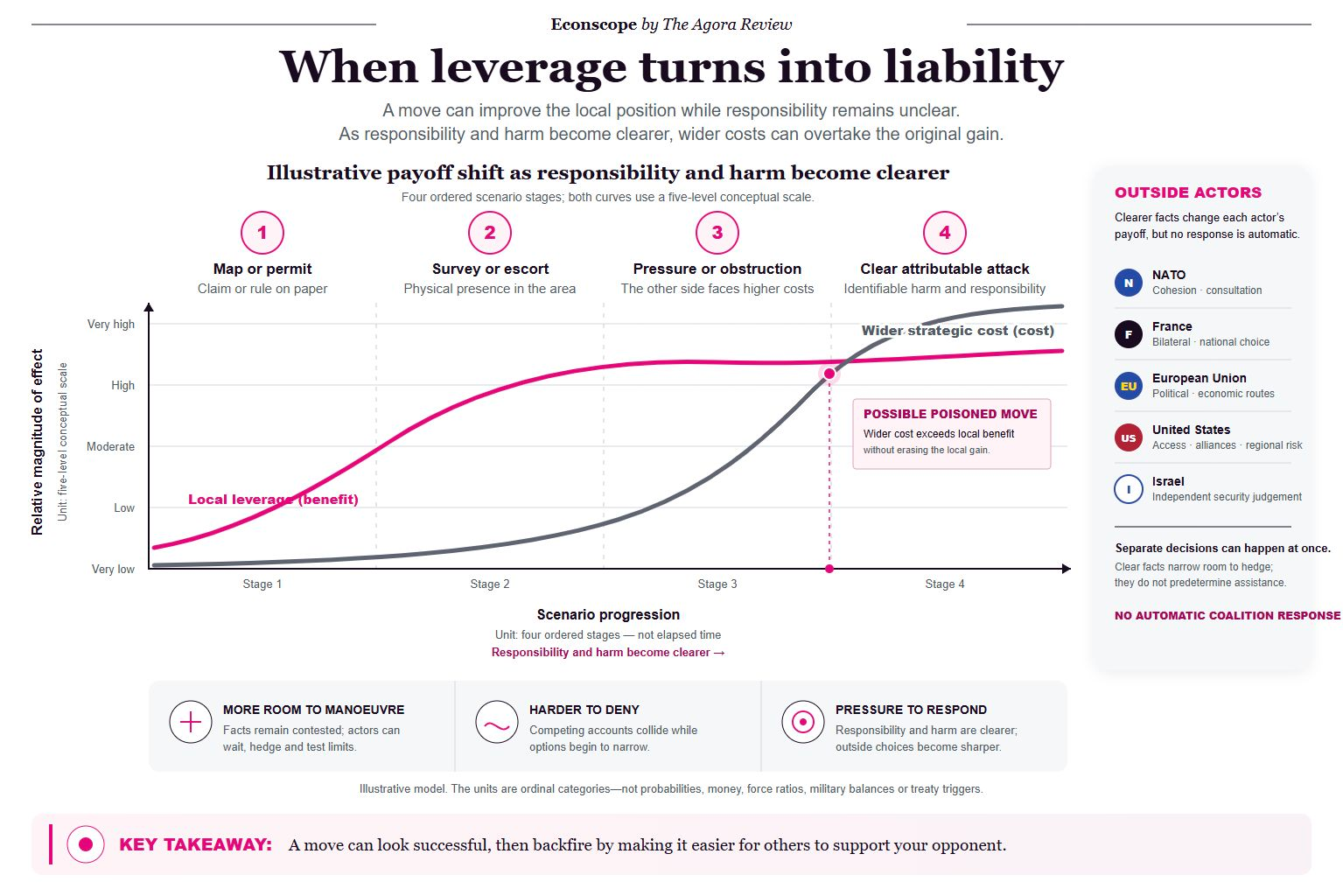
Swipe horizontally to inspect the chart at a readable size. A complete text description follows.
Method: Conceptual synthesis of the legal, institutional and strategic evidence developed in the article. The horizontal unit is four ordered scenario stages, not elapsed time. The vertical unit is a five-level ordinal scale from very low to very high, not measured utility. The curves illustrate direction and thresholds rather than probabilities, money, force ratios, military balances or treaty triggers.
Read a text description of the graphic
The graphic follows one illustrative path, while noting that different crises can move differently:
- A map or permit creates a claim or rule on paper.
- A survey or escort creates a physical presence in the area.
- Pressure or obstruction raises costs and limits the other side.
- A clear attack produces identifiable harm, location and responsibility.
The horizontal axis is Scenario progression. Its unit is four ordered stages, not elapsed time. The vertical axis is Relative magnitude of effect. Its unit is a five-level conceptual scale: very low, low, moderate, high and very high. These are ordinal categories, not measured data.
The local-leverage curve rises early and then begins to level off. The wider-strategic-cost curve starts low, rises sharply as the evidence becomes clearer and crosses the leverage curve near the clear-attributable-attack stage. The crossing is labelled the “possible poisoned move”: the action still helps locally, but the political and alliance consequences it triggers elsewhere now cost more than the original gain.
Below the chart, the decision environment moves from greater room to manoeuvre, through a stage in which the event is harder to deny, to stronger pressure on outside actors to respond. NATO, France, the European Union, the United States and Israel retain separate interests and choices throughout.
What this means
The Eastern Mediterranean may become less likely to produce an unmistakable opening attack while remaining highly competitive below that threshold. Greek defence investment, Turkish regional positioning, Israeli security calculations and denser alliance relationships can all raise the expected cost of open conflict. The same conditions encourage governments to search for forms of pressure that improve their position without creating the clearest possible case for outside alignment against them.
Incremental change therefore matters. A permit, survey, escort, deployment or repeated military encounter may look manageable in isolation. Repetition can gradually alter expectations and practical access until reversing the accumulated position becomes more expensive than resisting the next move.
Stability depends on more than whether armed conflict begins. The more revealing measure is whether successive decisions continue to leave governments with credible and affordable ways to resist, compromise or disengage. A region can avoid war for a long time while the range of inexpensive choices available to its governments steadily narrows.
Sources and method
Sources and method.
Each section distinguishes public record, a government’s stated position and the interpretation offered here. The strategic board is conditional: its reading changes with the factual record.
Law and maritime administration
- Greece–Türkiye Joint Declaration, 11 February 2026; NATO deconfliction mechanism.
- North Atlantic Treaty, Articles 4–6; TEU Article 42(7); France–Greece agreement.
- Treaty of Peace with Italy; UNCLOS; Türkiye–Libya memorandum record; Greece–Egypt agreement record; European Council conclusions on Libya.
- Greek legal position: Greek MFA: sole bilateral legal difference; Greek MFA on shelf/EEZ delimitation and island entitlement; Greek MFA response to Turkish claims; Greek MFA record on sovereignty claims.
- Maritime framing and practical administration: Türkiye Ministry of National Defence, Mavi Vatan-2026; Greek Environment Ministry park consultation; Fethiye–Kaş decree; North Aegean decree; Greek MFA response; Türkiye MFA No. 154; EU Maritime Spatial Planning Directive, Article 2(4).
Energy and infrastructure
Historical record
- The Met on Ptolemaic Egypt; Cambridge on Eastern Roman identity; The Met on the Eastern Mediterranean; Jewish Museum of Greece on Ioannina; The Met on the Greater Ottoman Empire; USHMM on Greece during the Holocaust; LSE on Greek Middle East policy; Journal of European Integration History on Papandreou and Arafat; UPI archive of Arafat’s 1981 visit; LSE research on the Greek-Israeli realignment.
- Cambridge, Jewish sources in the Hellenistic period; UNSC Resolution 353 on Cyprus; UNSC Resolution 395; Congressional Research Service on Imia / Kardak.
Alliances, institutions and current regional records
- Current and recent records, 2026: ERT on the Patriot transfer; OPEN on the cable statement; AP on Abu al-Duhur; AP on Syrian officials’ delegation account; AP on the 20 August denial; Türkiye MFA No. 160; Reuters on U.S.-mediated Jordan talks; Reuters on U.S. deconfliction work; White House record on Barrack; Pakistan MFA on the Makkah arrangement; Anadolu on the public Makkah defence briefing.
- Current evidence additions, 17–30 August 2026: 17 August air-activity report; 18 August air-activity report; 28 August UAV report; Greek MFA on the cable discussion; Greek MFA on the formal diplomatic note; EU briefing on marine-park maps; Türkiye MFA QA-13 on the renewable-energy spatial framework; Türkiye MFA QA-14 on the industry and supply-chain framework; Rhodes warning report; Rhodes clarification report; 30 August Netanyahu/Cyprus rhetoric report; 27 August Turkish statement on the proposed U.S. process.
- Achilles’ Shield, sources checked on 31 August 2026: Israeli Ministry of Defense: signed agreement, named systems and supplementary €26 million Drone Dome deal; Hellenic Ministry of National Defence: Tel Aviv signing, immediate programme implementation and its stated budget and industrial-participation framework.
Theory and methodology
Last checked: 31 August 2026. Israel’s Ministry of Defense said Greece and Israel signed an approximately €3 billion Achilles’ Shield agreement that day and identified David’s Sling, BARAK MX, SPYDER, MMR radars and a national command-and-control system. The official statement confirms a signed agreement, not a delivery schedule, operational capability, full contract terms or a mutual-defence obligation.